

What an Automatic Continuous Crate Washer is really solving
An Automatic Continuous Crate Washer is one of those pieces of equipment that only gets attention after a plant starts losing time to dirty returnable containers. In food production, agriculture, central kitchens, and distribution work, crates and bins come back with residue, label glue, dust, pulp, grease, or damp debris. Hand washing can handle a few dozen pieces. It becomes a bottleneck when the plant is moving containers all day.
That is the real search intent behind this topic: buyers want to know whether a continuous crate washing line will cut labor, stabilize cleanliness, and keep reusable packaging moving without turning the wash area into a traffic jam. The decision is not just about buying a machine. It is about whether the cleaning step can keep up with the rest of the operation.
For that reason, the machine’s long tunnel layout matters. A continuous system is designed for inline flow, not batch loading. Crates enter one end, move through enclosed wash zones, and exit ready for reuse or the next handling step. In a busy plant, that difference is often worth more than the purchase price comparison people start with.
How a continuous crate washer is typically arranged
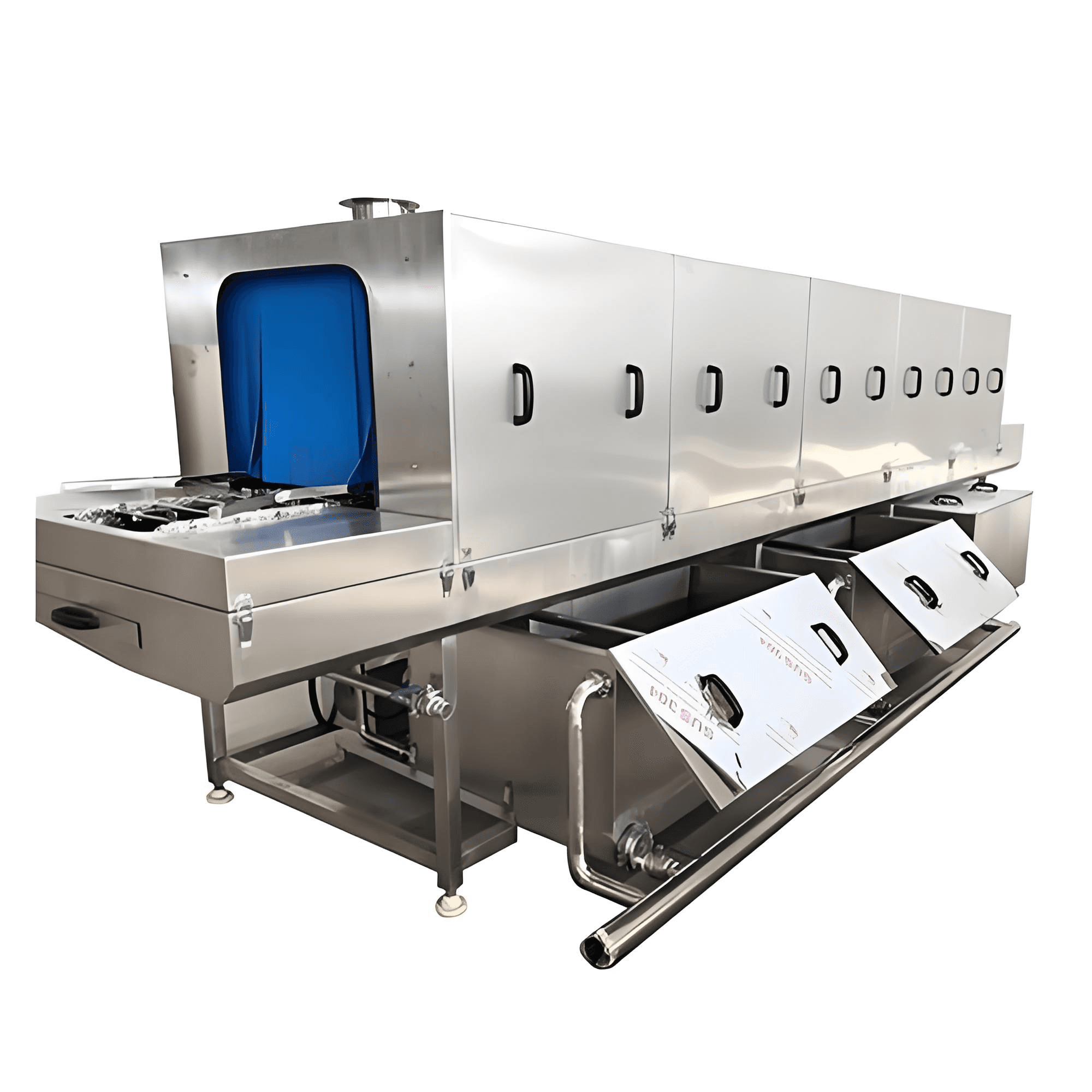
The supplied product information points to a stainless-steel tunnel machine with multiple enclosed sections, side access doors, and a conveyor or guide path through the center. That is a familiar format in industrial washing equipment because it supports steady throughput and makes maintenance easier than a fully closed box. The brushed metal finish is also practical: it holds up better in wet rooms and is easier to clean than painted surfaces that see constant spray.
Many systems of this type use separate stages for pre-wash, main wash, rinse, and sometimes air removal or drying. The exact internal process is not visible here, so it would be a mistake to claim a precise number of zones or a specific spray pattern. Still, the layout strongly suggests a multi-stage wash line rather than a single-pass rinse cabinet.
The three large lower modules shown beneath the main chamber likely serve as tanks, reservoirs, or utility cabinets. In day-to-day use, this kind of lower-section layout helps isolate water handling components and keeps the upper conveyor path unobstructed. On a practical level, it also gives maintenance staff a clearer route to pumps, filters, and plumbing without taking the whole line apart. That is the sort of detail plant engineers care about, even if it never makes the brochure.
Why continuous washing matters in plant operations
Reusable crates are only “reusable” if the cleaning step is fast enough and consistent enough to support production. When washing is done by hand, the result depends on shift discipline, staffing levels, and how stubborn the residue is that day. The machine does not eliminate all variables, but it reduces a lot of them.
A continuous crate washing machine is especially useful where containers circulate frequently between packing, storage, transport, and repack. Plants that work with fruits, vegetables, poultry products, prepared foods, or general distribution packaging often care less about elegant automation and more about one simple question: can the wash line clear the load without slowing the next shift?
There is also a hygiene-management angle. Even when the crate itself is not a direct food-contact surface in the final sense, dirty reusable containers can carry contaminants back into the clean side of the plant. A well-run wash line helps reduce that risk. It does not replace sanitation procedures, and it should not be treated as a magic fix, but it does make contamination control more repeatable.
Quick buyer takeaways before comparing systems
If you are short on time, these are the main points to keep in mind:
First, continuous flow is valuable only if your inbound and outbound crate handling is organized. If containers arrive in random bursts, the machine may be underused. If the line is starved or jammed, the theoretical capacity does not matter much.
Second, stainless-steel construction is more than a visual preference. In a wet, detergent-heavy environment, material choice affects cleaning, corrosion resistance, and maintenance cost over time.
Third, ask how the machine handles residue, not just whether it washes. Sticky labels, mud, grease, and protein residue can behave very differently. A machine that looks similar on paper may perform very differently in the plant.
Fourth, make sure your team understands water and drainage requirements before installation. Buyers often focus on crate throughput and forget about utilities until the machine is already on site.
Key selection criteria engineers and sourcing teams should check
Throughput and line balance
The right crate washer is not the biggest one available. It is the one that matches your actual crate flow. A continuous machine is a good fit when the plant already operates in a fairly steady stream. The moment the wash line becomes a waiting area, the benefit drops. Ask how the crate washer will interact with upstream sorting and downstream stacking or drying.
Wash quality versus mechanical speed
Plants sometimes chase speed and then discover that the crates leave the machine wet, streaked, or still carrying residue in corners. That usually means the wash cycle is too aggressive on throughput and too light on contact time or spray coverage. The point of a tunnel washer is not simply to move containers through quickly. It is to move them through cleanly enough for reuse.
Maintenance access
The side doors and modular lower sections visible in the supplied notes are worth attention. Good access can save hours during inspections, nozzle cleaning, and plumbing checks. In a washroom, serviceability is not a luxury. It is how the line stays available after six months of real use.
Water, detergent, and waste handling
Even without exact utility figures, buyers should assume that a continuous crate washer will need a clear plan for wash water management. Filtration, solids capture, and drain routing all affect operating cost. If the waste stream is heavy with organic residue or packaging debris, basic plumbing design matters almost as much as the washer itself.
Common mistakes buyers make
One of the most common mistakes is buying to peak capacity instead of average production. A machine rated for a high number of crates can still be a poor fit if your actual line is irregular. Another frequent issue is underestimating the difference between “looks clean” and “is clean enough for the next process.” Those are not the same thing, especially where food safety checks are involved.
Buyers also sometimes assume every stainless-steel washer is equally robust. That is not true. Weld quality, access panels, conveyor design, spray hardware, and cabinet sealing all affect how the machine behaves in daily service. You do not need to inspect every fastener, but you should look closely at the working zones and service points.
Finally, some teams overlook operator workflow. If loading and unloading are awkward, staff will find shortcuts, and shortcuts are where wash quality slips. A continuous line should simplify handling, not create a new choreography problem.
What the supplied product details suggest about this model
The notes describe a continuous inline washer with a tunnel-style body, stainless-steel housing, side access doors, vent stacks, and a transfer path for crates or boxes. That points to a machine built for high-volume, repetitive cleaning rather than occasional sanitation. It is the kind of equipment that belongs in a plant where returning containers never really stop coming.
The product description also indicates continuous operation in food processing, agricultural packaging, logistics, or similar environments. That is consistent with the visible structure. The machine appears designed for industrial duty, not light commercial use. In practical terms, that means plant managers should think in terms of flow integration, maintenance routines, and utility planning rather than just footprint.
Because the internal wash stages are not fully visible, it would be unwise to promise drying, sterilization, or heated washing unless the supplier confirms those functions. Many tunnel washers can be configured differently. The broad takeaway is safer: this is a continuous washing platform intended to automate container cleaning at scale.
Practical advice for requesting a quotation
When you approach a supplier, do not ask only for a price. Ask for the process description, the crate size range it can handle, the kind of contamination it is designed to remove, and how the machine fits into your line layout. If the washer is going into food production, ask how cleaning verification is normally handled in that environment. If your operation uses multiple crate styles, make sure that is addressed early. A machine that fits one container geometry perfectly can be awkward with another.
It also helps to share photos of your actual crates, not just dimensions on a drawing. Real-world deformation, labels, drain holes, and stacking behavior can change how a washer performs. That simple step often prevents avoidable mismatch later.
One practical aside: if your operation is already struggling with returnable-container buildup, plan for staging space before installation. The machine is only part of the system. Dirty incoming crates and clean outgoing crates need somewhere to live without crossing paths.
FAQ: short answers buyers usually need
Is a continuous crate washer better than manual washing?
For high-volume operations, usually yes. Manual washing may still be useful for exceptions or small batches, but it is rarely the best answer for steady throughput.
Does stainless steel matter?
Yes. In a wet cleaning environment, stainless-steel construction is generally preferred for durability and sanitation-oriented maintenance. The exact grade was not supplied, so that should be confirmed with the manufacturer.
Can one washer handle different crate types?
Sometimes, but not automatically. Compatibility depends on dimensions, crate stiffness, conveyor guidance, and whether the machine is adjustable for different formats.
What should I verify before purchase?
Check throughput, container dimensions, wash stages, utility needs, maintenance access, and the actual cleaning outcome for your residue type. Those points matter more than a polished sales sheet.
Where this equipment fits in a larger automation plan
A well-chosen Automatic Continuous Crate Washer is not an isolated purchase. It is part of the plant’s reusable-packaging loop, which means it affects labor, hygiene, storage, and even dispatch timing. When it works well, workers stop spending valuable minutes scrubbing bins and start keeping product flow organized. When it is underspecified, the wash room becomes the place where bottlenecks gather.
For teams comparing options, the right next step is to map container flow before requesting final specifications. Count the crates, define the contamination level, identify the busiest hours, and decide what “clean enough” means for your operation. Then compare machines against that reality rather than a generic catalog promise.
If you are reviewing a continuous crate washing line now, ask for a process drawing and confirm what the machine actually does in each section. That one request tends to surface the details that matter most before the order is placed.