

Specializing in Infrared Beak Trimming (IBT) and automated hatchery solutions. WhatsApp: +86 18998104353 MP: +86 18998104353 Email: owen.oyoung@julisense.com

Poultry Crate Washing System: What Buyers Should Look For

blog avatar
Published
May 22 2026
  • Product Guide

Follow us

poultry-crate-washing-system-what-buyers-should-look-for

Why a poultry crate washing system matters before the crates start circulating again


A poultry crate washing system is one of those pieces of equipment that rarely gets much attention until hygiene, labor, or throughput becomes a problem. In hatcheries and poultry operations, reusable plastic crates move through a lot of hands and a lot of stages: loading, transport, unloading, sorting, and sometimes disinfection or crate exchange. Once that flow becomes repetitive, manual cleaning quickly turns into a bottleneck. That is where an automatic crate washing machine or a broader automated crate-handling line starts to make commercial sense.

The practical question for buyers is not whether washing is necessary. It is how much automation the operation really needs, how the crates will move through the line, and whether the system can keep up without creating another choke point. For engineers and sourcing managers, that means looking past glossy machine photos and asking about conveyor layout, washdown compatibility, stacking logic, and maintenance access. In poultry work, small design choices tend to show up later as sanitation problems or labor headaches.

What a modern crate washing setup usually has to do


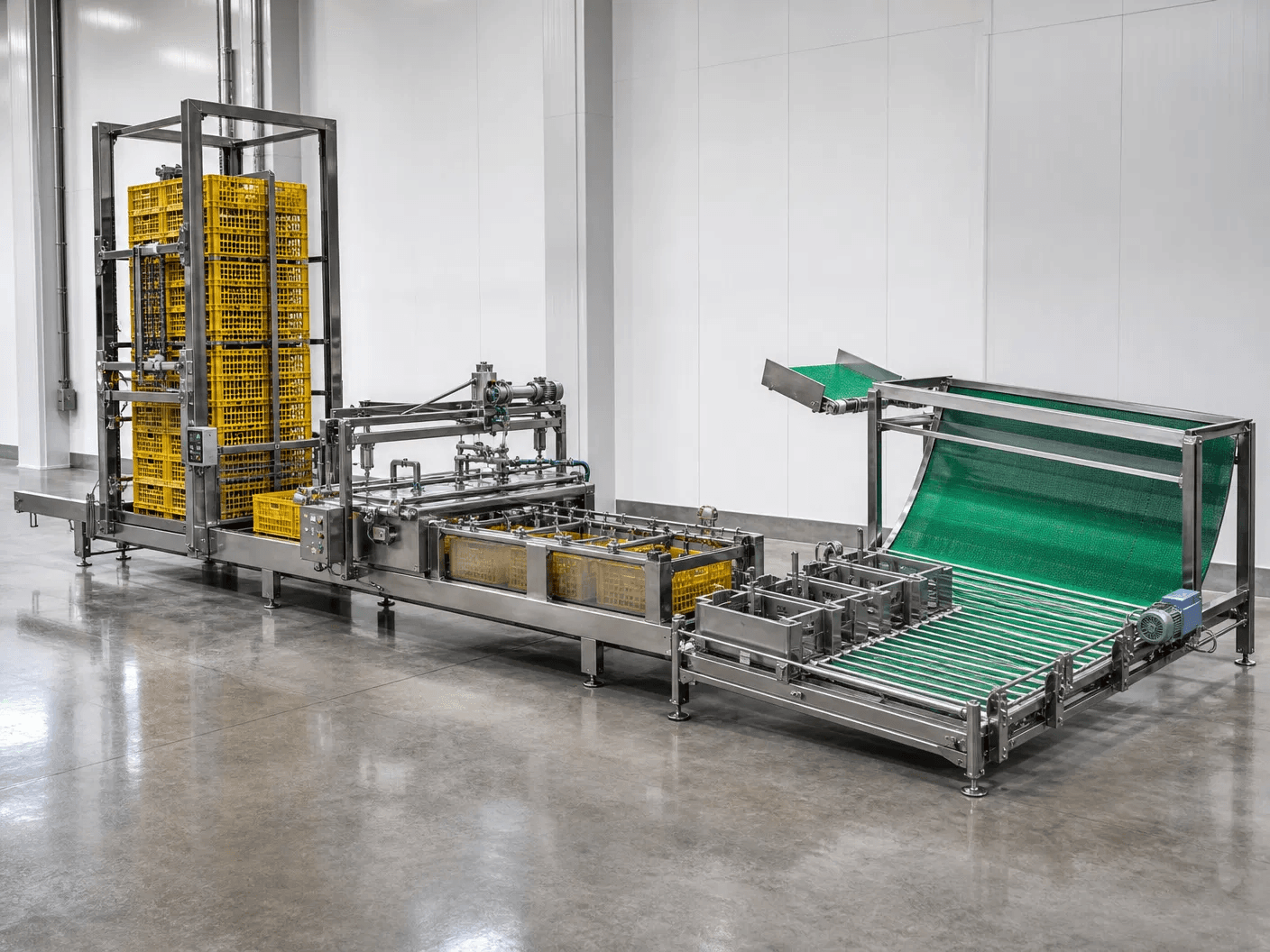
A crate washing setup in poultry environments is rarely just a washer. In many operations it is part of a wider handling sequence that may include conveying, stacking, unstacking, transfer, and sometimes sorting or pre-cleaning. The product information available here points to an industrial hatchery automation line with a stainless-steel frame, long linear conveyor sections, a vertical crate stacker or de-stacker tower, and a transfer section with rollers, rails, actuators, and a control box.

That layout tells you a few useful things. First, the system is designed around reusable yellow perforated plastic crates, which are common in poultry logistics because they are lightweight, washable, and easy to stack. Second, the use of stainless steel and guarded conveyor sections suggests the equipment is meant for hygienic industrial use and likely for washdown environments. Third, the modular rectangular footprint matters because poultry plants often need to retrofit equipment into existing lines without rebuilding the whole room.

If you are comparing equipment options, the real value is not only in wash performance. It is in how clean crates move from one step to the next with minimal manual handling. That is where an integrated line can outperform a standalone washer, especially when the operation wants fewer workers touching dirty or wet crates.

Standalone washer or integrated line?


This is the first decision many buyers need to make. A standalone automatic crate washing machine can be a good fit if the plant already has a reliable manual or semi-automatic feed and discharge arrangement. It can also be easier to budget and install. But if crate flow is inconsistent, or if workers are spending too much time lifting and aligning crates, then the washer alone may not solve the larger problem.

An integrated poultry crate washing system is more ambitious. It may connect crate exchange, conveying, washing or spraying, stacking, and maybe even buffering into a single controlled sequence. That kind of system reduces handling steps, which is usually good for both hygiene and labor use. It also helps standardize flow, which matters in hatcheries where timing and cleanliness are linked to production stability.

The trade-off is complexity. More automation means more drives, more sensors, and more places where a misaligned crate can stop the line. So the buyer is not simply choosing between “automatic” and “manual.” The actual question is whether the operation has enough throughput and enough floor discipline to support a system that runs continuously.

Key design features buyers should inspect closely


Frame material and hygienic access


The visible stainless-steel construction is a strong sign for poultry use. Stainless frames and guards are generally preferred in washdown settings because they hold up better in wet, chemically exposed environments than painted mild steel. Still, buyers should not stop at the frame. Look at how easy it is to reach under conveyors, around transfer mechanisms, and inside guard areas. Equipment that is technically cleanable but awkward to clean often becomes a maintenance nuisance.

Conveyor geometry and crate control


The long conveyor sections in the pictured layout suggest continuous movement through the line. That is useful, but only if crate orientation stays consistent. Poultry crates are perforated and lightweight, which makes them manageable, but they can still shift, jam, or ride unevenly if guides are not well designed. The safer systems are the ones that control crate position with enough restraint to prevent lateral drift, while still allowing easy transfer.

Stacking and buffering


The vertical tower on the left appears to hold multiple stacked crates, though the exact function is not fully confirmed. It could be a lift, a stacker, a de-stacker, or a buffer magazine. Whatever the precise role, vertical storage is often a smart way to save floor space. The caution is that stack handling can become sensitive if crate sizes vary, if crates are deformed, or if the stack isn’t stable. Buyers should ask how the system copes with mixed crate conditions, because poultry crates do not always age gracefully.

Controls and monitoring


The provided notes mention digital monitoring tools in related hatchery systems, including alarms and production data. Even when the exact control package is not visible, that is a useful benchmark. A crate handling or washing line should not be a black box. Operators need to know where a stoppage occurred, whether a crate is misfed, and when service is due. For sourcing teams, the value of a simple alarm history is easy to underestimate until the first week of production.

How to choose the right poultry crate washing system for your plant


Selection usually comes down to four practical questions.

First, how many crates per hour must move through the line? The number itself matters less than the pattern of flow. A plant with steady production can often run a smaller system efficiently, while a plant with batches and peaks may need buffering and stack handling to smooth out the workload.

Second, how dirty are the crates when they arrive? Some crates need only rinsing and detergent washing; others carry heavier organic residue and require stronger cleaning and more careful pre-treatment. Poultry operations should be realistic here. If the incoming condition changes with season, flock age, or transport distance, the machine should be selected with some margin.

Third, what is the labor model? A system that cuts one operator is useful; a system that cuts three operators and avoids ergonomic strain is far more compelling. The notes mention single-operator functionality in related systems, which is the right sort of direction, even if it should always be confirmed against the actual application.

Fourth, what maintenance skill set exists on site? Conveyor drives, sensors, spray sections, rollers, and lift mechanisms all need attention eventually. A plant with weak mechanical maintenance support should favor simpler routing and easier access over cleverness.

Common mistakes when buying crate handling and washing equipment


The biggest mistake is buying a washer based only on the drum, tunnel, or spray section and ignoring feed and discharge handling. In poultry work, the washer is just one part of the problem. If the crates arrive in a poor stack or leave in a disordered pile, the whole line loses its advantage.

Another mistake is underestimating washdown conditions. Poultry facilities are wet, and wet equipment exposes weak seals, poor guarding, and uncomfortable maintenance access very quickly. Buyers should ask where splash zones are expected and whether the controls are placed with hygiene and operator safety in mind.

A third mistake is specifying too tightly around today’s crate format and forgetting tomorrow’s needs. If crate dimensions, stack height, or throughput change later, a rigid system can age badly. Modular layouts are worth more than they first appear.

Practical buyer advice before issuing an RFQ


When you write the request for quotation, do not stop at the headline: automatic crate washing machine. Ask for the actual handling sequence. Does the system wash, spray, transfer, stack, de-stack, or buffer? What crate sizes are supported? How is crate alignment controlled? What parts are stainless steel, and where are the wear items?

Also ask for a layout drawing, even a preliminary one. For this kind of equipment, floor space and access routes matter almost as much as throughput. A compact system that fits awkwardly into a cleaning room can become a daily frustration. The same is true for service access; if a technician needs to dismantle half the guard set just to reach a drive, that is a warning sign.

Finally, insist on clarity about upstream and downstream integration. If the crate washing system sits between a hatchery process and a logistics process, the interface is everything. A good machine can still perform badly if the transfer points are poorly designed.

FAQ for sourcing and operations teams


Is a poultry crate washing system always fully automatic?


No. Some systems are automatic only in the washing stage, while others automate loading, transfer, stacking, and discharge as well. The right level depends on plant volume and labor availability.

Is stainless steel necessary?


In poultry washdown environments, stainless steel is strongly preferred for the frame and exposed structures. It is not the only factor, but it is a major one for durability and hygiene.

Can one machine handle washing and stack handling?


It can, but only if the line is designed as an integrated system. That is often better than treating the washer as a standalone island. Still, more integration means more commissioning effort.

What should I verify before purchase?


Verify crate dimensions, line flow, access for cleaning, transfer stability, control visibility, and maintenance requirements. If any of those are vague, ask again before committing.

What this means for a poultry operation planning its next upgrade


For hatcheries and poultry plants, the case for a poultry crate washing system is usually built on the same three pressures: hygiene expectations, labor availability, and throughput consistency. The pictured automation line, with its stainless frame, conveyor sections, and stack-handling architecture, reflects the direction many operations are moving in. Less manual lifting. More controlled movement. Better standardization.

That said, the best purchase is not necessarily the most complex one. It is the system that matches the crate flow on your floor and can be kept clean, serviced, and understood by the people who run it every day. If you are comparing suppliers, start with process fit, not features.

If you are planning a new line or upgrading an existing hatchery area, the next step is to map crate flow from arrival to discharge and identify where manual handling still creates delay. Once that is clear, it becomes much easier to decide whether a standalone automatic crate washing machine is enough, or whether a broader integrated handling system is the smarter investment.
blog avatar

Jili Intelligent

Professional Hatchery Automation Solution Expert

Specializes in automatic egg turning, intelligent incubation systems, poultry processing equipment, full-set hatchery automation solutions and customized farming machinery.

Tag:

    Share On

    Comment

    0 comments

      Got thoughts or experiences to share? We'd love to hear from you!

      Featured Blogs

      empty image
      No data