

What a chick conveying and stacking system is meant to solve
A chick conveying and stacking system is not just a piece of hatchery equipment; it is a response to a very practical bottleneck. Once day-old chicks leave the hatching area, they still need to be counted, transferred, processed, vaccinated in many operations, and moved into crates or downstream logistics without bruising, crowding, or losing track of throughput. That is where a poultry hatchery conveying line earns its keep. It replaces a series of handoffs that can be slow, inconsistent, and hard on labor.
For engineers and sourcing teams, the real question is not whether automation looks impressive on the floor. It is whether the line can keep chicks moving at a steady pace, support the required workflow, and fit the hatchery’s labor model. The supplied product information points to a modular automated poultry hatchery processing line with station-based operations such as vaccination, infrared beak trimming, automatic counting, needle sterilization, dust removal, alarm functions, and crate handling. The stated capacity of 3,800–4,200 chicks per hour suggests a system designed for serious commercial use rather than a pilot setup.
Why hatcheries are moving from manual handling to inline automation
Manual chick handling has a cost beyond labor hours. Every transfer step is another chance for uneven pacing, operator fatigue, and variation from shift to shift. In a hatchery, that variation matters because newly hatched birds are time-sensitive, and process consistency affects both welfare and downstream performance. A line built around conveyor transport and stacked crate flow helps standardize the sequence.
That matters especially when the same facility needs to handle different bird categories. The product notes indicate suitability for broilers, layers, and waterfowl. Those are not identical handling environments, so buyers should pay attention to modularity, station spacing, and how the line manages crate infeed and outfeed. A system that looks efficient on a brochure may not suit a hatchery if the crate format, operator workflow, or sanitation routine does not match real plant practice.
Key functions buyers usually expect from this kind of line
Conveying and transfer control
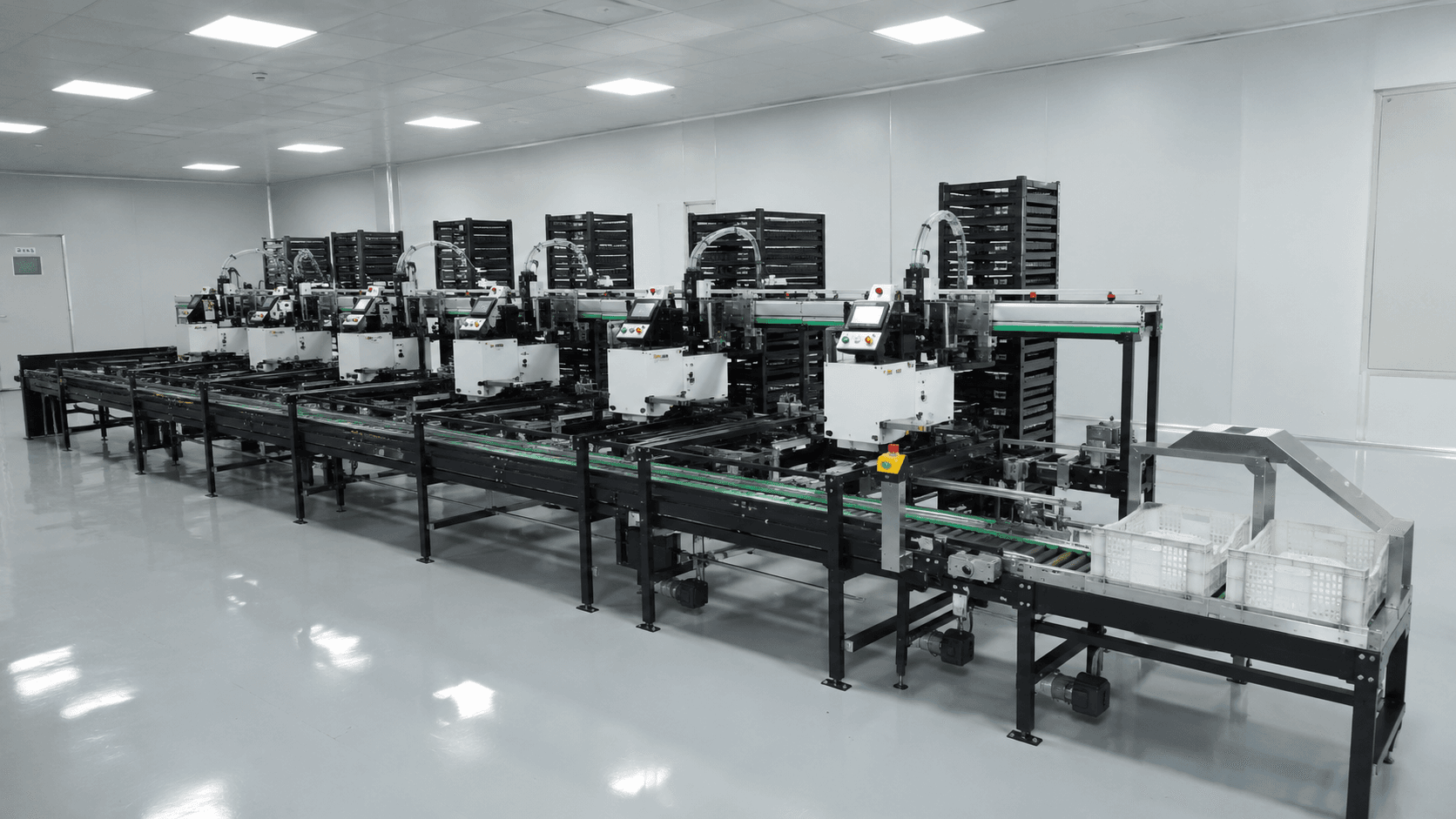
The heart of the system is the transport path. The visible product description suggests a long linear modular layout with green belt or conveyor sections, repeated support legs, and overhead routing for utilities. In practical terms, that means chicks are moved station by station in a controlled flow rather than being carried by hand from one task to another. For buyers, the important point is not the color of the belt but how smoothly the line keeps pace when upstream and downstream operators are not perfectly synchronized.
Station-based processing
The notes mention multiple identical processing heads or modules with touchscreens or control panels and emergency-stop style buttons. That kind of interface usually indicates that each module can be monitored and adjusted independently. In hatchery equipment, independence is useful because one station may be doing vaccination, another may be handling dust removal, and another may be managing a trimming or sorting step. Even when the exact function of each visible head is not fully clear from the photo, the modular pattern is useful to buyers: it makes troubleshooting and line expansion more manageable.
Counting, sterilization, and housekeeping functions
Automatic counting is one of the most practical features in any hatchery line. It gives operations teams a record of output without relying on manual tallies under pressure. Needle sterilization and dust removal, also mentioned in the notes, are the sort of “small” functions that can become big issues if ignored. They do not always get the same attention as the main processing step, but they help keep the line sanitary and reduce interruptions. In a live hatchery environment, that is not cosmetic detail; it is production discipline.
How this system compares with hand stacking and manual transfer
There is a reason many hatcheries keep some manual handling as a fallback. Humans can adapt quickly when a crate is damaged, a bird load is uneven, or a shift change causes temporary disruption. But manual stacking and transfer are hard to scale cleanly once throughput rises. Workers tire, spacing becomes inconsistent, and the risk of rough handling increases.
A chick conveying and stacking system shifts the focus from individual carrying to controlled flow. That does not eliminate the need for trained staff. It changes the job. Operators become line monitors, quality checkpoints, and exception handlers instead of the people physically moving every chick. For many hatcheries, that is the real appeal: less repetitive handling, more standardized output, and a clearer process footprint.
Selection criteria that matter more than brochure claims
When evaluating this kind of equipment, buyers should look past the headline capacity and ask how the line behaves in a real hatchery. Capacity stated at 3,800–4,200 chicks per hour is useful, but only if the facility’s crate handling, staffing pattern, and sanitation cycle can support it. Throughput on paper and throughput during an actual operating day are rarely the same thing.
A few practical checks are worth making early:
First, confirm how the line handles different chick sizes and bird types. Broilers, layers, and waterfowl can present different handling challenges. Second, review the operator interface. If each module has its own touchscreen, ask how alarms are displayed and whether one person can realistically supervise the whole line. Third, look at cleaning access. Hatchery automation that is difficult to clean becomes a maintenance problem quickly. Fourth, check how crates are fed into and out of the system. The right infeed design can save more time than a faster conveyor ever will.
One caution that experienced buyers will recognize: a highly automated line can still become labor-heavy if it needs constant clearing, adjustment, or manual intervention at every station. Automation should simplify the workflow, not just move the problem down the line.
Common mistakes when sourcing hatchery conveying equipment
A frequent mistake is buying for peak output only. Another is assuming that every station in a modular line will be equally useful for every hatchery. The supplied notes point to a customized integrated line assembled from modular stations, which is promising, but customization cuts both ways. It can fit the plant well, or it can create a maintenance puzzle if spare parts, training, and software logic are not well organized.
Another overlooked issue is plant integration. A poultry hatchery conveying line has to work with the surrounding room layout, crate storage, biosecurity routine, and staff movement. If the floor plan forces awkward turns or crowding around the line, throughput will suffer regardless of machine quality. In other words, the equipment is only one part of the system.
What the visible build suggests about the equipment family
From the supplied product notes, the visible machine family appears to be industrial hatchery automation built with a steel or coated-metal frame, green conveyor sections, white enclosures, transparent tubing or cabling, and integrated control panels. The enclosed, clean-room style environment is also telling. These systems are typically designed for controlled handling rather than rough warehouse duty. That matters because hatchery equipment has to balance accessibility with hygiene and protection of moving parts.
The stacked black poultry crates in the background also suggest that the line is intended to work with real infeed/outfeed logistics, not just as a bench-top demonstration. For a sourcing team, that kind of visual clue can be useful. It indicates the equipment is likely built to fit into a larger processing sequence rather than functioning as a standalone machine.
Practical buyer advice before requesting a quotation
Before asking for a final proposal, it helps to define the line in operational terms. How many chicks per hour does the hatchery need on an average day, not just on the best day? Which operations must be inline, and which can remain manual? Does the plant need vaccination support, infrared beak trimming, counting, sterilization, or a broader conveying and stacking function? Buyers who can answer those questions early usually get better proposals and fewer surprises later.
It is also worth asking for clarification on the scope of supply. The supplied notes suggest a broader automated poultry hatchery processing line, but the photo may show only part of a larger line. That is not a problem by itself. It is simply a reminder that buyers should not assume the visible stations tell the whole story. Ask what is included in the delivery, what is optional, and what depends on local installation.
FAQ: short answers buyers usually want
Is this only for one type of poultry?
No. The notes say it is suitable for broilers, layers, and waterfowl, although actual setup should still be matched to the bird type and crate format used in the plant.
Can one operator run the line?
The supplied information indicates single-operator functionality. That is attractive, but buyers should still confirm how much oversight is needed during cleaning, startup, and alarm handling.
Does the system only convey chicks?
Not necessarily. Based on the notes, it appears to combine conveying with stacking and other processing steps such as vaccination-related functions, counting, sterilization, and dust removal.
What should I watch most closely during evaluation?
Look at sanitation access, crate compatibility, alarm clarity, and how the system handles real throughput rather than idealized conditions. Those details usually decide whether the line becomes a production asset or a source of daily interruptions.
What to ask the supplier next
If you are comparing options for a chick conveying and stacking system, the next conversation should be about process fit, not just machine appearance. Ask for a layout proposal, a breakdown of each module’s role, the actual scope of automation, and the service model for installation and training. If the line is being considered for a hatchery expansion or a retrofit, request details on how it integrates with crate handling and existing room constraints.
That is usually where a serious supplier separates itself from a generic equipment seller. The right answer is not simply that the line is automated. It is that the line can keep chicks moving cleanly, support the required hatchery workflow, and do so without turning every shift into a troubleshooting exercise.