

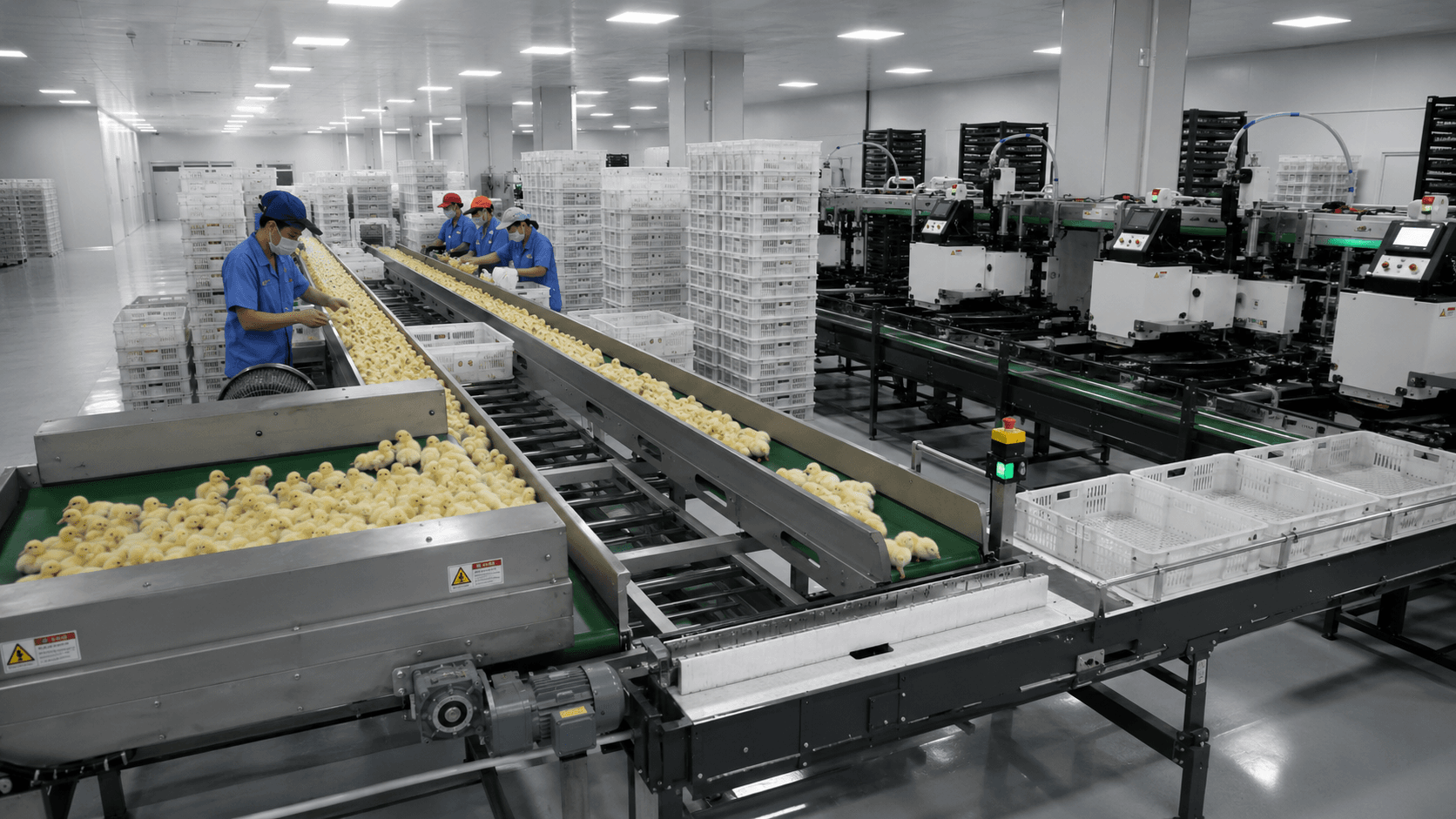
An integrated line supplier can show an impressive machine and still leave a buyer with an unfinished project. The difficult work lives between stations: tray dimensions, transfer heights, controls, cleaning access, data records and the moment a truck must leave. Choosing an integrated chick processing line supplier means checking those interfaces before the quotation becomes a promise.
The strongest supplier evidence is specific. It names the responsibility, the test and the document that closes the point. A long brochure is less useful than one marked-up layout, one interface schedule and one witnessed acceptance test.
Ask what “integrated” includes
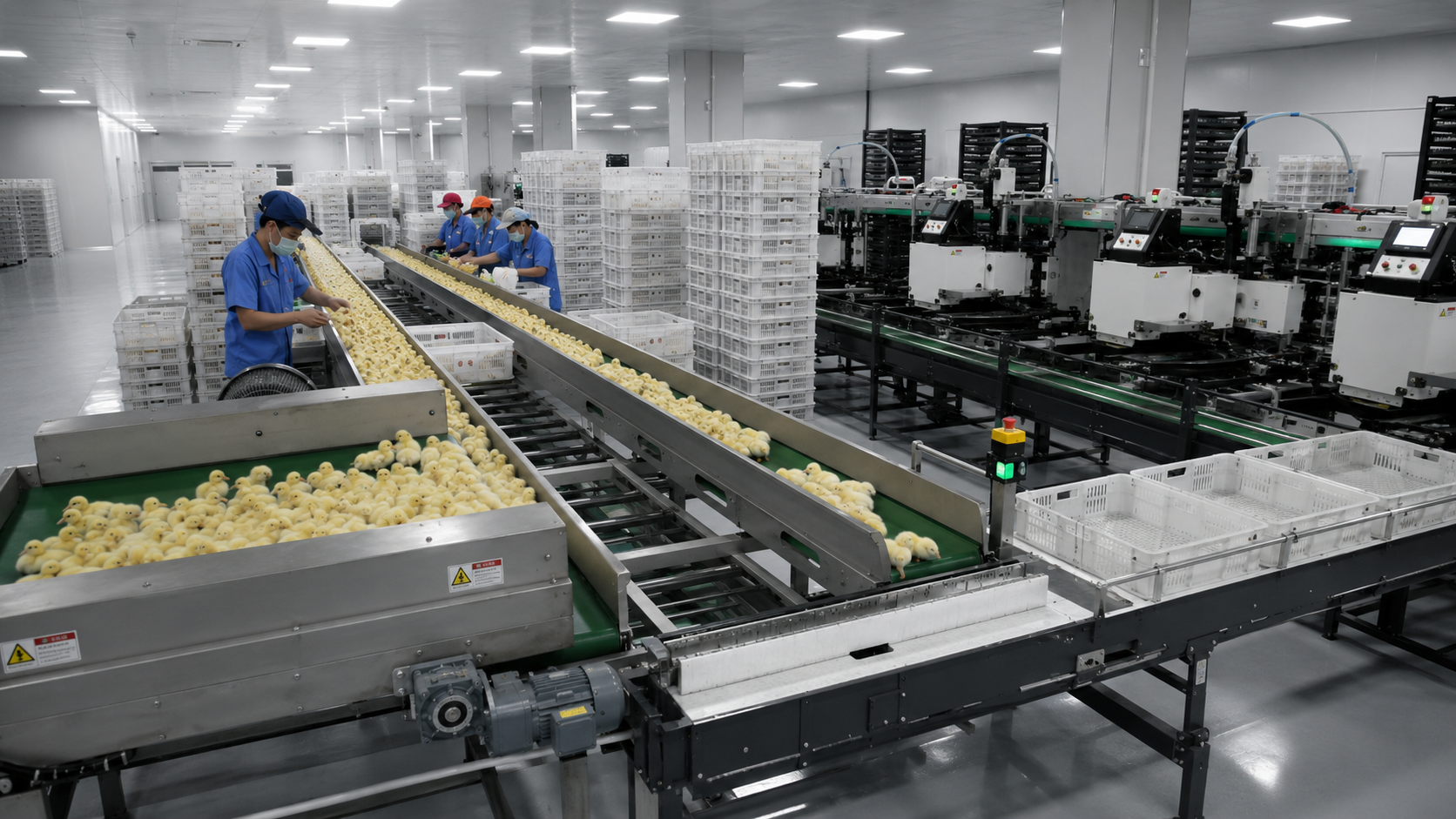
Start by asking the supplier to draw the boundary of its scope. Does it include tray handling, vaccination, beak trimming, take-off, conveying, crate washing, controls, utilities and operator training? If a component is “by others,” name the other party and the handoff data required.
Request a responsibility matrix
A responsibility matrix should cover design, fabrication, factory testing, shipping, installation, wiring, software, validation, training and after-sales support. It should also say who supplies foundations, compressed air, drainage, network access and safety guarding. Ambiguity at this stage becomes a change order later.
Trace one tray through the line
Take a single tray from arrival to dispatch and mark every transfer. Ask who owns the gap between one machine and the next. This simple exercise reveals whether the supplier understands the room as a process or only as a set of product pages.
Score evidence, not promises
Buyers do not need a complicated procurement model. A short scorecard is enough to compare evidence across suppliers and expose unanswered questions before price dominates the conversation.
| Evidence area | What to request | Strong signal | Risk signal |
|---|---|---|---|
| Similar project | Reference site, scope and operating context | A reference with comparable volume and interfaces | Only generic photos |
| Line integration | Layout, elevations and interface list | Dimensions and ownership are explicit | “Compatible” without measurements |
| Factory test | FAT protocol and sample records | Test steps, acceptance limits and sign-off names | Demonstration without a record |
| Commissioning | Site plan, training and restart method | Named people, dates and handover documents | Installation left as an assumption |
| Service | Response route, spares and revision control | Practical support path with escalation | Support described only as “available” |
The scorecard is not a substitute for engineering review. It is a way to make the review comparable and keep commercial enthusiasm from hiding technical gaps.
Give each shortlisted integrated chick processing line supplier the same evidence request and the same reply deadline. Comparable inputs make the final meeting much more productive.
Check the reference context
A reference is useful only when the context is known. Ask about hatch volume, shift pattern, room constraints, tray formats and the work included by the local team. A line that performed well in a new building may not answer a retrofit question.
Inspect the document trail
Ask to see a sample layout, wiring philosophy, maintenance schedule and acceptance report with sensitive information removed. The quality of the documents often predicts the quality of the handover.
Test the interfaces before the machines arrive
Most commissioning surprises are not caused by the core mechanism. They are caused by a height, speed, signal or cleaning assumption at the boundary. Put those assumptions into the design review and give each one an owner.
Ask the integrated chick processing line supplier to sign the interface schedule at design approval. That creates a shared reference when site conditions or connected equipment change.
| Interface | Detail to freeze | Site evidence to collect |
|---|---|---|
| Tray and crate | Length, width, stack height and tolerance | Sample trays and crate drawings |
| Product handoff | Speed, spacing and accumulation rule | Timed walk and downstream capacity |
| Utilities | Power, air, water, drainage and heat load | Site services survey |
| Controls | Signals, stop logic, alarms and network | I/O list and control narrative |
| Hygiene | Cleaning access, drainage and zoning | Sanitation route and sign-off |
JuliSense presents integrated hatchery options on the complete hatchery automation solutions page. Use that system view alongside the individual product range so the quote reflects the real line boundary.
Make factory acceptance meaningful
A factory acceptance test should prove more than power-on. It should use representative trays, demonstrate the agreed sequence, record stop and restart behaviour, verify safety devices and leave a list of open points. A video can support the record, but it should not replace the written acceptance limits.
Use a witnessed scenario
Choose one normal run, one restart after a planned stop and one controlled fault. Record cycle time, handling quality, alarms and the operator action required. The same scenarios can be repeated during site acceptance, creating a fair comparison between factory and field results.
Freeze the change list
Every change after FAT should have an owner, due date and acceptance impact. A small change to a guide or sensor can affect a whole handoff, so record it rather than relying on email memory.
Check installation and service ownership
Installation is where a supplier’s coordination skill becomes visible. Ask who supervises mechanical assembly, who validates wiring, who trains operators and who signs the final punch list. The JuliSense service page gives buyers a useful structure for questions about commissioning, maintenance and support, while the FAQ section helps close routine commercial and operating questions.
Also ask what happens after the first year. Request the spare-parts logic, software or controller revision process, remote support route and escalation time. A line is a long operating relationship, not a one-time shipment.
That after-sales record should remain part of the integrated chick processing line supplier score, rather than becoming a separate discussion after the technical decision is made.
Questions buyers ask about an integrated chick processing line supplier
Should one supplier provide every station?
Not always. A single accountable integrator can reduce interface risk, while a multi-vendor design may suit an existing line with strong internal controls. Compare responsibility clarity, not only the number of companies on the purchase order.
How many reference sites are enough?
One closely comparable reference can be more useful than five unrelated sites. Ask for a reference that matches the room type, product flow, scale and level of integration you are planning.
What should be in the final quote?
Require the scope boundary, layout assumptions, utilities, commissioning days, training, warranty, spares, exclusions, delivery milestones and acceptance criteria. Send open questions through contact us so the commercial response is tied to the actual line.
Choose the supplier you can audit
The best integrated chick processing line supplier is not simply the one with the biggest equipment list. It is the one that can show how a tray moves, who owns each interface, how a fault is recovered and what document proves the line is ready. Keep those questions in the RFQ, then compare evidence and price on the same page.
That discipline gives the project team a better start and gives the hatchery something more valuable than a polished brochure: a line that can be commissioned, operated and expanded with fewer surprises.
Background on the company, manufacturing focus and project approach is available on the about JuliSense page.