

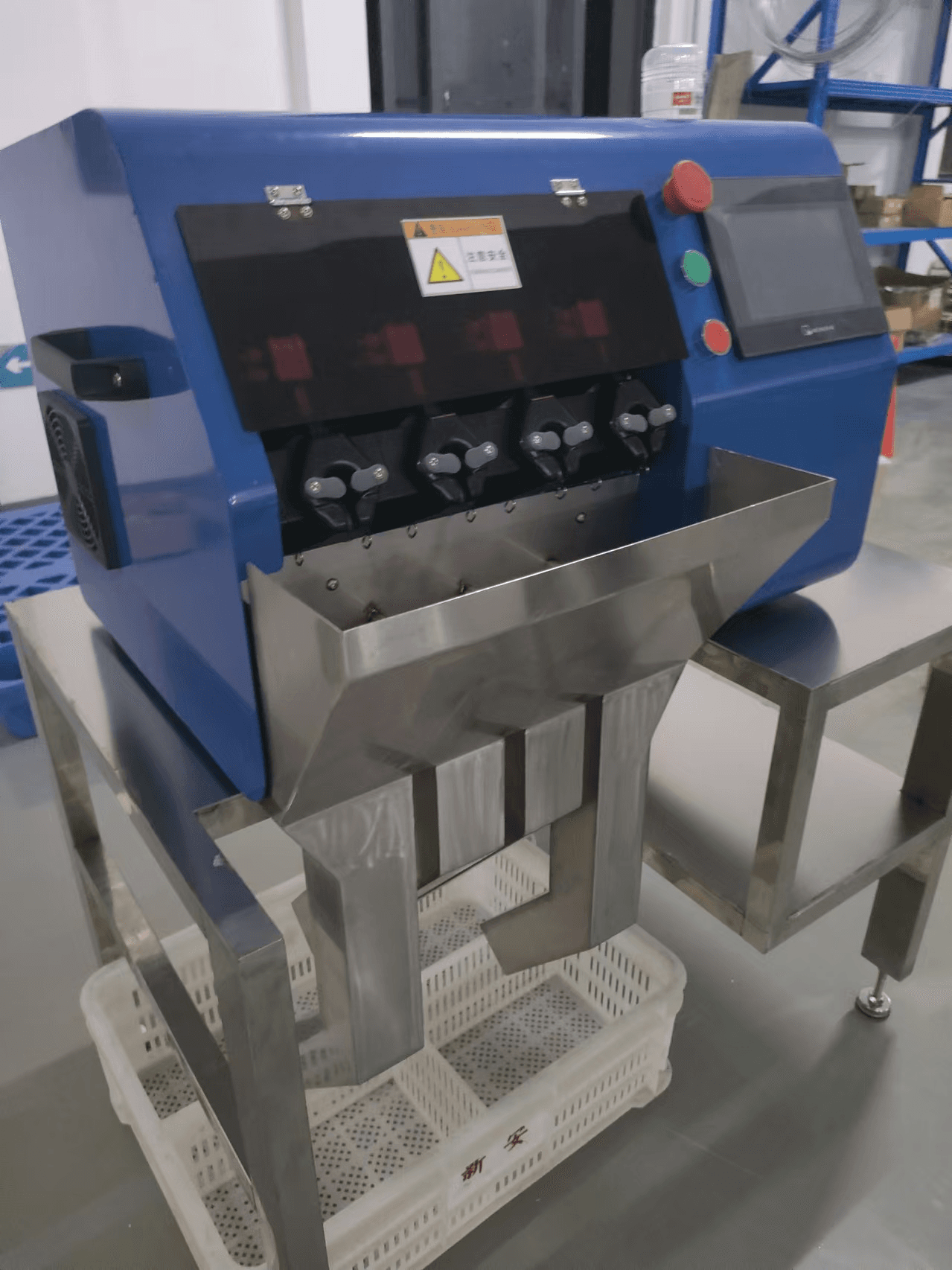
An automatic chick debeaking equipment purchase should leave the buyer with a usable record, not only a successful demonstration. Build an acceptance ledger with seven entries: ordered scope, representative conditions, operator work, welfare ownership, controlled stop, cleaning access, and open-item closure.
Write the questions before the supplier starts the machine. This keeps the test centered on the customer's future work instead of the most convenient sample.

Entry One: Record the Machine That Will Ship
List the configuration, guarding, controls, accessories, interfaces, customer-supplied items, documents, and temporary factory-test arrangements. Compare the record with the quotation, approved drawings, and purchase scope.
Jili Intelligent presents day-old chick infrared beak trimming equipment through JuliSense. Exact capability, configuration, welfare criteria, and capacity basis must be confirmed for the project.
Mark substitutions openly
Highlight any temporary cable, test fixture, operator aid, supply, or surrounding equipment that will not travel to the customer site. A test result is useful only when those differences are understood.
Give each boundary an owner
Name who owns utilities, upstream presentation, downstream transfer, building work, local safety interfaces, training, and acceptance records.
Entry Two: Define Representative Conditions
Agree the input context, batch pattern, operators, settings where authorized, duration, normal variation, supplies, observation points, stop conditions, and record format before the run.
During an automatic chick debeaking equipment test, do not replace a representative condition with the easiest sample after an uncomfortable result. Explain the difference and decide whether another run is required.
Include the surrounding process
Record what arrives before the machine and what must accept work after it. A machine can perform well while the full handoff remains impractical.
Keep customer decisions separate
The customer's qualified welfare or veterinary owners approve applicable criteria and observations. The World Organisation for Animal Health Terrestrial Code provides an internationally recognized reference; destination requirements and customer procedures govern the actual process.
Entry Three: Follow the Operator's Hands
Ask an authorized customer operator to perform preparation, presentation, routine checks, replenishment, documentation, normal variation, and permitted exception handling. Record walking, touches, waiting, communication, and requests for help.
Count hidden correction
Experienced people often make small adjustments without announcing them. These touches may be expected work, a training gap, or evidence that the input method needs improvement.
Ask for a teach-back
After instruction, the operator explains machine state, allowed actions, stop authority, and escalation in plain language. Silence is not proof of understanding.
Entry Four: Run One Controlled Stop
Choose a safe interruption allowed by the test plan and risk assessment. Freeze current work, machine state, signals, people, and buffers before recovery starts.
For machinery risk assessment and risk reduction, ISO 12100 provides a general framework. Apply relevant legal, technical, and customer requirements to the complete installation.
Separate reset from restart
The person who can operate a control may not own the decision to resume the customer process. Put both responsibilities in the ledger.
Repeat the explanation from two roles
Ask the operator and supervisor to describe the event independently. Differences reveal a status, communication, training, or authority gap.
Entry Five: Walk Cleaning and Maintenance Access
After the run, sanitation and maintenance review visibility, reach, removable parts, service positions, tools, collection areas, guarding, reassembly, inspection, and release.
The automatic chick debeaking equipment layout should work when covers are open and work is protected, not just when production is flowing.
Follow the cart route
Trace approved cleaning resources, waste removal, inspection, and return to service. Do not assume that a nearby drain or open aisle solves every access question.
Name the release owner
Record who confirms cleanliness, parts, guarding, machine state, and readiness before the next approved start.
Entry Six: Attach Evidence to Every Decision
Use photographs, configuration records, run sheets, operator observations, controlled-stop notes, training evidence, revised drawings, and open-item records. Give every file a date, test reference, and owner.
Separate fact from conclusion
Write what was observed first. Put interpretation, cause, disposition, and approval in separate fields so the evidence remains useful later.
Keep an exception register
An open item needs impact, owner, due date, required proof, temporary control where applicable, and authorized closer. Do not close it with a vague email sentence.
Entry Seven: Decide Whether the Ledger Is Complete
The ledger is ready for commercial discussion when the customer can answer what was tested, under which conditions, who operated it, who approved welfare observations, how a stop was recovered, how access works, and what remains open.
| Ledger entry | Buyer question |
|---|---|
| Scope | Was the ordered configuration represented? |
| Conditions | Was the run relevant to the future site? |
| Operator | What work was actually required? |
| Welfare | Who owned criteria and stop decisions? |
| Recovery | Was state and restart authority understood? |
| Access | Can authorized teams clean and maintain it? |
| Closure | What evidence closes each open item? |
Keep conditional acceptance visible
If the customer accepts with conditions, record the condition, risk, deadline, owner, temporary control, and required final proof.
Turn the Ledger Into a Site Plan
JuliSense describes commissioning, training, and after-sales support on its service page. Use the accepted ledger to plan site utilities, interfaces, staffing, training, documents, spare information, and follow-up evidence.
What should a buyer send JuliSense?
Share the application context, expected flow, floor plan, approved procedures, operating roles, surrounding equipment, utilities, and acceptance questions through the JuliSense contact page.
Does acceptance prove universal performance?
No. It proves only the agreed scope and conditions. A buyer should keep the limits visible when applying the result to another site or batch.
Add a Buyer Question Before Every Test Block
Before scope review, ask whether the tested configuration matches the order. Before the run, ask whether the input and staffing represent the site. Before operator observation, ask whether hidden work is being counted. Before the stop, ask who owns the restart. Before cleaning, ask whether the access envelope is open. Before closure, ask what proof is still missing.
This question-first habit keeps automatic chick debeaking equipment evaluation practical for people who did not design the machine.
Keep a customer witness list
Invite production, qualified welfare or veterinary ownership, quality, maintenance, sanitation, engineering, and procurement. Each role should bring one concern and leave with one evidence reference.
Review the ledger after one night
Ask a person who was not present at the demonstration to read the entries and explain the next site action. Confusion shows where the handover record needs clearer language or attachments.
Connect Evidence to Commercial Decisions
The ledger can support shipment, site planning, training, and service conversations, but it should not be presented as a universal certification. State which conditions were observed, which were customer-controlled, and which questions remain outside the test.
What belongs in the quotation?
Include configuration, interfaces, test conditions, customer inputs, training, documents, spares, support, open-item treatment, and any exclusions. This prevents a later discussion from relying on the demonstration alone.
What belongs in the site acceptance plan?
Carry forward the representative run, controlled stop, cleaning access, operator teach-back, records, release authority, and closure evidence required at the customer's facility.
A Ledger Makes the Test Useful After Shipping
Automatic chick debeaking equipment is easier to buy responsibly when the factory test creates a record the site team can understand. JuliSense can organize equipment and service discussions around this ledger, while the customer retains authority over welfare, site procedures, acceptance, and release.
What should remain in the buyer's folder?
Keep the approved scope, representative conditions, run sheets, operator notes, welfare ownership, stop and restart record, cleaning map, training evidence, configuration reference, open-item register, and closure proof. A future service team should be able to understand the automatic chick debeaking equipment without asking the original witness to recreate the visit.
How should a buyer compare two demonstrations?
Use the same ledger headings, conditions, observer roles, record requirements, and closure rules. Compare what each supplier proved, what the customer supplied, and what remains an assumption rather than comparing only the smoothest output.