


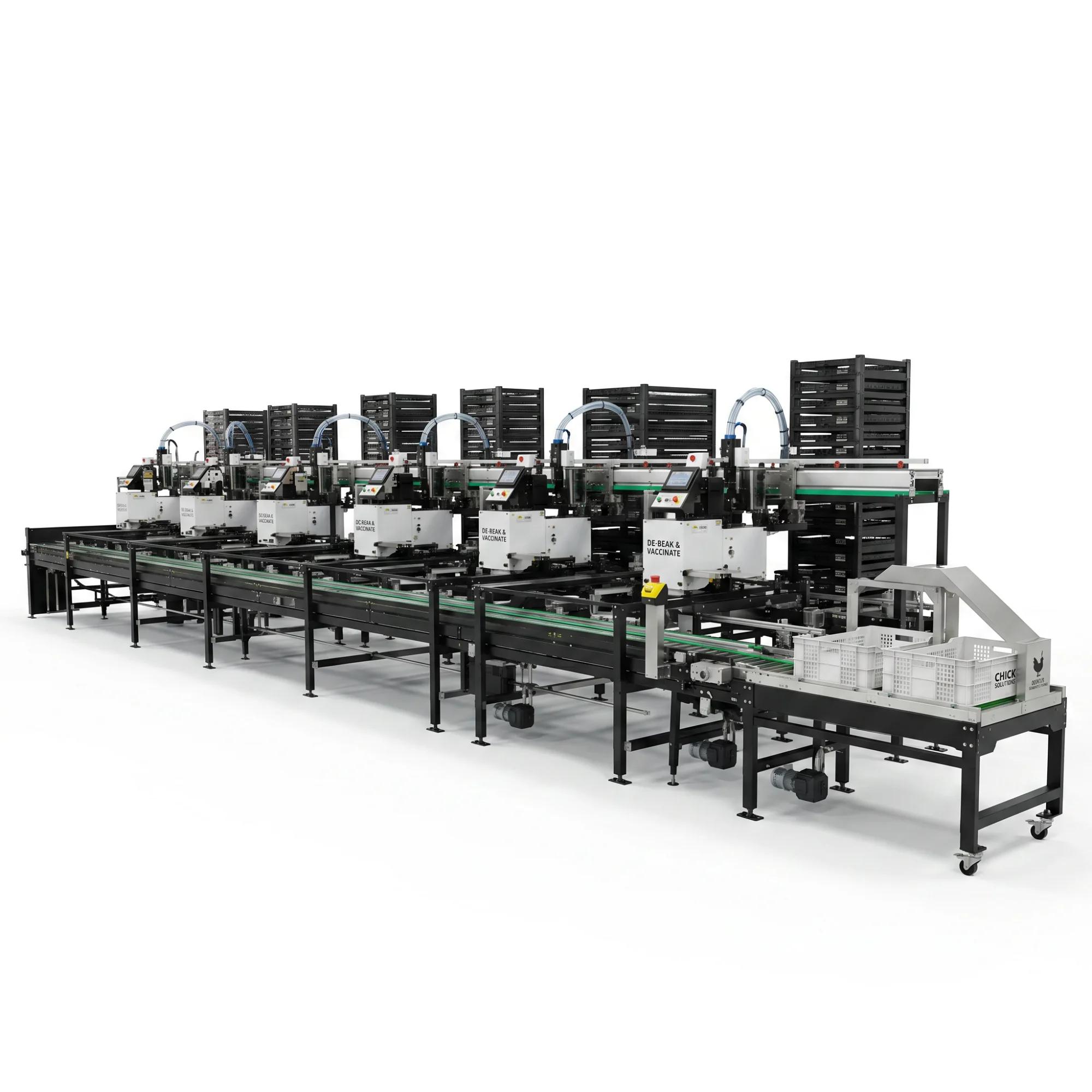
The treatment stations may be running smoothly while the end of the line still depends on people lifting, turning, carrying, and arranging crates. During a peak batch, that final section can decide whether the upstream equipment keeps moving or waits for space.
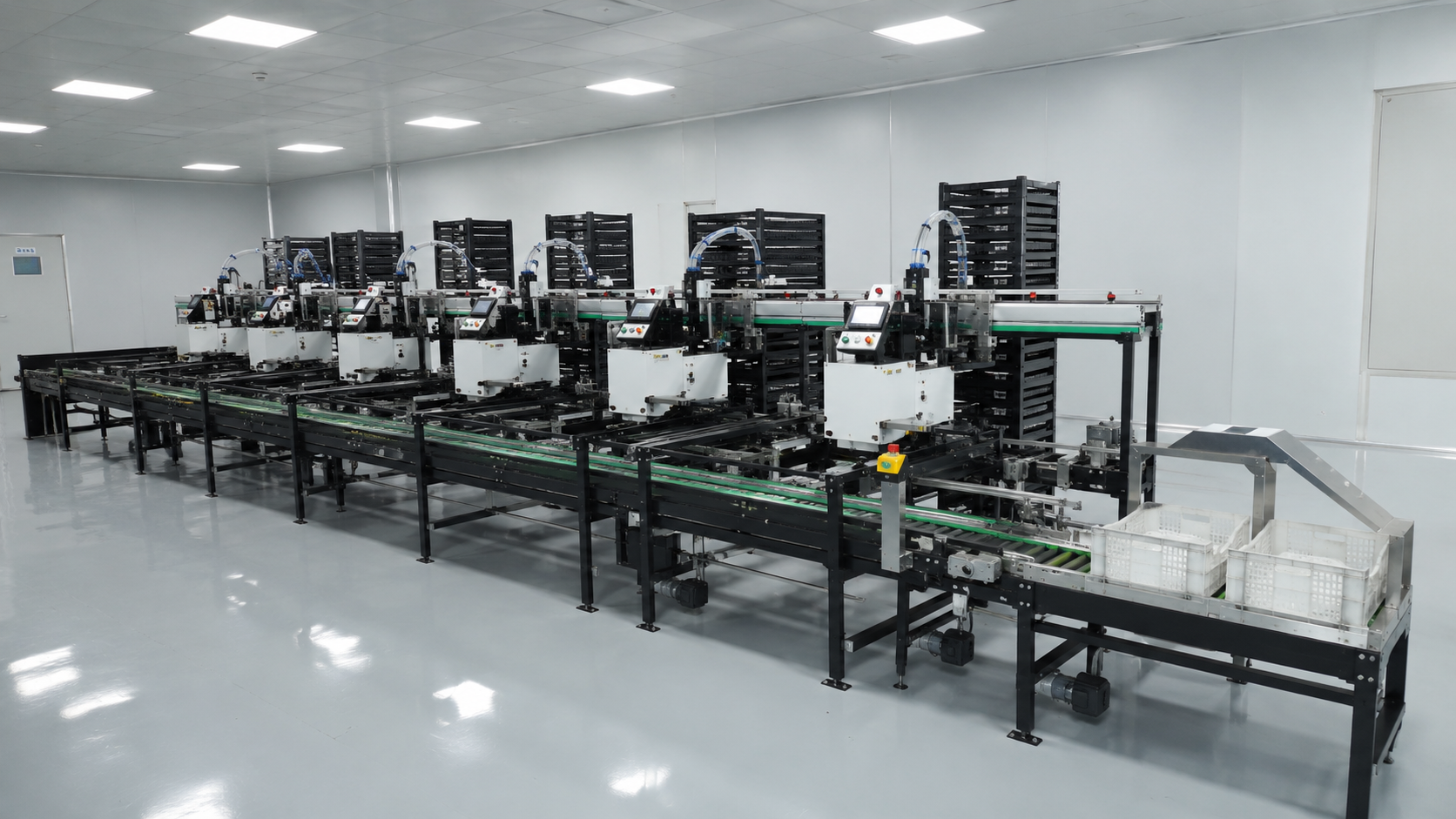
An automatic chick stacking line is not simply a faster way to pile crates. It has to receive the correct crate, in the correct orientation, at an uneven real-world pace, then build the approved stack while keeping operators, chicks, cleaning staff, and maintenance teams in mind.
A useful buying discussion begins with crates and workflow, not with the stacker model.
Bring the Actual Crates Into the Project
Crates that appear identical in a photograph may differ in outer dimensions, base geometry, rim shape, nesting features, stiffness, wear, labels, and the way they sit on a conveyor. Mixed crate fleets create additional variation.
Provide the supplier with physical samples or controlled drawings for every crate expected on the line. Include new and normally worn examples where possible.
Record:
- Manufacturer and model.
- External length, width, and height.
- Empty and maximum operating weight.
- Base and sidewall geometry.
- Handholds, latches, lids, or liners.
- Approved orientation on the conveyor.
- Permitted stack height and pattern.
- Condition limits for damaged crates.
- Labels or identification that must remain visible.
Do not assume the machine can accommodate "standard poultry crates." The acceptance test should use the exact agreed types.
JuliSense, the hatchery automation brand on this site, presents a conveying and stacking line as part of a day-old chick treatment system. The final proposal should confirm crate compatibility and the included conveying, loading, and stacking functions.
Define the Stack Before Discussing Speed
The project team should agree on the stack delivered by the machine. A complete definition may include:
- Number of crates per stack.
- Crate orientation by level.
- Maximum stack height and weight.
- Whether lids, liners, or spacers are present.
- Required alignment tolerance.
- Discharge direction.
- Pallet, trolley, floor, or conveyor destination.
- Rules for incomplete final stacks.
- Identification or batch-separation requirements.
If several products or destinations use different patterns, list each recipe and the changeover method. Ask who can select or edit a recipe and how the active pattern is confirmed before production.
The Stacker Cannot Fix an Unbalanced Line
Crates rarely arrive at perfectly even intervals. Treatment stations, operators, batch changes, quality checks, and downstream handling create variation. A stacking module needs enough control and buffer capacity to absorb normal variation without becoming a storage area for every upstream problem.
Use a short time study rather than a single average:
- Record the arrival time of each full crate during several batches.
- Mark planned stops and unplanned delays.
- Note the longest cluster of closely spaced crates.
- Measure how long completed stacks wait for removal.
- Record empty-crate return behavior if it shares the area.
This information helps the supplier evaluate conveyor zones, accumulation, stack cycle, and discharge arrangement.
| Observation | What it may indicate | Question for the design review |
|---|---|---|
| Crates arrive in bursts | Upstream work is batch-driven | How many crates can wait without blocking production? |
| Completed stacks remain in place | Downstream removal is the constraint | Is a second discharge position or clearer logistics needed? |
| Empty crates cross full-crate flow | Routes are not separated | Can the layout create one-way movement? |
| Damaged crates frequently stop conveyors | Fleet condition is uncontrolled | What rejection and manual bypass process is required? |
| Operators repeatedly re-square crates | Presentation is inconsistent | Where should alignment be corrected? |
The JuliSense guide on JuliSense.com covering chick conveying system layout checks examines upstream and downstream interfaces in more detail.
Decide How the System Handles a Bad Crate
No crate fleet remains perfect. Cracked rims, deformed bases, missing parts, labels, debris, or incorrect orientation may interfere with automatic handling.
The design should define detection, stopping, access, removal, and restart. A bad crate should not force operators to climb into the equipment or improvise around a guard.
Ask the supplier to demonstrate or explain:
- How misalignment is detected.
- What the alarm tells the operator.
- Where a rejected crate can be removed.
- Whether a manual bypass is included.
- How stored energy is controlled before access.
- How the line confirms the area is clear before restart.
- What happens to the incomplete stack.
The hatchery should also set crate inspection and retirement rules. Automation works better when obviously damaged crates are removed before they reach the stacker.
Empty Crate Flow Is Part of the Same Problem
Many projects focus on full crates and leave empty crates to operators. That can shift labor rather than remove it.
Map where empty crates originate, how they are separated, whether they are cleaned, how they return, and where operators need them. If empty and full crates use nearby conveyors, check crossing points and access.
Questions include:
- Are empty crates delivered in stacks or individually?
- Who destacks or presents them?
- Is the return rate synchronized with production?
- Where are surplus crates stored during a smaller batch?
- Can the route accept a different crate type after changeover?
- Does washing or inspection interrupt supply?
A useful automatic system addresses the complete crate loop, even if some modules remain manual.
Controls Should Show the State of the Flow
Operators need to know more than "fault." The interface should help them understand where the crate is, what the system expected, and which safe action comes next.
Agree on status and alarms for:
- Crate detected at each important zone.
- Incorrect or missing crate.
- Stack in progress.
- Stack complete.
- Discharge area occupied.
- Downstream not ready.
- Guard or access event.
- Emergency stop.
- Utility or drive fault.
- Recipe or stack-pattern selection.
If the stacker is connected to treatment equipment, define signal ownership. The complete sequence should state when upstream machines pause, whether a buffer continues filling, and what conditions allow restart.
Leave Space for People and Completed Stacks
The equipment footprint is only part of the layout. A stack needs a removal route, and the stacker needs operating, cleaning, and maintenance clearance.
Show on the drawing:
- Full-crate conveyor.
- Empty-crate return route.
- Stack discharge and pickup area.
- Trolley, pallet, or forklift path where applicable.
- Operator station and safe access.
- Rejected-crate point.
- Guard and door swing.
- Electrical-panel clearance.
- Cleaning and drainage route.
- Maintenance removal space.
- Manual bypass path.
Run a peak-flow simulation on the plan. Place completed stacks at the rate they would be removed, not at the rate the drawing assumes they disappear.
Guarding and Recovery Must Be Designed Together
Automatic stacking involves moving loads, conveyors, drives, and potential stored energy. Safeguarding needs a project-specific risk assessment and compliance review for the installation country.
From an operating perspective, focus on predictable recovery. If a crate stops halfway through a cycle, the system should provide a safe method to access, correct, and reset the equipment. Operators should not need to defeat a guard or reach through a moving zone to keep production running.
Discuss emergency stops, access doors, interlocks, isolation, restart warnings, and the position of manual controls. Include these functions in the factory test.
Cleaning and Debris Control Affect Reliability
Crate conveyors and stacking areas collect dust, feathers, labels, fragments, and other debris. The design should allow routine cleaning and inspection without turning every task into a maintenance shutdown.
Review:
- Access beneath and between conveyor sections.
- Covers and trays that can be removed.
- Places where debris can reach sensors or drives.
- Cable and pneumatic routing.
- Drainage and the approved cleaning method.
- The sequence for clearing crates before sanitation.
- Parts that must remain dry or protected.
The supplier explains equipment access and material limitations; the hatchery defines the approved sanitation procedure. Review project-specific checks alongside the manufacturer's quality-control process.
A Factory Test Should Include Imperfect Conditions
A demonstration with identical new crates arriving one at a time proves very little about a commercial hatchery.
Build an acceptance test around the agreed operating range:
- Run every approved crate type and stack recipe.
- Vary crate arrival intervals within the agreed pattern.
- Create a downstream-not-ready condition.
- Present a crate in an incorrect orientation.
- Demonstrate the rejected-crate or manual-recovery method.
- Stop the machine at different points in the stacking cycle.
- Test guard and emergency-stop responses.
- Verify restart and incomplete-stack handling.
- Review alarms, access levels, counters, and recipe selection.
- Inspect cleaning and maintenance access.
Use non-live representative loads and an agreed safe test method. Record open items with owners and closure evidence.
Information to Include in the RFQ
Send the supplier:
- Installation country and site layout.
- Normal and peak full-crate arrival pattern.
- Every crate model, drawing, sample, and expected condition.
- Crate weight range and approved stack pattern.
- Required stack destination and removal method.
- Empty-crate source and return route.
- Upstream and downstream equipment details.
- Available buffer space.
- Electrical and pneumatic utilities.
- Controls, alarms, language, and data requirements.
- Cleaning method and environmental constraints.
- Guarding and local compliance expectations.
- Factory and site acceptance requirements.
- Training, spares, installation, and support scope.
Ask the quotation to separate conveyors, alignment devices, buffer zones, stacker, discharge, guards, controls, installation, commissioning, training, spares, and exclusions.
Frequently Asked Questions
Can one stacker handle several crate sizes?
Possibly, but compatibility must be engineered and tested. Provide exact drawings and samples. Confirm required adjustments, recipes, changeover time, and whether mixed crates can be present in one shift.
How many crates should the buffer hold?
Size the buffer from measured arrival bursts, stack cycle, downstream removal time, allowed accumulation, and available space. A large buffer can hide a problem without fixing it.
Is automatic stacking useful for a small hatchery?
It may be, particularly where lifting, staffing, crate consistency, or integration is a concern. The business case depends on actual flow and labor, not hatchery size alone.
What happens if the stacker stops?
The project should include a defined stop sequence, safe recovery method, manual bypass or contingency where needed, and clear restart conditions. Ask to see this during the factory test.
Can the stacking line connect to an existing treatment line?
Potentially. The supplier must review conveyor height, crate presentation, speed range, controls, guards, buffer behavior, room layout, and downstream logistics.
Where JuliSense Fits the Crate-Handling Project
The JuliSense conveying and stacking product is a direct match for buyers studying this part of the hatchery flow. Its placement within a wider day-old chick treatment system also supports conversations about upstream treatment stations and complete automation rather than treating the stacker as an isolated island. Buyers should use that broader product range to clarify interfaces, then keep the commercial scope precise: approved crate types, conveying zones, stack rules, controls, guarding, testing, installation, and support must be stated in the final offer.
Design the End of the Line as Carefully as the Beginning
An automatic chick stacking line earns its place when it removes a real crate-handling constraint and keeps the rest of the hatchery moving. That requires known crate geometry, clear stack rules, balanced arrival and discharge, useful alarms, safe recovery, and enough room for cleaning and completed-stack removal.
JuliSense also provides broader complete hatchery automation solutions. Send crate drawings, samples, arrival data, stack rules, room layout, connected-equipment details, and the desired project boundary through the contact page for an interface review and itemized proposal.
Reference Point
- OSHA Machine Guarding provides general information about machine hazards and safeguarding. The installation must follow the risk assessment and legal requirements applicable at the site.
A Clearer Project Decision
An automatic chick stacking line should be reviewed with the actual crate. The automatic chick stacking line needs defined infeed orientation and stack rules. Test the automatic chick stacking line with normal variation and a planned interruption. Ask how the automatic chick stacking line records a stop and controlled restart. Compare an automatic chick stacking line by guarding, cleaning access, and spares. Before approving an automatic chick stacking line, review ISO 12100 and OSHA machine-guarding guidance.