


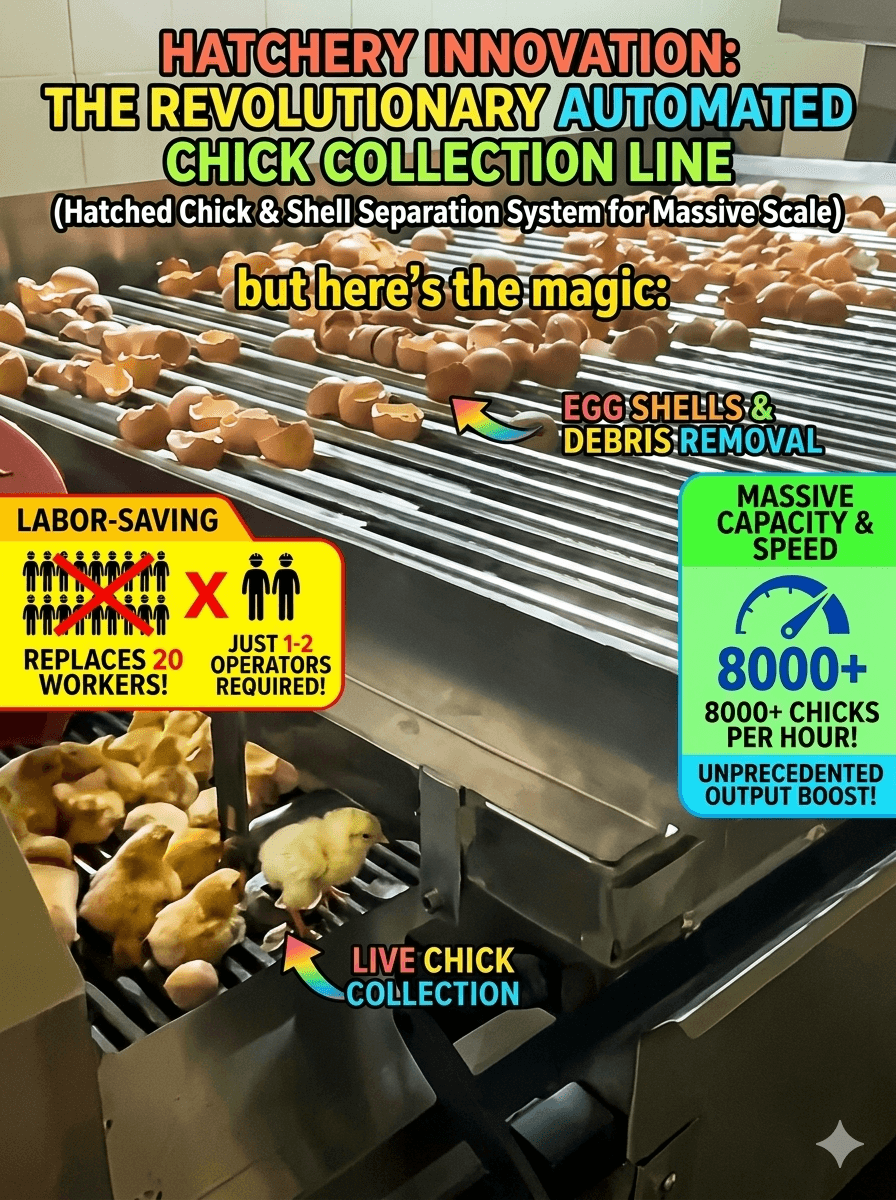
The number at the end of a hatch day is more than a statistic. It tells the hatchery what left the room, what the farm should expect to receive, and whether the paperwork will survive an audit. When that figure is wrong, the first suspect is usually the equipment.
In practice, a chick counting machine is rarely the whole story. Counting sits at the busiest handover in the room, and most drift comes from what arrives at the sensor rather than from the sensor itself.
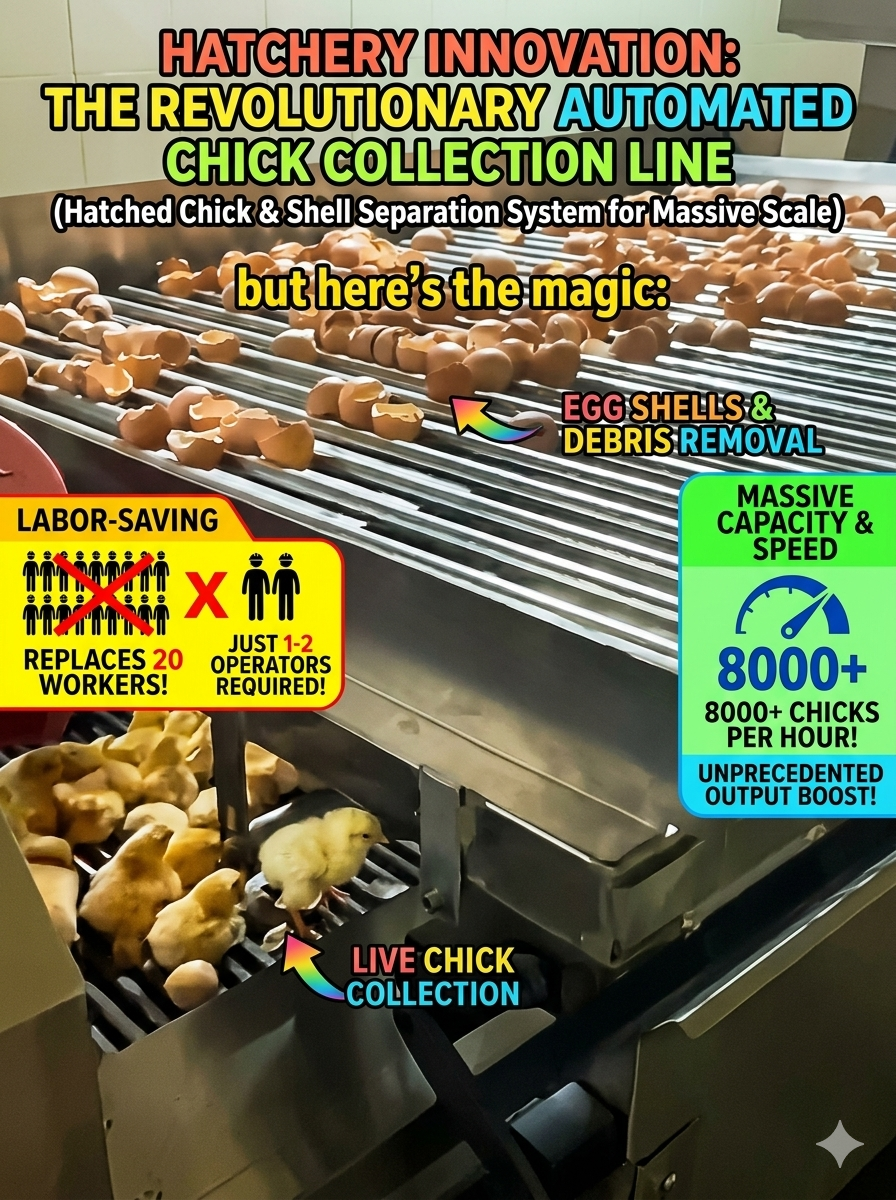
What is actually being counted
Designs differ, but the counting function usually sits where chicks leave the tray and travel in a single direction. Debris, shells, dust and sometimes whole eggs travel with them. Whether the counter sees a bird, a piece of shell or two birds touching depends on how well the upstream section prepares the flow.
That is why the specification should describe the input condition as carefully as the output figure. A chick counting machine specified for a clean, single-file flow will not perform the same way when trays arrive wet and heavy, and no supplier should pretend otherwise.
Counting for traceability, packing or control
Three jobs hide behind one number. Traceability links the count to a flock and a hatch day. Packing uses it against a target per crate. Line control uses the running figure to pace the stations downstream. They need different resolutions and different alarm thresholds, and the hatchery should decide which is primary before the panel is designed.
Where the count drifts
Six sources explain most discrepancies reported after commissioning, and only one of them is electronic.
Shell and debris in the flow
Fragments are counted as birds when separation is incomplete. The fix is usually upstream: extraction and screening that keeps debris out of the counting lane rather than a more sensitive sensor.
Running above the design window
Every counting arrangement has a speed range in which accuracy was verified. Push the line beyond it and the error appears as a small, consistent shortfall rather than an obvious fault, which is exactly why it goes unnoticed for weeks.
Birds arriving in clusters
Groups that arrive touching each other read as one. Better lane guidance, not more sensitivity, is the usual answer.
Fouling and cleaning residue
Dust, down and cleaning water change how sensors behave. A daily wipe-down and a weekly check against a known count belong in the cleaning routine, not in a maintenance manual nobody opens.
Diverted or rejected birds
If birds are removed after the counting point, the count and the crates will never agree. Decide whether the count is taken before or after diversion, write it down, and design the paperwork around it.
The manual fallback
Someone needs a number now, so a crate is estimated by eye. This is the most common cause of a wrong figure on a night shift, and the most easily fixed: give the team a defined way to record an estimate without overwriting the counter total.
A symptom table for the night shift
| What you see | Likely cause | First check | Who usually fixes it |
|---|---|---|---|
| Small consistent shortfall | Line running above the verified speed | Compare cycle time with the agreed rating | Production supervisor |
| Occasional large error | Clustered birds or a blocked lane | Watch the infeed for two trays | Maintenance |
| Count rises with shell load | Separation upstream is losing debris | Inspect the extraction section | Maintenance and supplier |
| Drift that grows across the shift | Sensor fouling or cleaning residue | Stop, clean, repeat a known tray | Operators |
| Count and crates never reconcile | Diversion after the counting point | Trace the path of rejected birds | Quality team |
What to specify on a chick counting machine
The specification conversation is short if you ask four questions and insist on examples.
| Specification item | What to ask | Why it matters |
|---|---|---|
| Verified speed window | At what rate was accuracy tested, and on what input? | Defines the ceiling for daily operation |
| Accuracy statement | How is a counted figure checked, and over how many birds? | Turns a claim into a testable statement |
| Output signal | What does the counter send, and to whom? | Decides what downstream stations can do with it |
| Cleaning method | How is the sensor cleaned between shifts? | Prevents the most common cause of drift |
| Reporting format | What record does the counter leave behind? | Supports traceability during audits |
Nothing in this list requires a fixed performance promise. What it does require is that the selected configuration is confirmed in writing, because accuracy without a stated input condition is not a number anybody can rely on.
Verifying the count before you accept the line
Verification is straightforward and worth doing properly.
Run a known quantity of birds through the line at the rated speed, then at a slow speed, and compare the counter with a manual count of the same run. Repeat it three times, once with a normal tray and twice with trays that represent the worst condition the hatchery expects to see. Record the figures on the acceptance sheet, with the settings used.
Ask the supplier to run that test with the chick counting machine on the same trays the hatchery will use in production, not on a demonstration tray prepared for the visit.
The same routine is worth repeating a month after commissioning, because cleaning habits and operator behaviour change once the equipment stops being new. Where traceability matters, keep the results with the quality records so the count can be defended if a farm queries a delivery later.
Counting is also a good reason to look at the whole line rather than one station. The position of the counter relative to separation, treatment and packing is described on the picking and transfer machine page and in the wider hatchery automation solutions overview, and the measurement practices we apply during build are outlined in the service section.
Where counting sits in the wider line
A counting function that works in isolation is of limited use. Its value grows when the figure travels: to the packing station, to the stacking line, and into the record that accompanies the crates out of the building.
That is why the practical question is not "how accurate is the chick counting machine" but "how accurate is it at the speed we intend to run, with the trays we actually receive". Everything else, including the number of digits on the display, is a detail.
A note on farm-end expectations
Some discrepancy between the count at the plant and the count at the farm is normal, because birds are not identical objects and handling continues after dispatch. Agreeing an acceptable tolerance in advance, and stating it in the delivery documentation, prevents a reasonable variance from becoming a commercial argument.
Questions buyers ask about counting equipment
Can a chick counting machine replace manual counting entirely?
In most hatcheries it changes the role rather than removing it. Operators stop counting continuously and start verifying against samples, which is faster and produces a record that can be audited.
Does counting slow the line down?
No, if the counting lane is designed for the line speed and the infeed presents birds in a controlled stream. This is decided at the layout stage, not at the counter.
What accuracy should we ask for?
Ask for the tested figure at a stated speed and input condition, and ask how it is measured. A single percentage without those two details is not something a supplier can be held to.
Do we need a separate machine?
Many plants count inside an existing station, usually where chicks are transferred or separated. A standalone unit makes sense where volumes are high or where the count needs to be taken at a specific point in the process.
Ask us to test it, not describe it
JuliSense builds day-old chick processing equipment with counting arranged where it suits the room, then verifies the figure against a known run before the line leaves the factory. Send us your volumes, your tray condition and the point in the process where the number has to be taken. Product details are on the products page, our background is on about us, quick answers sit in the FAQ, and counting questions can go straight to the team through contact us.