


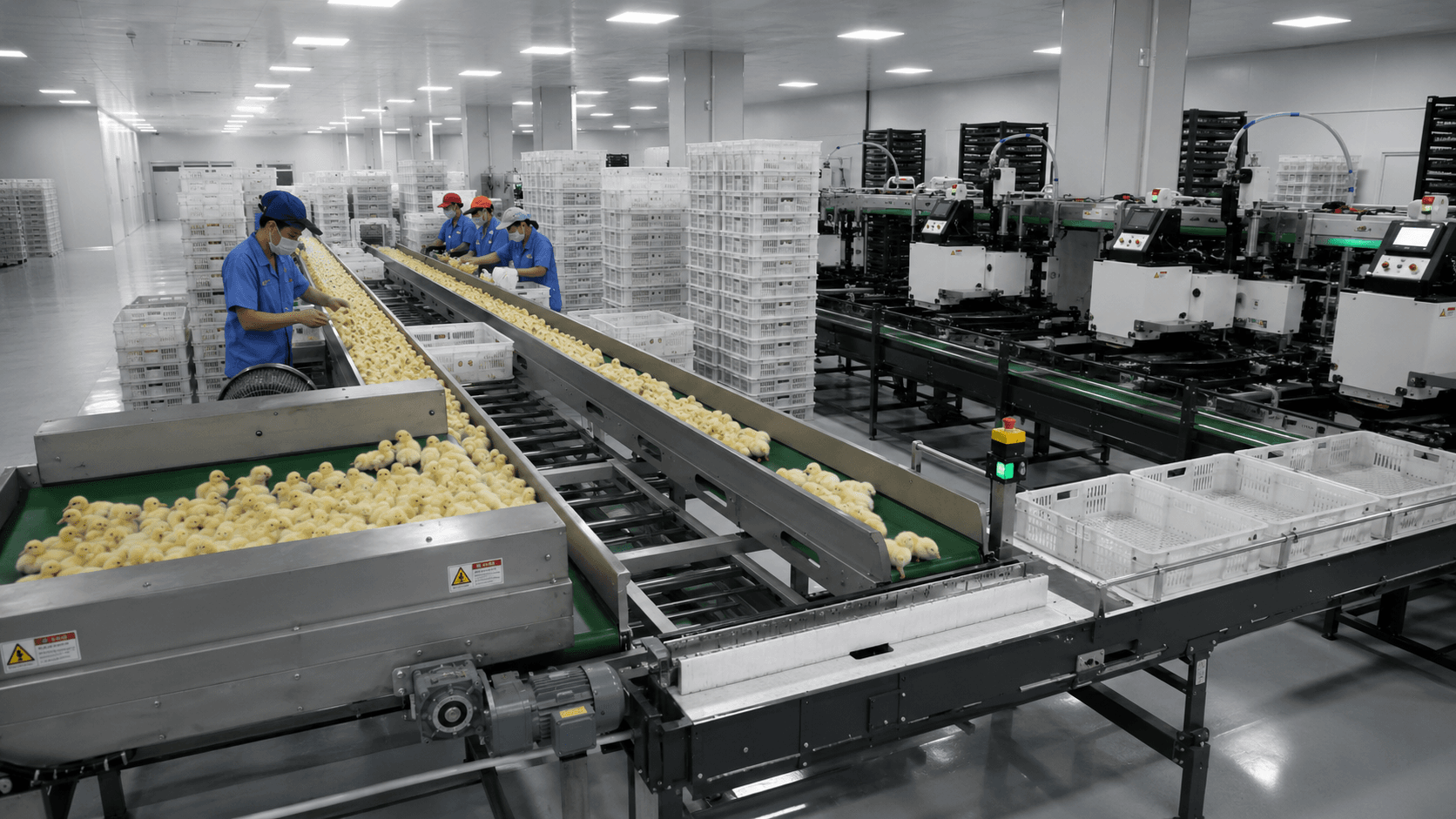
A serious chick processing equipment manufacturer should help a buyer understand the project before asking for commercial approval. A polished catalogue is useful for finding possible equipment, but it does not show how transfer, treatment, vaccination, conveying, stacking, utilities, cleaning, controls, and service will work at one hatchery.
The strongest comparison is a project proof pack. Seven documents can reveal whether the supplier understands the operating problem and is prepared to take clear responsibility.
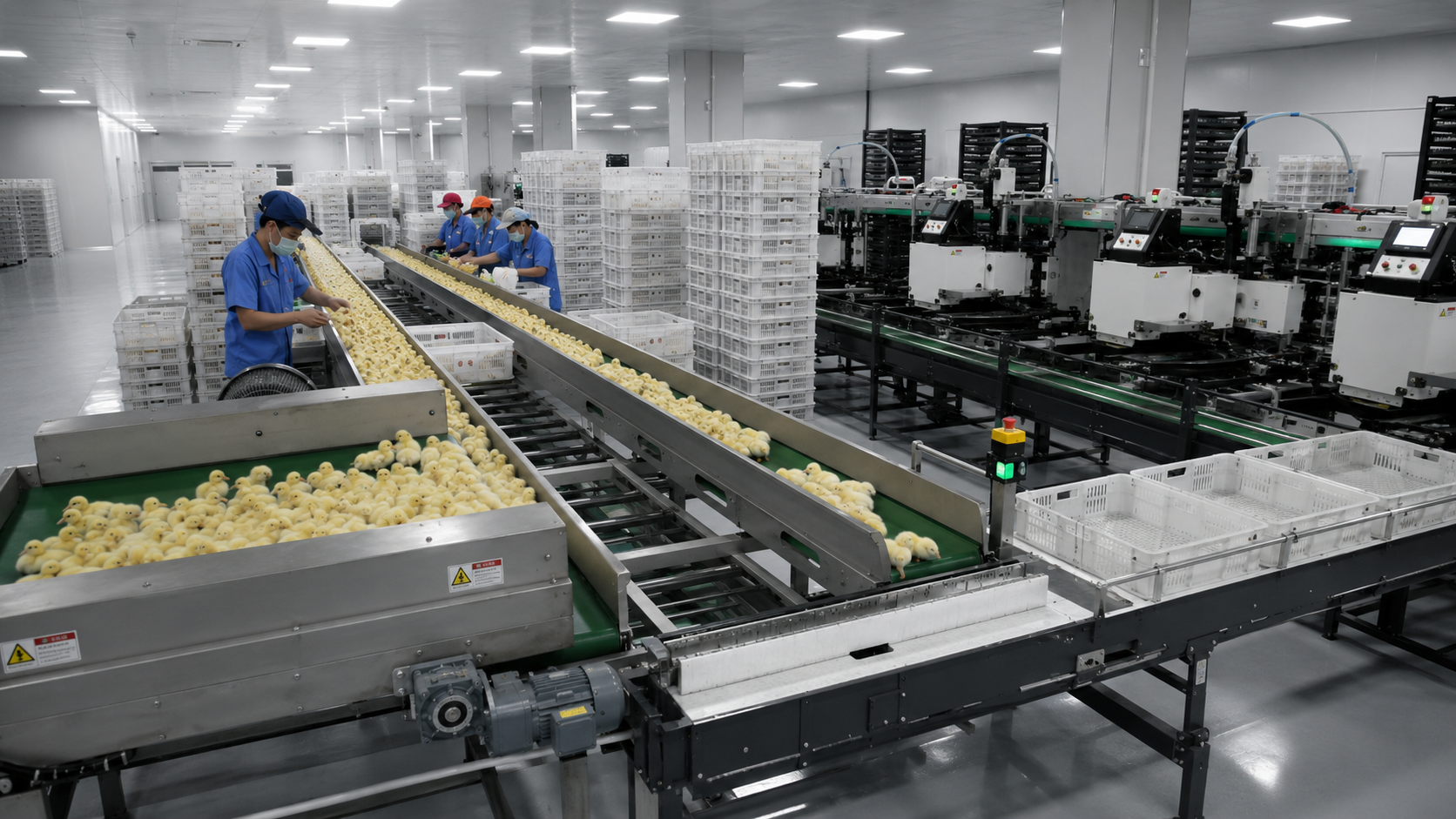
Document One: The Customer Process Map
Before recommending machines, the supplier should be able to restate the customer's current process and intended future process. The map should show where chicks arrive, which approved jobs occur, how containers move, where operators work, and where the batch leaves the room.
This document does not need to be visually elaborate. It needs to be correct. Production, veterinary, sanitation, maintenance, and procurement teams should be able to point to the same flow and agree on the project boundary.
If the proposal begins with equipment models before the supplier understands the batch pattern and handoffs, the buyer is likely comparing catalogues rather than solutions.
Document Two: The Equipment and Responsibility List
Every module, accessory, control, service, and customer-supplied item should have an owner. The list should distinguish included equipment, optional items, site utilities, installation work, commissioning, training, consumables, spare parts, documentation, and exclusions.
For a connected line, add interface ownership. Who supplies the signal between transfer and treatment? Who defines what happens when full boxes cannot leave? Who provides guarding or supports at the boundary with existing equipment?
The best responsibility list prevents two suppliers from assuming that the other will solve the same gap.
Document Three: The Layout With Real Operating Space
A machine footprint is not a working layout. The drawing should include operator positions, access doors, maintenance clearance, control panels, material staging, clean and dirty routes, full-box pickup, and the path used during sanitation.
Review the same drawing in normal production, peak arrivals, a blocked downstream condition, maintenance access, and end-of-shift cleaning. A layout that works only while every module is running smoothly is incomplete.
Jili Intelligent publishes complete hatchery automation solutions along with individual modules for transfer, infrared treatment, vaccination, conveying, stacking, and crate washing. The value of a broad range is the ability to discuss interfaces, not a reason to place every available machine in one room.
Document Four: The Capacity Assumptions
Capacity should be written with its conditions. Ask for the bird application, staffing, presentation method, operating window, batch pattern, included stops, changeovers, cleaning time, and downstream availability assumed by the proposal.
A chick processing equipment manufacturer may publish a machine-level capability, while the hatchery needs a shift-level result. Those numbers are not automatically the same. A line can only move at the rate its slowest real stage and recovery process allow.
The buyer should provide measured arrivals in short intervals, not only an annual volume. Peaks reveal the need for buffers, staffing, and coordinated stop behavior.
Document Five: The Factory Acceptance Script
The factory acceptance test should be written before the equipment is complete. It should state what configuration will be present, which materials or containers will be used, which sequences will be demonstrated, and what evidence constitutes acceptance.
Include normal running, planned pauses, representative alarms, blocked downstream behavior, restart, batch change, controls, guarding, documentation, and cleaning access where relevant. For integrated equipment, verify coordinated behavior across modules rather than testing each machine only in isolation.
A video can support the record, but it should not replace agreed test results and open-item tracking.
Document Six: The Site Readiness and Commissioning Plan
The buyer needs to know what must be ready before the supplier's team arrives. The plan should cover floor and access, power and other utilities, drainage where needed, network or control connections, customer-supplied equipment, lifting, local safety work, representative containers, trial materials, operators, and technical approvals.
Commissioning should then have a sequence: installation checks, dry tests, interface tests, training, representative production, open-item resolution, and site acceptance. Separating these stages makes responsibility and progress easier to manage.
Document Seven: The Support File After Handover
The project does not end when the machine runs once. Ask how manuals, electrical information, maintenance tasks, spare parts, training records, software or parameter backups, remote support, and service communication will be organized.
The useful question is not “Do you provide service?” It is “What information will our team have on day one, who responds to which issue, and what evidence should we send when requesting support?”
Buyers can review Jili Intelligent's service information and quality-control process, then make the project-specific commitments explicit in the quotation and contract.
What the Proof Pack Says About Jili Intelligent
Jili Intelligent positions itself around intelligent hatchery automation and publishes product coverage across the main post-hatch processing stages. That makes the company relevant for both individual-machine and connected-line inquiries.
Brand fit is only the starting point. The project proof pack should show how the proposed Jili configuration fits the customer's application, site, output pattern, operating team, sanitation requirements, acceptance plan, and destination.
Frequently Asked Questions
Should buyers request all seven documents before receiving a price?
Not in final form. Early quotations can begin with a process summary, preliminary layout, scope list, assumptions, and exclusions. The documents should become more detailed before technical and commercial approval.
How can a buyer compare two manufacturers fairly?
Give both suppliers the same process data, layout, container information, operating requirements, service expectations, and acceptance scenarios. Then compare scope and evidence, not only the total price.
What information should a hatchery send first?
Send the current process map, required operations, batch arrivals, room drawing, containers, staffing, utilities, cleaning constraints, existing equipment, destination, and expansion plan.
Approve Evidence, Not Just Equipment Names
Choosing a chick processing equipment manufacturer is a decision about engineering clarity and project execution as much as machinery. The proof pack shows whether the supplier has understood the work, defined interfaces, planned acceptance, and prepared the hatchery for handover.
Send Jili Intelligent your project information through the contact page and ask the proposal to include a process map, preliminary layout, responsibility list, assumptions, acceptance approach, service scope, and exclusions.