


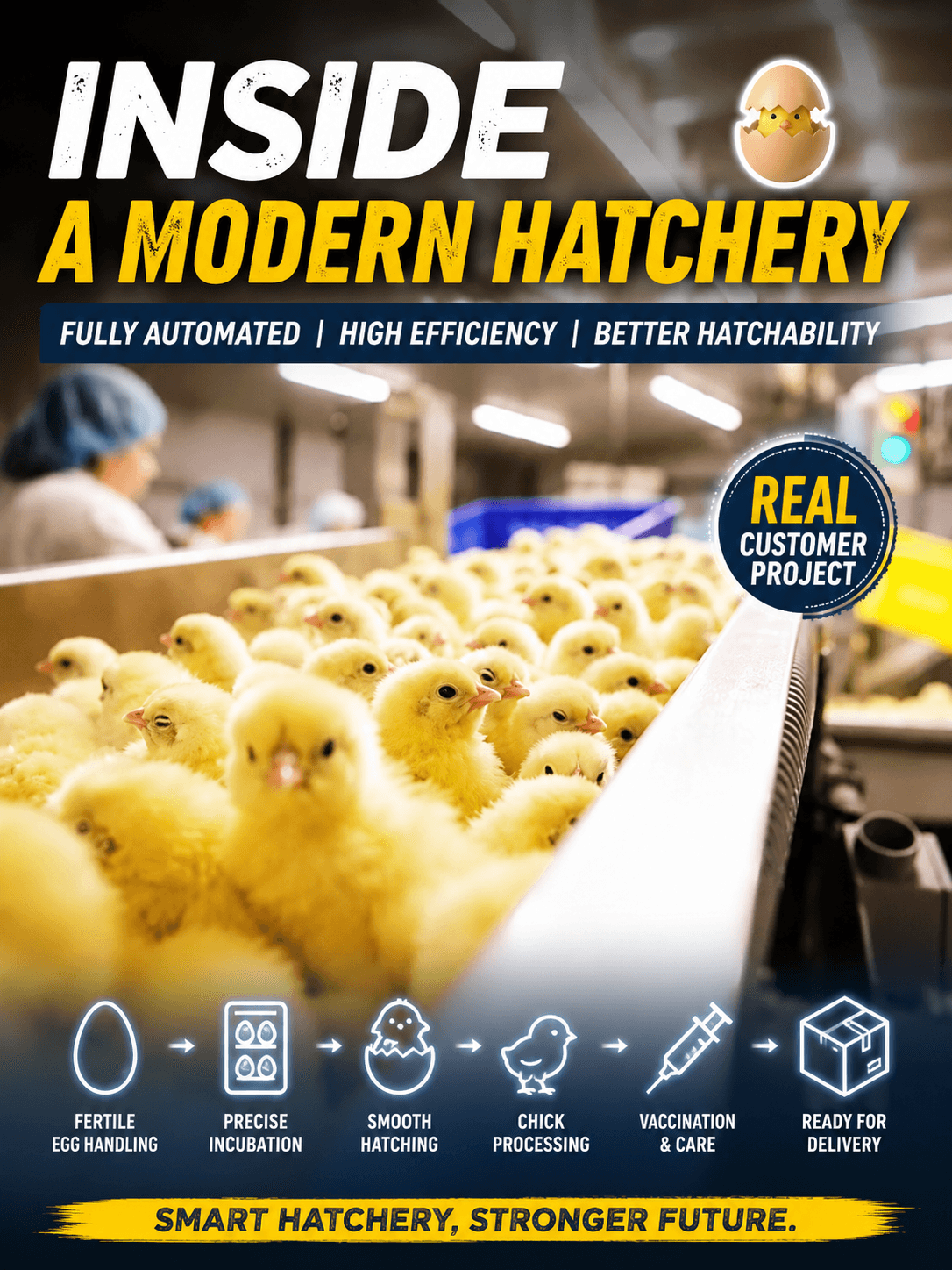
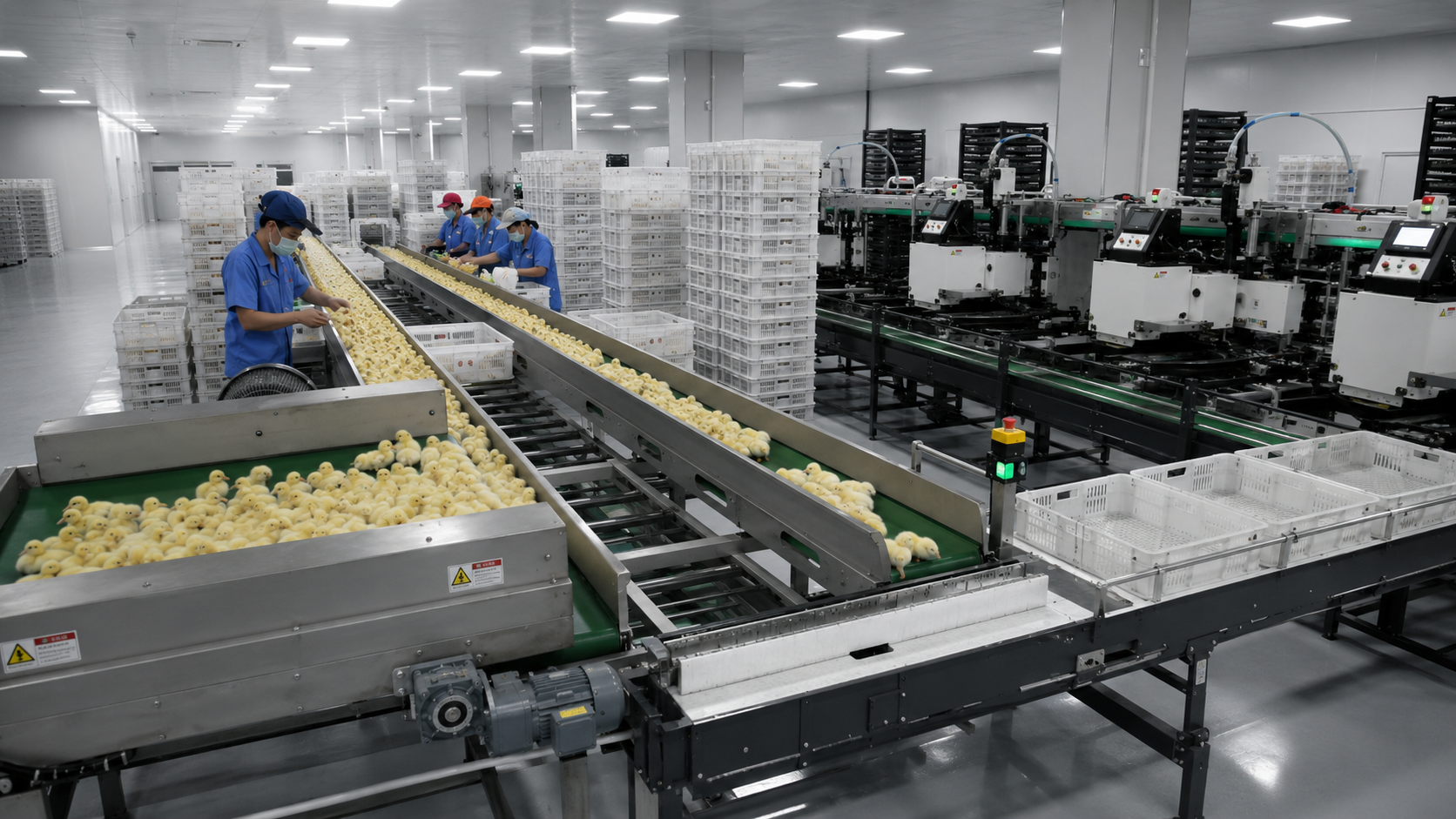
A chick processing line for hatchery operations should begin with the room, not a catalog. The line has to coordinate chicks, operators, crates, supplies, records, cleaning routes, maintenance access, utilities, and downstream timing. A list of fast machines does not automatically create a stable production system.
The most useful early drawing is often a simple flow map. It shows where each movement begins, where it waits, who owns the handoff, and what happens when the next step is unavailable. Jili Intelligent uses the JuliSense platform to present equipment and integrated hatchery automation solutions, but every project still needs a layout based on the customer's real building and operating model.
Walk the Empty Room Before Adding Equipment
Stand at the room entrance and imagine five separate journeys:
- the chick journey;
- the operator journey;
- the crate or box journey;
- the supply and waste journey;
- the sanitation and maintenance journey.
Draw each one in a different color. Crossings reveal risk, congestion, and unnecessary handling. Long returns reveal lost time. Blind corners reveal supervision problems. Narrow service spaces reveal future maintenance pressure.
This exercise prevents the layout from being shaped by whichever machine drawing arrives first.
The Chick Journey Sets the Production Logic
Follow the planned chick flow from the first inbound point to the final handoff. Mark every transfer, operator touch, wait position, inspection, treatment, vaccination, counting, loading, conveying, or packing step that applies to the customer's approved process.
For each handoff, ask three questions:
- What makes the next step ready?
- Where do chicks wait if it is not ready?
- Who decides that flow can restart?
A chick processing line for hatchery production is only as stable as its least-defined handoff. Adding capacity upstream can make the room worse if downstream accumulation and recovery are not designed.
The Operator Journey Determines Whether the Layout Works at Peak Time
Operators need clear positions, supply access, visibility, communication, and safe movement. A room that looks open on a clean drawing may become crowded after carts, crates, consumables, waste containers, tools, and temporary holding positions are added.
Use full-size floor marks or movable outlines before freezing the layout. Ask operators to simulate normal production, a supply refill, a batch change, a stop, and shift handover. Their walking paths will show whether the design supports work or creates repeated crossing.
The supplier should not decide operator numbers from a brochure alone. The plan depends on selected functions, batch pattern, automation boundary, local work rules, and the customer's desired level of redundancy.
The Crate and Box Journey Often Hides the Bottleneck
Empty containers must arrive at the correct moment. Full containers need a clear route to conveying, stacking, dispatch, or another process. Rejected, damaged, or incorrectly prepared containers need an exception route.
If boxes or crates share the same aisle as operators and sanitation equipment, peak-time congestion can appear even when every machine meets its own rated output. The layout review should therefore include buffer positions, orientation, loading, full-container release, and return flow.
JuliSense's complete hatchery automation solutions page provides context for connected systems. Buyers should ask Jili Intelligent to mark the exact scope and interfaces proposed for their line.
Design the Stop Before You Celebrate the Flow
Choose three realistic interruptions: downstream unavailable, supply missing, and a station needing attention. For each event, trace the effect backward and forward through the room.
The line concept should explain:
- how the condition is detected;
- where product or containers are held;
- which stations stop and which may continue;
- what the operator sees;
- who removes the cause;
- how restart is authorized;
- what evidence is recorded.
Machinery risk assessment should cover the installed system and interfaces. ISO 12100 offers a general framework for machinery risk assessment and risk reduction. Engineering teams must determine the applicable standards, guarding, emergency functions, and local compliance requirements for the completed installation.
Give Sanitation Its Own Layout Layer
Production flow and cleaning flow are not the same. Mark where removable parts go, where cleaning tools and supplies are stored, how water or waste moves, which areas need visual access, and how equipment is released after sanitation.
Avoid placing a frequently serviced or cleaned area where another machine blocks access. Also check whether conveyors, frames, or utility runs create ledges and hidden spaces that are difficult to inspect.
The chick processing line for hatchery plan should include sanitation representatives before equipment positions are fixed. Their input can change spacing, access sides, removable sections, drainage assumptions, and the order in which areas are cleaned.
Utilities Are Part of the Flow
Power, air, water, drainage, network, extraction, and other project-specific services need routes, capacities, isolation points, and owners. A utility list without a coordinated drawing can still produce clashes or inaccessible connections.
Ask the supplier to distinguish machine requirements, line requirements, recommended conditions, and customer-supplied work. The quotation should also state who confirms final utility suitability and when that confirmation occurs.
Build the Line Around Evidence, Not Only Equipment
A chick processing line for hatchery projects also sits inside the customer's veterinary, welfare, and biosecurity responsibilities. The World Organisation for Animal Health Terrestrial Code is a useful international reference point, while qualified customer owners must determine the specific rules and approved procedures that apply.
A good project creates evidence at several stages:
- approved process and layout basis;
- interface and utility schedule;
- design-review decisions;
- factory acceptance plan and results;
- shipment and installation records;
- site acceptance and open-item closure;
- training attendance and competence follow-up;
- early-production observations and support actions.
This evidence allows production, engineering, quality, maintenance, sanitation, and procurement to discuss the same project. It also prevents verbal assumptions from becoming expensive disputes.
Leave Space for the Next Decision
Future-ready does not mean buying every function now. It means protecting the interfaces and space that would be difficult to change later. Ask whether production volume, product mix, packaging, records, or downstream logistics may change.
A phased chick processing line for hatchery project can define the current equipment, future connection points, reserved space, control boundaries, and assumptions. The team can then invest in stages without pretending that future integration will be effortless.
JuliSense describes custom design and system-integration capabilities on its about page. The project proposal should translate those capabilities into named drawings, reviews, tests, training, and support deliverables.
Frequently Asked Questions
What information is needed for an initial line layout?
Provide a scaled room drawing, doors, columns, drains, utilities, current equipment, approved processes, batch pattern, operator plan, container flow, and expansion needs.
Should the fastest machine set the line capacity?
No. Stable line output depends on handoffs, stops, buffers, operators, supplies, cleaning, and downstream availability as well as individual equipment capability.
How much buffer space is required?
There is no universal answer. Buffer needs depend on batch behavior, interruption scenarios, recovery time, container format, room limits, and approved handling rules.
Can an existing room be automated without major changes?
Sometimes, but the layout review must confirm access, utilities, floor conditions, sanitation, safety, operator flow, and interfaces before that conclusion is made.
Who should approve the layout?
Production, engineering, sanitation, maintenance, safety, quality, technical owners, and procurement should review the areas relevant to their responsibilities.
What should factory acceptance demonstrate?
It should demonstrate the agreed configuration, functions, controls, stop behavior, interfaces, documents, and open-item process within the test boundary.
What remains for site acceptance?
Site acceptance normally addresses installed utilities, interfaces, layout, safety, integrated operation, training, and other items that cannot be fully proven at the factory.
How should future expansion be planned?
Reserve practical space and define mechanical, control, data, utility, safety, and responsibility interfaces for likely future modules.
Does JuliSense provide layout support?
JuliSense presents custom design and integrated hatchery automation capabilities. The exact layout deliverables and revision process should be defined in the proposal.
Where should a buyer start?
Start with a room drawing and a one-page description of the current workflow, problems, approved processes, batch pattern, and desired project outcome.
Ask for a Layout That Explains the Work
The right chick processing line for hatchery operations is not a row of equipment. It is a coordinated room where chicks, people, containers, supplies, information, cleaning, and maintenance can move without hidden conflicts.
Send Jili Intelligent your scaled layout, process map, batch pattern, operator plan, utilities, container flow, interruption scenarios, and future needs through the JuliSense contact page. Ask for a room-first concept with clear assumptions and interface responsibilities.