


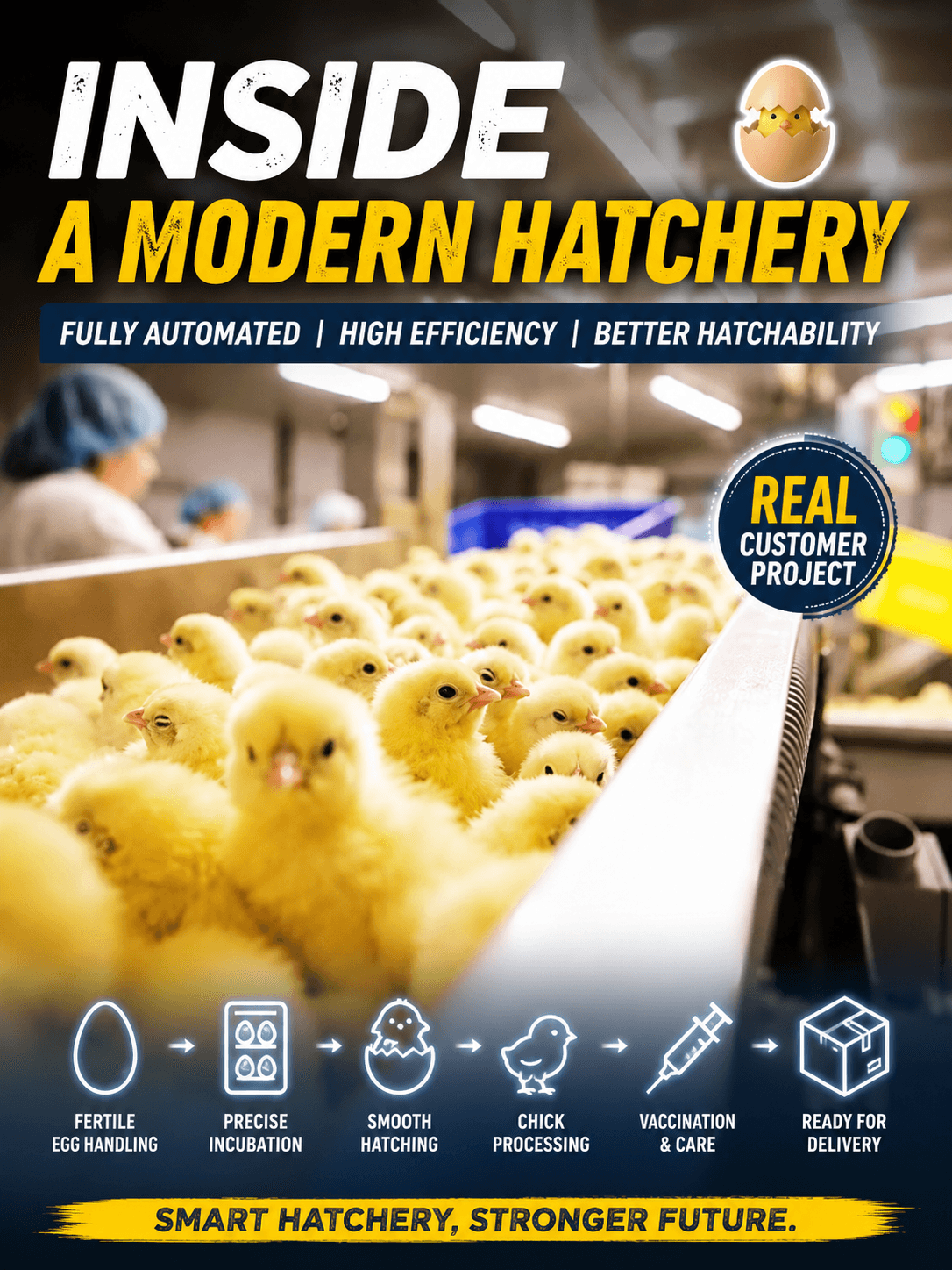
Automation proposals often begin with a floor plan full of conveyors. Hatchery teams usually begin somewhere else: a difficult shift, too much lifting, inconsistent flow, crowded work areas, production records that arrive late, or equipment that stops because the next station is not ready.
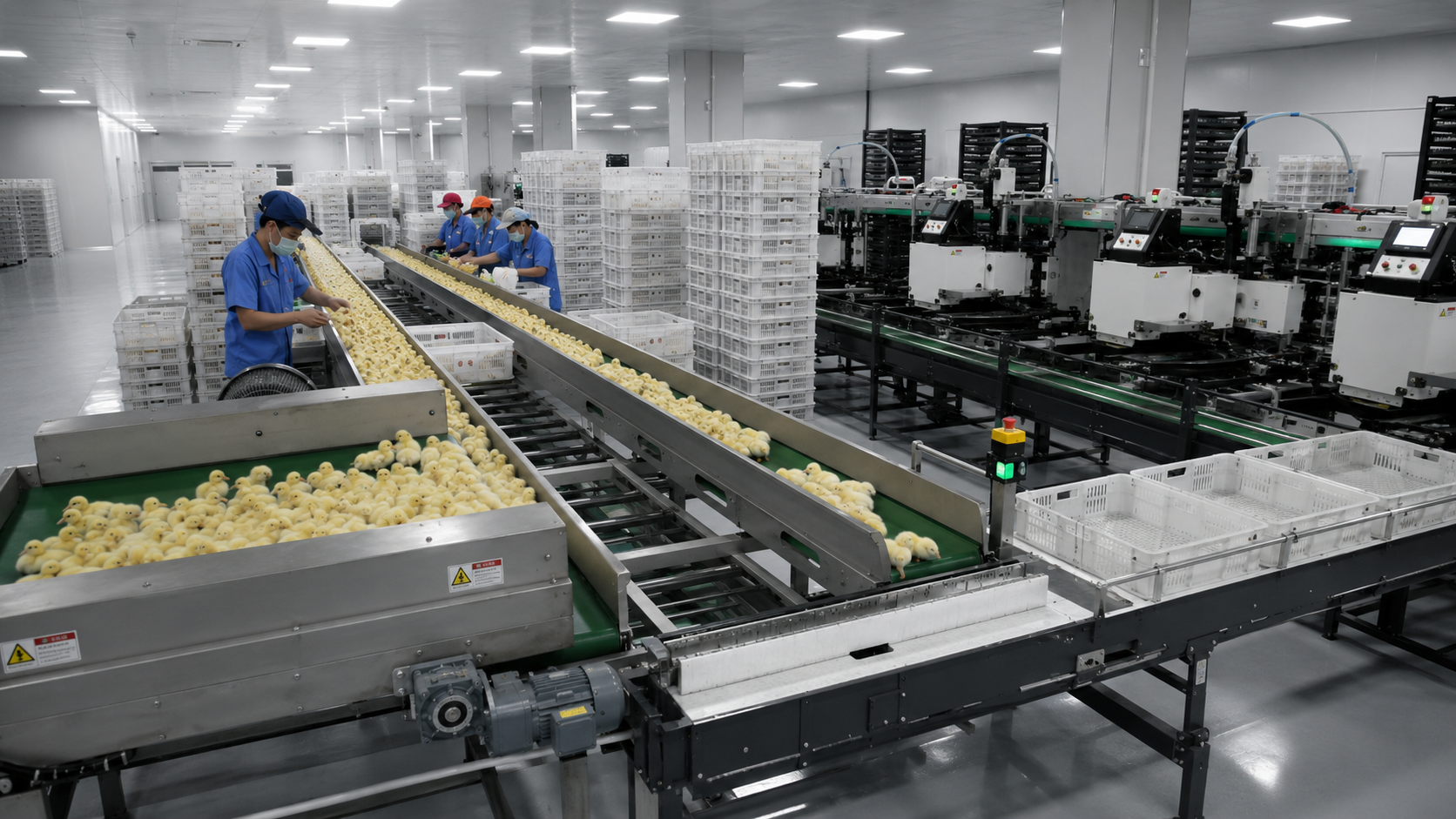
Those operational details should shape the investment. Commercial hatchery automation equipment pays its way by taking pressure off a known weak point while still fitting the room, the cleaning shift, the available utilities, and the people who run production.
Trying to mechanize every movement in the first project can blur that purpose. A better starting point is a line the crew can understand on Monday morning, clean at the end of the shift, and extend later without undoing the first installation.
Begin With a Week of Observation
One plant tour gives a snapshot; it seldom shows the constraint that returns week after week. Spend time on a peak day, then come back for a smaller batch, a changeover, and cleaning. An ordinary stoppage is useful evidence too.
Keep a rough field note of the work people do between machines: waiting for trays, carrying crates, correcting spacing, checking counts, or hunting for an answer. Mark the corners where chicks, supplies, and containers begin to gather. Operators will usually point out the unofficial route used when the planned one is blocked.
The result should be a short list of constraints, not a catalogue wish list. Examples might include:
- Chicks arrive faster than the treatment stations can receive them.
- Operators spend too much time moving empty and full crates.
- A manual transfer creates irregular spacing at the next machine.
- Cleaning one module blocks access to another.
- A short downstream stop forces the entire room to stop.
- Production counts are reconciled manually after the shift.
- One process depends on a small number of experienced operators.
Rank each issue by frequency, production impact, safety or welfare importance, labor burden, and ease of correction. Some problems need equipment; others need layout, scheduling, maintenance, or clearer standard work.
Match Equipment to the Constraint
Commercial hatchery automation may include chick collection or transfer, treatment stations, vaccination, conveying, counting, crate loading, stacking, washing, and line controls. A project does not need every module to be valid.
| Operational constraint | Equipment or design response to evaluate | Question before investing |
|---|---|---|
| Irregular feeding to a station | Presentation conveyor or controlled buffer | Is the variation coming from the previous process? |
| Excessive crate movement | Crate conveyor, loading aid, or stacking module | Are crate types and routes standardized? |
| Manual transfer between treatments | Integrated conveyor and shared controls | Can both stations accept the same flow pattern? |
| Long cleaning access time | Hygienic layout and better access | Is the issue the machine or the room arrangement? |
| Frequent whole-line stops | Zoned control and correctly sized buffers | Which event actually triggers the stop? |
| Poor production visibility | Counting, status, and data collection | Who will use the data during the shift? |
| Capacity pressure | Parallel stations or line redesign | Is the bottleneck proven under peak conditions? |
JuliSense, the hatchery automation brand on this site, presents complete hatchery automation solutions as integrated systems rather than a single universal machine. Its product range shows modules for beak treatment, vaccination, chick transfer, conveying, stacking, and crate handling.
Avoid the "Maximum Automation" Trap
More automation creates more interfaces. Each interface needs mechanical alignment, electrical signals, guarding, operating rules, cleaning responsibility, maintenance access, and recovery behavior.
That does not make integration undesirable. It means every automated step needs a reason.
Ask these questions for each proposed module:
- Which current problem does it remove?
- What new dependency does it introduce?
- How does production continue if the module is unavailable?
- Who cleans and maintains it?
- Which data or controls does it exchange with other equipment?
- Can it support the next planned expansion?
If the team cannot answer the first question, the module may belong in a future phase rather than the current purchase.
Should the Project Be Phased?
Splitting the investment can make commissioning more manageable and keep the first budget focused. The catch is physical: Phase 1 still needs to leave room, power, signals, and access for Phase 2. Without those provisions, the second purchase can begin by relocating the first.
Phase 1: Stabilize a proven bottleneck
Choose a process with clear baseline data and a manageable project boundary. Confirm that the surrounding workflow can support the new module.
Phase 2: Connect adjacent work
After the core station is stable, automate transfers or crate handling that still consume time or create variation. Use actual production data from Phase 1.
Phase 3: Improve coordination and visibility
Add line-level controls, status, counting, or data exchange where they help supervisors act during production rather than only report afterward.
Phase 4: Expand capacity or replicate
Use documented settings, layout standards, operator feedback, and maintenance history to expand the line or repeat it at another site.
Reserve floor space, electrical capacity, control-panel room, network points, and access routes for planned phases. Put those provisions on the approved drawing.
Capacity Should Be Modeled as a Shift
An hourly equipment rating does not describe a commercial hatchery day. The line experiences starts, stops, batch gaps, replenishment, sanitation checks, operator rotation, crate changes, minor faults, and downstream delays.
Build a simple shift model using:
- Normal and peak batch volumes.
- Available production window.
- Planned breaks and cleaning stops.
- Average and longest changeover.
- Expected equipment availability assumptions.
- Staffing by position.
- Upstream arrival pattern.
- Downstream clearance pattern.
- Buffer capacity and recovery rate.
Do not hide assumptions inside a single output figure. A supplier's capacity statement should identify the feeding pattern, staffing, included modules, and conditions used.
The JuliSense hatchery automation project planning guide on JuliSense.com provides related questions for system scope and layout.
Layout Planning Is More Than Fitting Rectangles
Equipment can fit on a drawing and fail the room test. Commercial layouts need space for people, materials, sanitation, maintenance, safe access, and future change.
Mark the following around every module:
- Normal operator position.
- Supply replenishment route.
- Empty and full crate movement.
- Used-item and waste route.
- Cleaning access and drainage.
- Guard and door swing.
- Maintenance removal space.
- Electrical-panel access.
- Emergency route.
- Space reserved for expansion.
Then review the complete route. A clear aisle beside one machine is not useful if crates block it during peak production.
Use the final equipment dimensions, not early catalogue estimates, for approval. Confirm door sizes, ceiling height, columns, floor loading where relevant, utilities, drains, ventilation, and the path from unloading to the installation point.
Controls Should Help the Shift Team Make Decisions
Production data earns its place when it changes a decision during the shift. Ten counters on a screen are mostly decoration if nobody knows which one calls for action.
Begin with the questions supervisors already ask on the floor:
- Is the line starved, balanced, or blocked?
- Which module caused the current stop?
- How long has the stop lasted?
- Is a buffer approaching its limit?
- Has the batch count reached the planned quantity?
- Which settings changed and who changed them?
- Is a maintenance check due?
Then decide what the equipment must display, record, or export. Separate essential production data from information that is merely available.
Access control also matters. Operators, supervisors, maintenance staff, and supplier engineers may need different permissions. Agree on backup, restoration, time settings, language, and ownership of project files before commissioning.
Sanitation and Maintenance Need Their Own Design Review
Production staff naturally focus on flow. Sanitation and maintenance teams see a different machine: covers, fasteners, lower frames, cable routes, access panels, removable parts, and spaces between modules.
Invite both teams to the layout and factory-test review. Ask them to demonstrate how routine cleaning, inspection, lubrication where applicable, adjustment, and component replacement will be completed.
Specific questions include:
- Which parts are removed during routine cleaning?
- Where are those parts placed and inspected?
- Can lower surfaces be reached without moving another machine?
- Are electrical and pneumatic items protected appropriately for the approved cleaning method?
- Which components require periodic replacement?
- Can a common failure be corrected without dismantling the line?
- What maintenance work requires production to stop?
The supplier should explain material, access, and maintenance requirements. The hatchery remains responsible for its approved sanitation and maintenance program.
Define Responsibility Across the Project
Large automation projects can involve the equipment manufacturer, local installer, electrical contractor, building team, software provider, and hatchery staff. A responsibility matrix prevents assumptions from becoming site delays.
List who is responsible for:
- Final layout approval.
- Utility design and connection.
- Equipment unloading and positioning.
- Mechanical assembly.
- Electrical installation.
- Network and data connections.
- Guarding and local compliance review.
- Factory and site acceptance.
- Operator and maintenance training.
- Production support during ramp-up.
- Punch-list closure.
Include deliverables and due dates. "By customer" is not enough when several customer contractors are involved.
Compare Proposals With a Common Boundary
A useful commercial comparison separates:
- Core machines.
- Conveyors and buffers.
- Crate handling and stacking.
- Controls and software.
- Guarding and access platforms.
- Factory testing.
- Packing and international freight.
- Installation and commissioning.
- Training.
- Recommended spares and consumables.
- Documentation.
- Local works and exclusions.
Ask suppliers to note assumptions beside each item. A surprisingly low equipment subtotal often has a story behind it. The missing pieces may be buyer-supplied conveyors, site wiring, controls, installation labor, or acceptance testing.
Questions From Commercial Project Teams
Where should the first automation project begin?
Choose a frequent, measurable constraint with a clear boundary and enough surrounding stability to support the change. Repetitive transfers, treatment-station feeding, crate movement, or a proven capacity bottleneck may be candidates. Observation should decide, not fashion.
Is a turnkey solution better than buying separate machines?
Turnkey delivery puts more interface responsibility in one place. Buying modules separately can suit a hatchery with strong local engineering or preferred regional suppliers. Whichever route is used, put controls, testing, documents, support, and responsibility beside the price before comparing the offers.
How much future capacity should be included?
Use credible production forecasts and define the expansion path. Reserve space and utilities where the cost is modest, but avoid buying unused complexity without a clear trigger for growth.
Can an existing hatchery be automated without a complete rebuild?
Often, yes. A phased approach can replace or connect selected processes. The project team must survey the existing room, utilities, levels, access, control systems, and production constraints before selecting modules.
What information does a supplier need for a layout?
Send a scaled plan and the awkward details that affect it: doors, columns, drains, ceiling restrictions, utilities, existing machines, traffic direction, operator positions, crate and tray sizes, batch records, and cleaning access. Add a clear line showing where the supplier's work should start and finish.
How JuliSense Supports a Modular Approach
JuliSense's published portfolio follows the same modular logic described in this guide. Buyers can review separate products for chick transfer, infrared beak treatment, injection vaccination, conveying and stacking, crate washing, and complete hatchery automation. That breadth is useful when a project is expected to grow in phases or when several interfaces need to be reviewed together. It should not be read as a claim that every hatchery needs a full package. The proposal still needs to identify the selected modules, integration boundary, site responsibilities, and future connection points.
Leave the Hatchery With a Line It Can Run
Commercial hatchery automation equipment should leave the next shift with fewer workarounds, not merely a room that photographs well. Tie each module to an observed constraint. Give crates, chicks, operators, cleaners, and maintenance staff a visible route. Then make the stop sequence and the next expansion point part of the approved design.
JuliSense describes its approach to automated hatchery equipment on the company page and through its automation services. To discuss a project, send your process map, production data, layout, utilities, staffing, current constraints, and planned phases through the contact page.
Reference Points
- OSHA Machine Guarding provides general machine-safety information for workplaces in the United States. Site-specific and local requirements still apply.
- WOAH international standards provide animal-health and welfare reference material relevant to poultry operations.
A Clearer Project Decision
Commercial hatchery automation equipment should answer a measured bottleneck. The commercial hatchery automation equipment scope should show the affected task and operator position. Review commercial hatchery automation equipment against room access, utilities, cleaning, and future interfaces. A supplier of commercial hatchery automation equipment should separate standard modules from custom work. Compare commercial hatchery automation equipment during a representative shift and a planned stop. Before approval, give commercial hatchery automation equipment a named owner for testing and handover.