


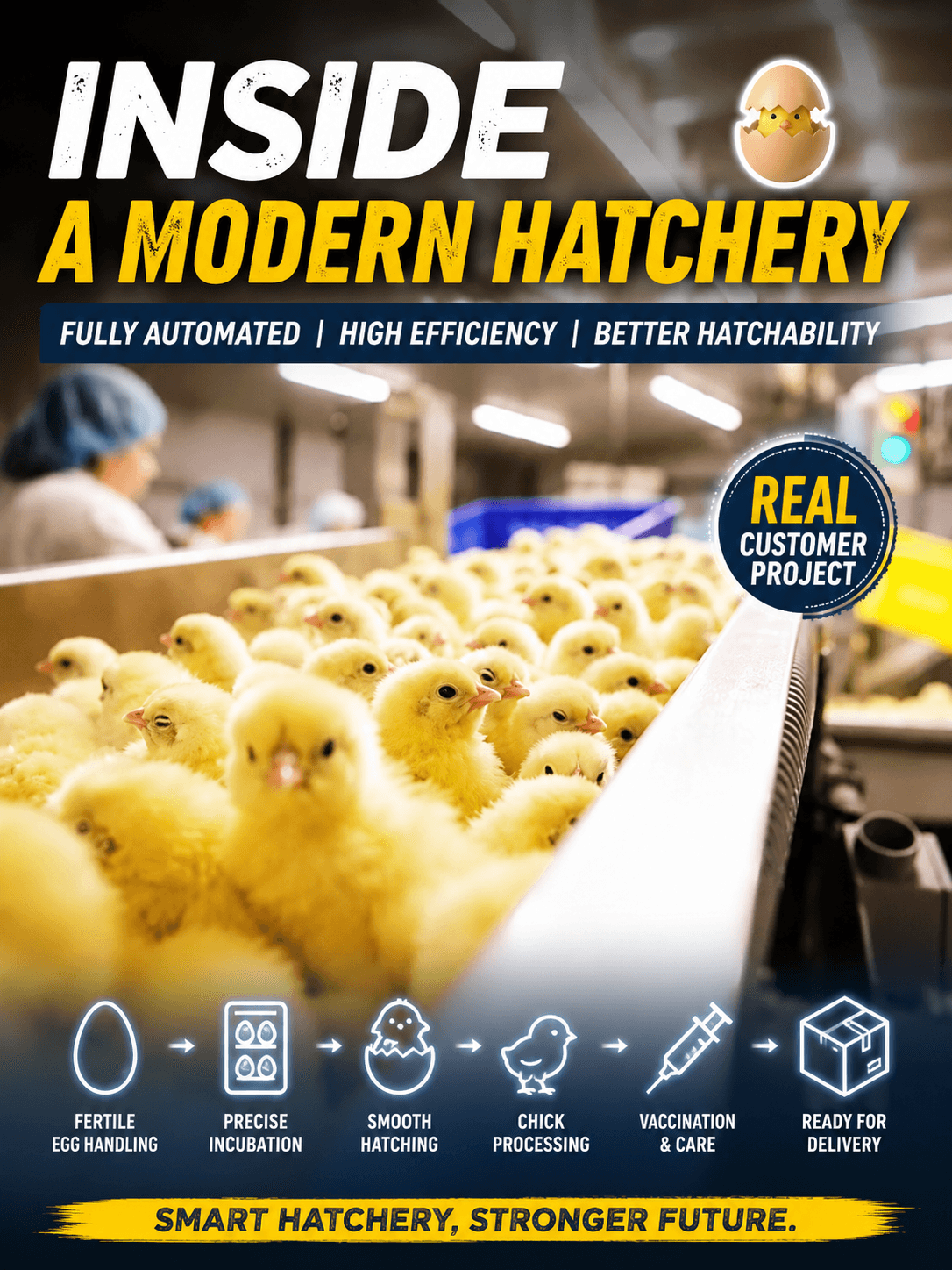
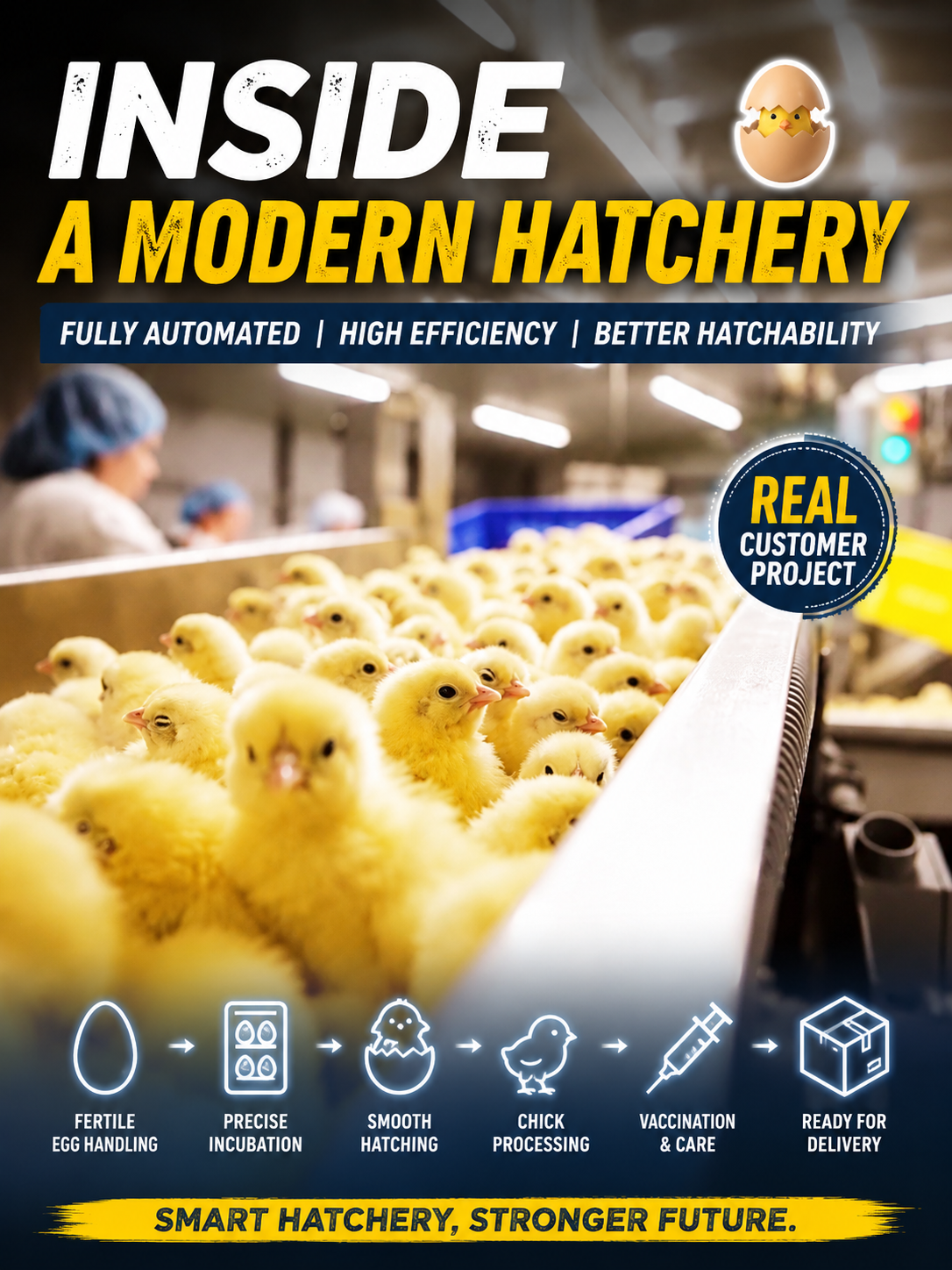
Automated hatchery solutions help poultry groups move from isolated machines to a more predictable day-old chick workflow. Buyers usually search this topic when manual transfer, vaccination, beak treatment, conveying, or stacking creates labor pressure and unstable output during peak production.
Jili supports modular planning through products such as the Day-Old Chick Picking and Transfer Machine, Infrared Beak Trimming and Vaccination Machine, Conveying and Stacking Line, and Complete Hatchery Automation Solutions. These modules can be combined according to the real bottleneck, rather than forcing every hatchery into the same equipment list.
Start with the workflow, not the machine list
A strong automation plan starts by mapping how chicks move through the hatchery. Where do chicks arrive? Which station creates waiting? Which operators are correcting flow by hand? What happens after transfer, vaccination, or beak treatment? These answers define the project more accurately than a general request for automation.
Useful automated hatchery solutions connect equipment decisions with output goals, labor planning, and service access. The goal is to make production easier to inspect and easier to scale, not just to add more machines.
Where automation can improve daily operation
- Transfer and picking: reduce manual pressure at the start of chick handling.
- Vaccination: support dose control and repeatable operator routines.
- Beak treatment: stabilize settings, counting, dust blowing, and alarms.
- Conveying and stacking: keep downstream movement organized.
- Crate return or cleaning: prevent support processes from slowing production.
- Line planning: leave space for future modules and maintenance access.
Planning table for buyers
| Project area | Information to prepare |
| Current bottleneck | Transfer, vaccination, beak treatment, conveying, stacking, or crate return |
| Output target | Daily volume, peak hourly demand, and shift schedule |
| Facility layout | Room size, operator access, cleaning route, and downstream movement |
| Labor plan | Number of operators and current manual correction points |
| Module scope | What is needed now and what may be added later |
| Support | Training, spare parts, installation guidance, and service expectations |
How to avoid overbuilding the first phase
Some hatcheries need a complete line immediately. Others gain more value by solving the strongest bottleneck first. A phased plan can begin with transfer, vaccination, beak treatment, or conveying, then reserve space and control logic for later modules.
When discussing automated hatchery solutions, buyers can send photos, floor sketches, production targets, and current labor pain points. This gives Jili enough context to recommend a practical first phase and a realistic upgrade path.
How to turn the plan into a useful RFQ
A good RFQ includes daily chick volume, peak-hour demand, current process flow, room layout, required modules, utility conditions, and the problem the buyer wants to solve. If the hatchery has expansion plans, include them early so the layout can support future growth.
Jili can provide a clearer proposal when the buyer explains the business goal: labor reduction, more stable output, better process control, or a complete connected workflow.
Build the investment case around measurable operating changes
Before approving a project, buyers can define the operating changes they expect from automated hatchery solutions. Useful targets include fewer manual transfers, more stable hourly output, clearer production counting, shorter waiting time between stations, and easier operator training. These measures give the project team a practical way to compare the current workflow with the new line after commissioning.
The review should also include costs that are easy to miss in an equipment-only quotation. Installation preparation, utilities, spare parts, preventive maintenance, operator training, and production ramp-up all influence the real budget. A supplier proposal is more useful when it explains these items and identifies which responsibilities belong to the hatchery team.
For a clearer discussion with Jili, buyers can share a short video of the current process, a marked floor plan, recent peak-hour records, and the points where operators manually correct the flow. This evidence helps the engineering team focus on changes that can improve daily production instead of recommending automation in general terms.
FAQ
What are automated hatchery solutions?
They are connected equipment plans for improving transfer, vaccination, beak treatment, conveying, stacking, washing, or full day-old chick processing.
Does every buyer need a full line?
No. Many buyers start with one bottleneck and build the rest of the line in phases.
What should be prepared before asking Jili for a proposal?
Prepare chick volume, target output, room layout, photos, current labor pressure, and required process modules.
Why does layout matter?
Layout affects operator access, cleaning, maintenance, line handoffs, and whether the system can expand later.
Which Jili page supports broader planning?
Buyers can review Jili Complete Hatchery Automation Solutions for wider project planning.