


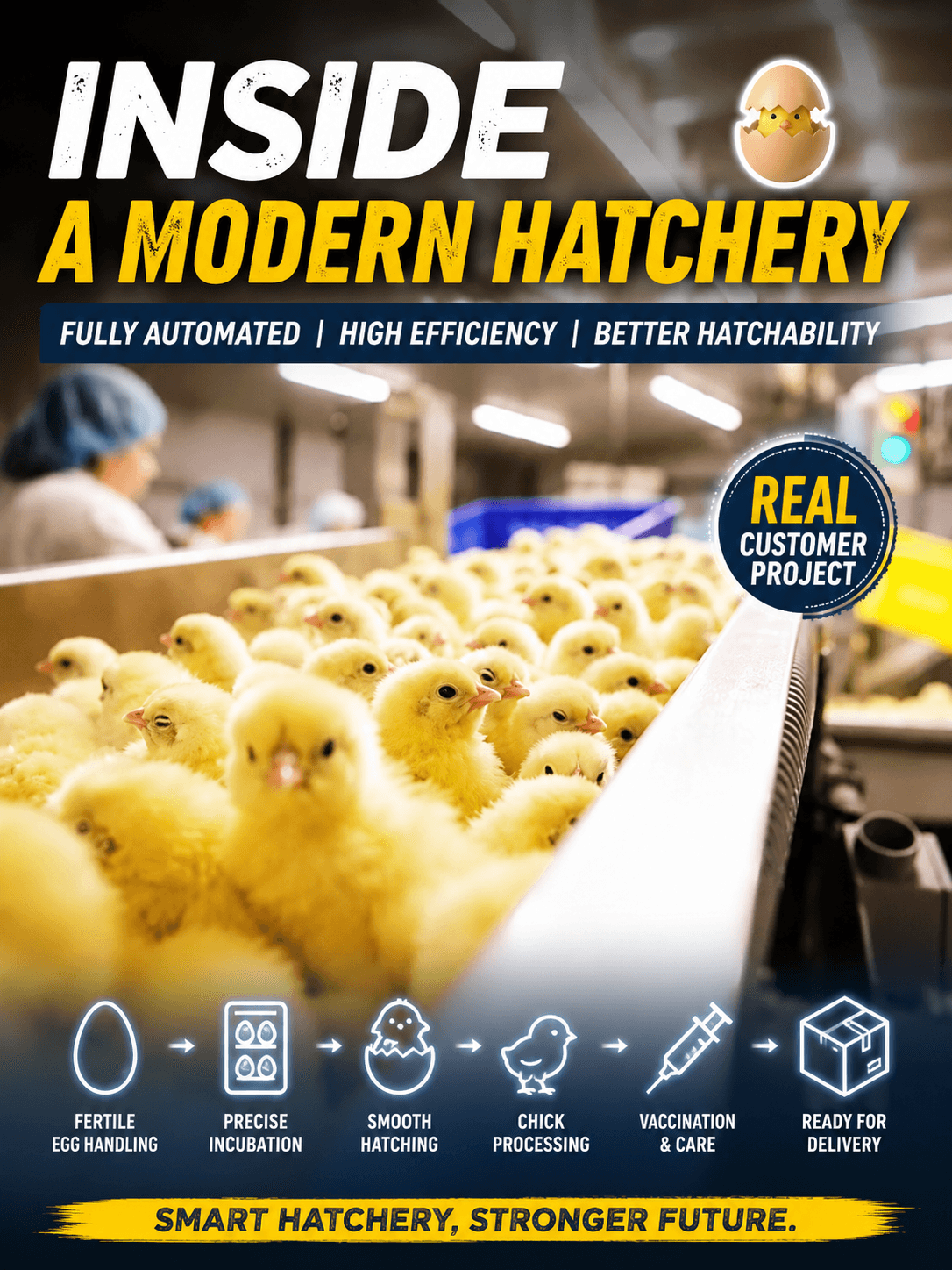
Ask ten hatchery owners what they want from automation and you will hear ten versions of the same answer: fewer people inside the chick room, fewer birds handled twice, crates leaving the dock on time. Put a price on those three things and you are having a hatchery automation return on investment conversation instead of reading a wish list.
The hard part is never the arithmetic. It is deciding which numbers belong in the calculation and which ones quietly flatter the project. Below is the way our team works through it with a buyer, room by room, before anything is quoted.
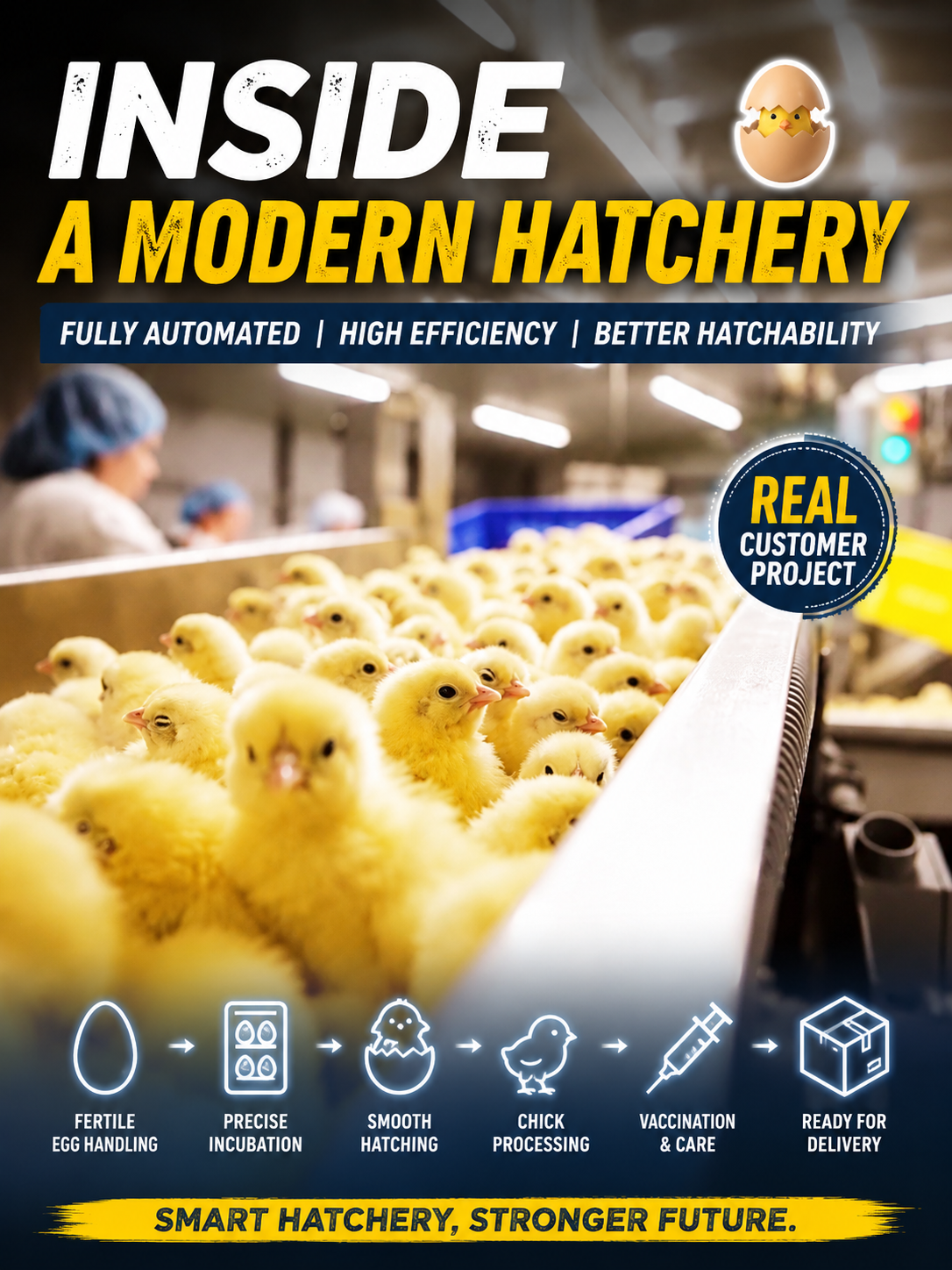
Three payback paths, not one
Most proposals arrive with a single line: labour saved. That is the easiest number to defend and usually the weakest one, because a hatchery rarely dismisses staff after commissioning. People move to other rooms, and the real gain shows up somewhere else.
That is why a credible hatchery automation return on investment is rarely one figure. It is a short list of changes that a plant can actually observe.
Labour released from the chick room
The honest version of this path asks where those hours go. If three operators who spent a hatch night carrying trays now supervise a line and cover cleaning, the saving is not a salary. It is the overtime you stop paying, the temporary crew you stop calling, and the extra hatch day you can absorb without recruiting.
Consistency that survives a bad hatch day
Automated handling gives you the same motion on the ten-thousandth chick as on the first. Fewer dropped birds, fewer double-handled trays, fewer complaints from the farm end. This path is real but it needs a baseline: complaint counts, cull percentages and rejection notes from the last three months, not a memory of last season.
Capacity released without a new building
Sometimes the return is not cost at all. A line that clears the chick room two hours earlier can change truck departure, and a departure that moves earlier can change how many hatch days fit into a week. When a hatchery is turning work away, released capacity is usually worth more than every labour saving combined.
A payback worktable you can fill in during a meeting
The table below is the one we ask buyers to complete before a scope discussion. Blank cells are useful information: they tell you where the case is still a guess.
| Payback path | Baseline to capture | What changes after commissioning | The mistake that inflates it |
|---|---|---|---|
| Labour | Overtime hours, agency shifts, headcount per hatch night | Hours redeployed, overtime reduced, fewer calls to casual crews | Counting a full salary when nobody leaves the payroll |
| Handling quality | Culls, complaints, rework notes from the last quarter | Fewer birds handled twice, steadier treatment timing | Comparing a good week with a bad month |
| Capacity | Hatch days per week, chick-room clearance time, truck windows | Earlier clearance, room for extra volume | Assuming demand exists just because capacity does |
| Uptime | Unplanned stops, emergency spares, call-out cost | Predictable service windows, planned maintenance | Leaving support and spares out of the yearly figure entirely |
The numbers teams forget to count
Four categories explain most of the gap between a projected hatchery automation return on investment and the figure a plant actually experiences two years later.
Second handling and rework
Every time a chick is picked up, put down and picked up again, someone pays for it. Manual rooms rarely record that cost, because it is hidden inside a shift that simply runs long. Walk the hatch day and count touches: the number is usually higher than the process drawing suggests.
Utilities, consumables and cleaning
Continuous crate washing uses water, heat and chemicals on a schedule rather than in bursts. Vaccination stations use needles, disinfectant and gloves at a predictable rate. These lines belong in the annual figure, not in a footnote, and they should be confirmed against the selected configuration rather than copied from another site.
Uptime, spares and after-sales support
A line that stops on a hatch night costs more than the part that failed. Ask what the spare parts plan looks like, how remote support works, and how quickly a technician can be on site. Our service and support structure is described on the service page, and buyers should price it as part of the project rather than as an optional extra.
Learning time
New equipment has a bedding-in period. Operators need to learn the touchscreen, the cleaning routine and the fault list. Planning that time honestly, and training two people per station rather than one, is cheaper than discovering it in week three.
Building the case on one page
Finance committees rarely want twenty pages. They want one page that shows where each number came from and who owns it. This is the format that works in hatchery projects.
| Input | Where the number comes from | Who should own it |
|---|---|---|
| Current labour cost per hatch night | Payroll and rota records, last 12 weeks | Plant manager |
| Baseline handling quality | Cull and complaint logs for the same period | Quality or vet team |
| Capital cost and installation | Written quotation, including site works | Project engineer |
| Running cost per year | Utilities, consumables, service, spares | Maintenance lead |
| Volume assumptions | Bookings and forecast from sales | Commercial lead |
Two rules keep the page honest. First, every input needs a source document, not an estimate passed between colleagues. Second, the assumptions get reviewed at the same time every year. A payback case that is never revisited slowly becomes fiction.
Filling in this page is where a technical preference turns into an approved hatchery automation return on investment. It is also where weak projects quietly reveal themselves, because assumptions that cannot be sourced rarely survive a second meeting.
What quietly destroys the case
The largest risk is not price. It is buying equipment that solves a problem the plant does not have.
A hatchery whose bottleneck sits at vaccination does not gain much from a faster take-off station; the queue simply moves ten metres down the room. A site with no space between the hatcher and the next station cannot benefit from a transfer machine that needs a clean path. And a plant that has not measured its own baseline has no way of proving the gain afterwards, which makes the second phase of an automation programme much harder to approve.
This is why we usually start with a process map rather than a machine list. If the constraint is unclear, the sequence of a hatch day is worth reviewing first, alongside the existing line documentation and the rooms it has to pass through.
How to check the baseline before you commit
Three small exercises make a project approval much easier, and none of them require new equipment.
Run a timed walk of one full hatch day and write down every handover between people. Review the last quarter of quality records against volumes, so seasonal effects are visible. Then list the interfaces the new equipment will touch, including the existing hatchery equipment around it. Published standards help structure these checks: the WOAH Terrestrial Code covers poultry production biosecurity expectations, and ISO documentation such as ISO 9001 gives a familiar frame for records and traceability.
Questions buyers ask about hatchery automation return on investment
How long should payback take?
There is no universal answer, and any supplier who gives one without seeing your numbers is guessing. Projects that focus on a genuine bottleneck tend to move faster than projects justified mainly by headcount, because released capacity and reduced overtime appear on the books sooner than a payroll decision.
Can we measure the gain after installation?
Yes, if the baseline was recorded before. Capture labour hours, handling quality and clearance time for four to six weeks, then repeat the measurement two months after commissioning. The comparison is usually more persuasive internally than any quotation document.
Should we automate the whole room at once?
Not necessarily. Many plants phase a programme so that each stage releases capacity for the next, and an integrated line can be planned with the later stages in mind even when only part of it is installed first.
Where does support sit in the calculation?
Support, spares and training belong in the annual running cost. Treat them as part of the project, and ask for the plan in writing. Practical details are collected in our FAQ section.
Where to take it next
If you already know which part of the hatch day hurts, send us the process, the volumes and the rooms involved. JuliSense designs, builds and commissions day-old chick processing equipment and integrated hatchery lines, and we would rather argue about your bottleneck than sell you a machine that sits idle. Start with an outline on the hatchery automation solutions page, read more about the company on about us, or send the numbers directly through contact us for a scope-based review.
Get the constraint right first, and the hatchery automation return on investment tends to look after itself.