


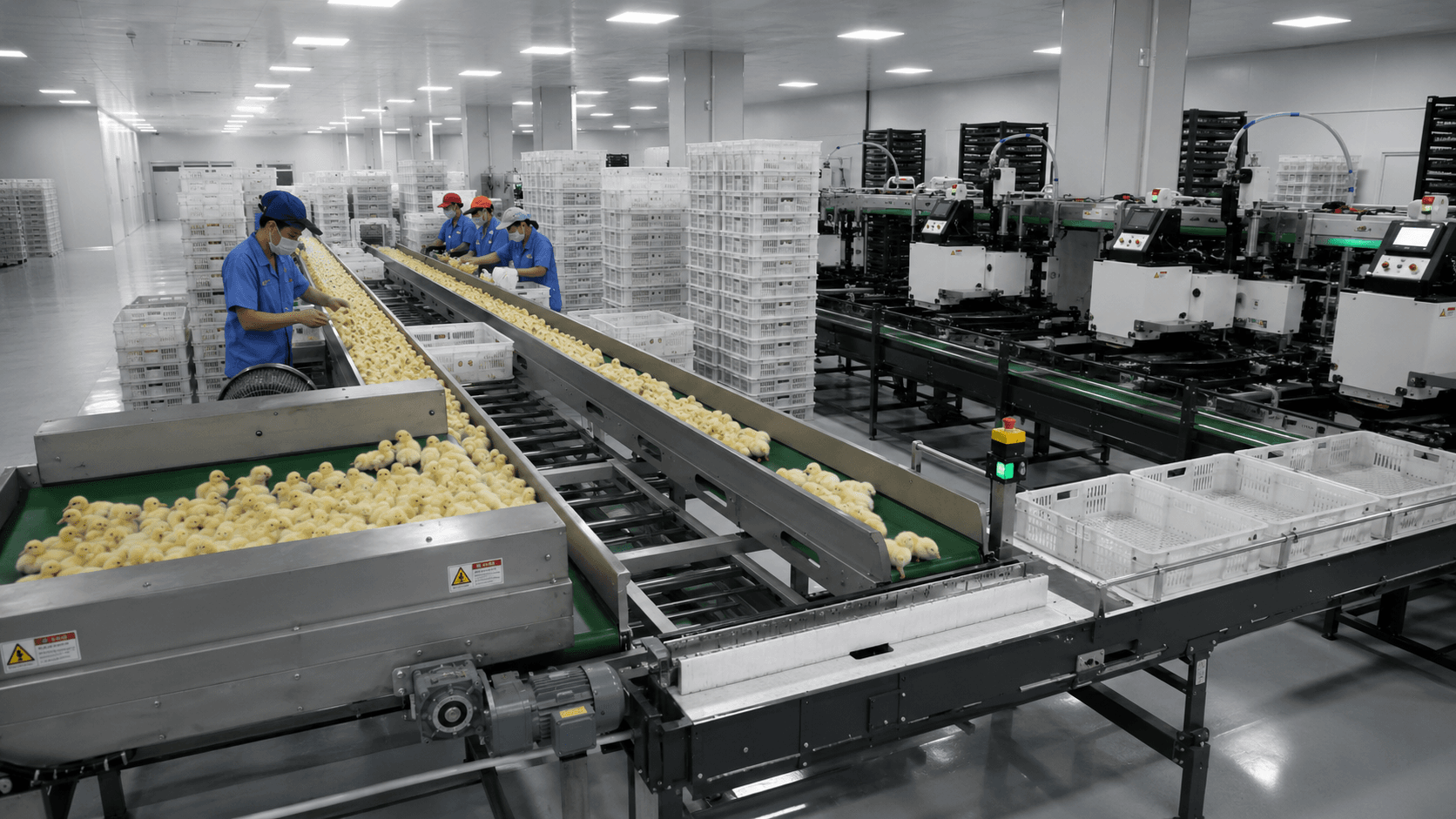
A touchscreen does not make hatchery equipment intelligent. Neither does a network cable or a dashboard filled with numbers. Intelligent poultry hatchery equipment should help people run the process more consistently: operators can see what is happening, connected stages respond in a coordinated way, common interruptions are easier to recover from, and recorded information supports a real decision.
That definition is more useful to a buyer than the word "smart." It shifts the conversation from how modern the machine looks to what the hatchery team can do better after installation.
Picture the Monday-Morning Production Meeting
The previous shift finished late. The manager asks why. One operator remembers a stop near the treatment area. Another thinks empty crates were delayed. Maintenance saw several alarms but cannot tell which one caused the longest interruption. The production count is available, yet it does not explain the lost time.
Now imagine the same meeting with clearer equipment state, coordinated stop records, protected settings, and a shared timeline across connected modules. The team may not receive an automatic answer, but it has reliable evidence. It can decide whether to adjust staffing, investigate a recurring fault, change the crate plan, or revise the startup sequence.
That is the practical value of intelligence: better control during the shift and better decisions afterward.
A Five-Level Maturity Model for Buyers
Not every hatchery needs the highest level on every machine. A standalone replacement project may only require clear local controls and dependable recovery. A new integrated line may need coordinated states and production information across several modules. The model below helps buyers describe the level that serves the business problem.
Level 0: The Machine Performs the Task
At the first level, equipment mechanizes a physical operation, but people coordinate most of the work around it. Operators start and stop locally, remember settings, and communicate delays verbally. Production counts and downtime may be recorded elsewhere.
This can still be useful equipment. The limitation appears when output depends heavily on individual memory or when a stop at one station creates confusion in the rest of the line.
Level 1: Operators Can See and Repeat the Process
At this level, the interface shows a clearer machine state. Important settings can be stored or protected, alarms identify the affected area more precisely, and startup follows a repeatable sequence.
The customer benefit is not a more attractive screen. It is that a trained operator can understand the current condition and repeat approved work with less improvisation. Buyers should ask to see a normal startup, a setting change with the correct access level, and recovery from a common alarm.
Level 2: The Equipment Records Useful Events
The next step is trustworthy data. Counts, stops, alarms, settings, or batch information may be recorded with enough context to support review.
More data is not automatically better. A list of hundreds of alarm messages can create work without creating insight. The useful question is, "Which decision will this record improve?" If the answer is recurring-fault analysis, the event needs a time, location, duration, and clear meaning. If the answer is batch review, the production record needs a reliable way to connect with the batch.
Level 3: Connected Modules Coordinate Their Behavior
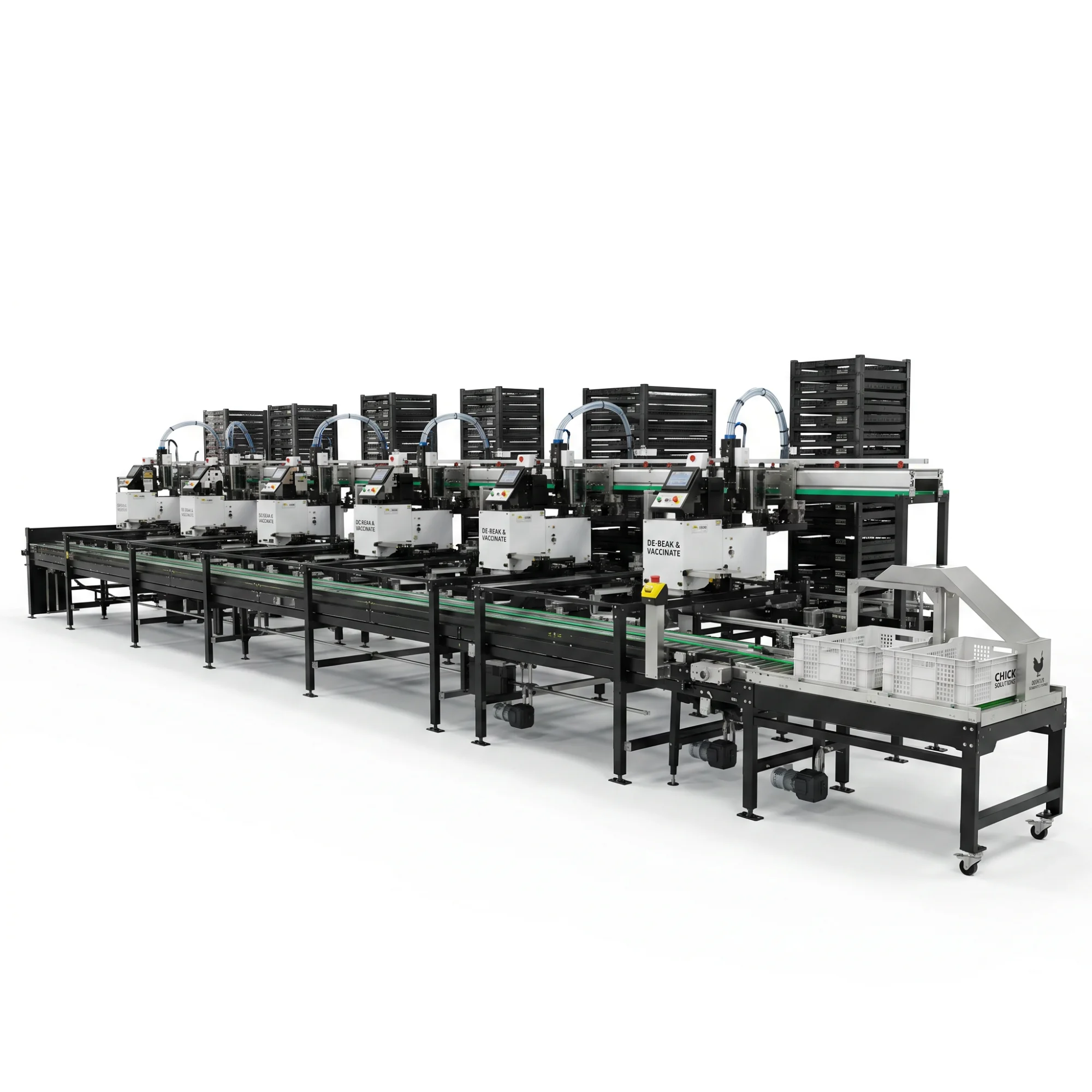
In an integrated chick processing line, one machine should not continue blindly when the next area cannot receive work. Level 3 equipment exchanges meaningful states such as ready, running, blocked, full, stopped, or faulted. Buffers and upstream modules respond according to agreed rules.
This is where hatchery automation becomes a system rather than a row of separate machines. The most revealing test is a downstream blockage: does the line slow or stop in an orderly sequence, protect suitable waiting areas, show operators what happened, and restart without sending a second surge into the same bottleneck?
Level 4: Information Changes Management Decisions
At the highest level in this model, the hatchery uses reliable operating information to improve planning, maintenance, quality review, or capacity decisions. The value does not come from storing everything. It comes from connecting a trusted record to an owner and an action.
For example, repeated short stops at one transfer may lead maintenance to inspect a specific component. A pattern of late crate supply may change shift preparation. Different recovery times between teams may reveal a training need. The equipment supports the decision, while management remains responsible for acting on it.
Score the Outcome, Not the Feature List
When comparing proposals, ask each supplier to demonstrate the operating outcome behind the feature.
| Buyer question | Evidence worth seeing |
|---|---|
| Can operators understand the state? | Clear normal, waiting, blocked, and fault displays |
| Are settings repeatable? | Protected access, saved parameters, and change records where needed |
| Can the line recover? | Controlled stop, clear action, reset condition, and ordered restart |
| Do modules coordinate? | Demonstrated cause-and-effect between connected stages |
| Is the data trustworthy? | Defined source, timestamp, context, retention, and ownership |
| Can the site support it? | Backup, access control, documentation, training, and support boundary |
A supplier does not need to use the same terms as this table. It does need to show what the system actually displays, records, exchanges, and protects.
One Upgrade Can Be Smarter Than a Large Data Project
Consider a hatchery where supervisors spend every afternoon reconciling production counts from several stations. It may be tempting to begin with a site-wide analytics platform. But if the underlying counters use different definitions or batches are not identified consistently, the new dashboard will only display disagreement more quickly.
A better first step may be to agree on what each count means, confirm where it is created, and make the relevant batch reference consistent. Once the source is trusted, reporting can expand. This smaller change may produce more value than collecting a larger volume of uncertain data.
The same logic applies to alarms and integration. Solve the operating problem at its source before adding layers of visibility around it.
Questions About Ownership Matter Early
Intelligent equipment creates responsibilities that a standalone mechanical purchase may not. Someone must approve user access, manage backups, maintain network connections, interpret records, and decide how software or control changes are handled.
These duties can sit with the hatchery, the supplier, a local integrator, or a combination of parties. The proposal should make the boundary visible before commissioning. Otherwise, a useful function can become unavailable because no one owns the surrounding process.
The Julisense hatchery automation system planning guide provides additional context for defining these responsibilities across a larger project.
How Jili Intelligent Fits the Model
Jili Intelligent, the company behind Julisense.com, describes its work as supporting stable, replicable, data-driven intelligent production on its company page. Its published product range includes standalone machines and connected modules for chick treatment, vaccination, transfer, conveying, stacking, and crate handling.
For buyers evaluating intelligent poultry hatchery equipment, this range supports conversations from local equipment control through coordinated line automation. A higher maturity result still depends on the exact controls, data scope, site processes, interfaces, and management use case agreed for the project. Buyers should not infer a complete analytics system from the word intelligent. They should ask what the quoted configuration does and request a demonstration of the relevant functions.
Jili Intelligent's automation services can also be reviewed when the project includes broader planning, installation, or integration needs.
Frequently Asked Questions
Does intelligent equipment require a fully automated hatchery?
No. A standalone machine can improve state visibility, setting control, alarm clarity, and repeatability. The appropriate level depends on the operating problem and how the equipment connects with the site.
Is more production data always better?
No. Record data that has a clear meaning, a reliable source, an owner, and a decision it can improve. Unused or poorly defined data adds complexity without helping the hatchery.
What should buyers ask to see in a demonstration?
Ask to see normal startup, operator status, protected settings, a common interruption, controlled recovery, relevant records, and the behavior of connected modules when one area is not ready.
Intelligence Is Measured in Better Decisions
Intelligent poultry hatchery equipment should give the team clearer state, more repeatable work, better coordination, and information that changes a real decision. It should not add screens, data, or interfaces without an operating purpose.
Send Jili Intelligent your current process map, recurring control problems, stop history, desired integrations, data questions, site layout, and expansion plan through the contact page. Ask the proposal to identify the maturity it supports function by function.
Reference Point
- NIST Smart Manufacturing Systems Design and Analysis Program provides general reference material on smart manufacturing systems. The maturity model in this article is a practical purchasing framework, not a NIST standard.