



Poultry hatchery automation capacity planning should answer how a route behaves on a normal day, a peak day, and a recovery day. It is not a single number copied from a machine nameplate. Capacity depends on release pattern, handoffs, buffers, staffing, cleaning, utilities, and the point where output is accepted.
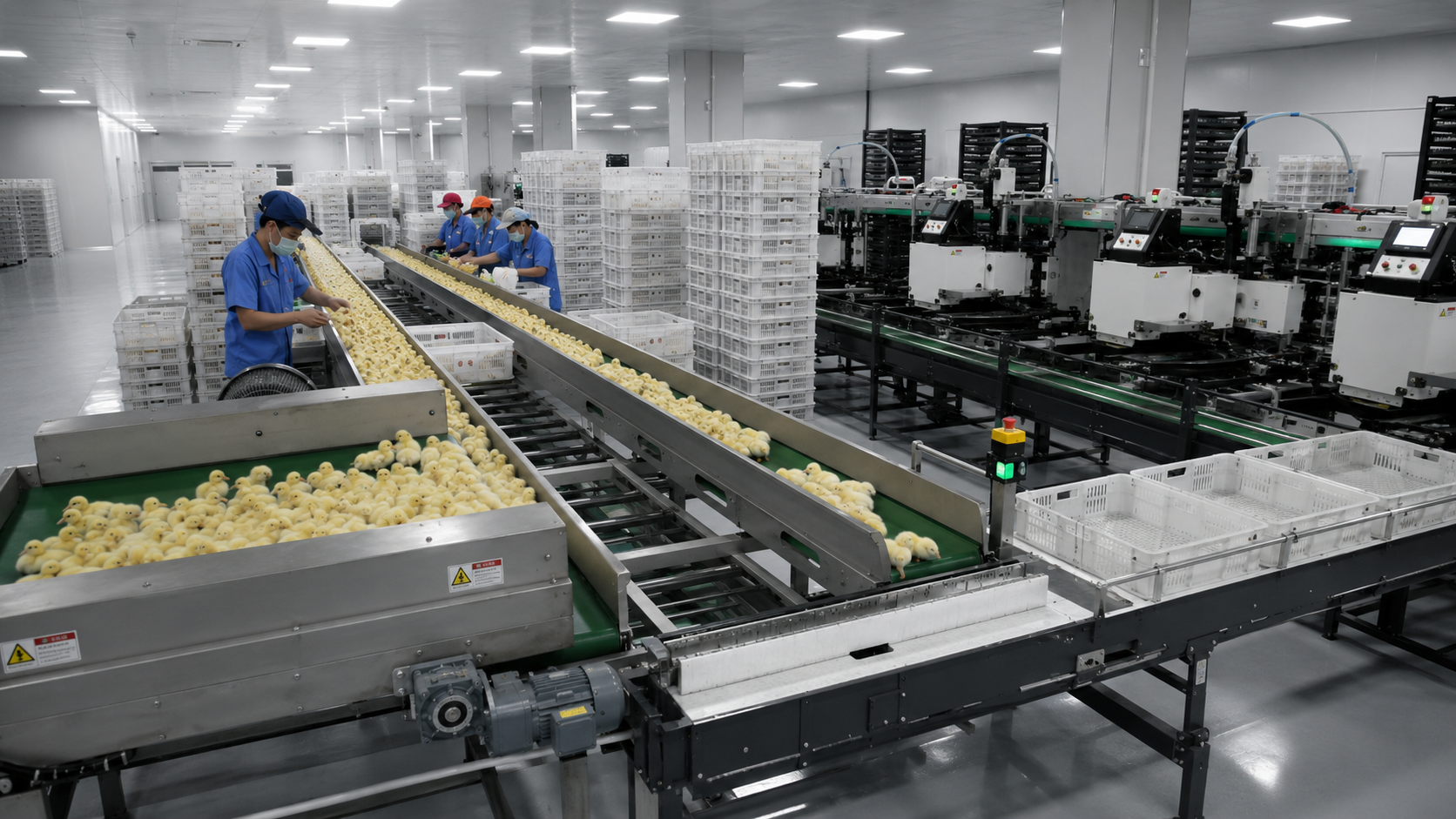
JuliSense can help buyers connect selected modules to a complete operating route. Use the three-scenario method to make a capacity discussion understandable to production, engineering, procurement, and finance.
Scenario A: The Normal Shift
Describe the expected batch pattern, operating window, staffing, breaks, planned cleaning, container supply, and dispatch rhythm. Calculate accepted output after ordinary pauses and handoffs, not just the fastest machine cycle.
Start at release
Record when work becomes available, who authorizes movement, and how identity is carried forward. A machine waiting for release is not producing at its rated speed.
End at acceptance
Define when downstream staff or equipment accepts the load. The poultry hatchery automation capacity planning basis should stop at a measurable result.
Scenario B: The Peak Window
Use the largest normal surge, shortest arrival interval, or busiest dispatch period the hatchery expects to handle. Mark queue length, buffer capacity, operator response, and the point where a short mismatch becomes a lost shift.
Make the buffer explicit
Give each buffer a capacity, release rule, identity method, and full response. A buffer can absorb a short difference; it cannot fix a permanently slow station.
Test the next handoff
If the receiving zone is full, trace loads already moving, warnings, stop behavior, manual access, and restart ownership. That is where many poultry hatchery automation capacity planning assumptions fail.
Scenario C: Recovery After a Stop
Choose a five-minute stop, sensor disagreement, empty consumable, delayed collection, power interruption, or planned sanitation pause. Record the committed loads, safe holding, recovery sequence, and time to return to stable flow.
Count recovery, not only restart
A motor running again does not mean the route has recovered. Include clearing, verification, batch reconciliation, operator communication, and downstream catch-up.
Define a red line
State when the operator stops, when a supervisor decides, and when technical support is called. ISO 12100 provides a general machinery risk-assessment framework.
Convert Rated Speed to Usable Capacity
List speed losses from loading, alignment, inspection, container variation, cleaning, changeover, manual recovery, and downstream collection. Use a transparent calculation with measured or clearly labeled assumptions.
Keep people in the model
Map who releases, observes, loads, clears, records, cleans, and escalates. Two tasks may share one person only if travel and response are realistic.
Keep utilities in the model
Power, air, water, drainage, network, and ventilation can constrain available time. The poultry hatchery automation capacity planning document should name point-of-use evidence.
Compare Options on One Page
Put current operation, minimum intervention, staged modules, and wider integration in columns. Use the same normal, peak, and recovery scenarios for each option.
Show what changes
For every option, list capacity basis, staffing, buffers, local work, downtime, testing, training, spares, and future expansion. This helps a buyer see why a proposal costs more or less.
Avoid false precision
Use ranges when the site has not measured a peak or accepted output. Explain which decision would change if the assumption moves. WOAH standards provide relevant animal-health context for the operating environment.
Plan the Test Around the Scenarios
Factory and site testing should include representative inputs, normal flow, a full zone, a planned stop, a fault, restart, cleaning access, records, and operator action. Acceptance should demonstrate the agreed capacity basis, not an undefined promise.
Give every test an owner
Record setup, expected result, evidence, deviation, action, and closure authority. Keep customer, supplier, and local work boundaries visible.
Observe the first shifts
Compare actual accepted output and recovery behavior with the planning scenarios. Feed findings into maintenance, training, and expansion decisions.
Ask JuliSense for a Scenario-Based Proposal
Send the process map, workload pattern, room plan, equipment list, containers, utilities, staffing, dispatch condition, destination, and project window. Review JuliSense products, services, and complete automation solutions.
What is the next useful question?
Ask which measurement would most change the proposal: peak arrival, buffer limit, accepted output, cleaning window, or recovery time. Use the JuliSense contact page to discuss poultry hatchery automation capacity planning with those scenarios attached.
Build the Capacity Data Sheet
Before asking for a quotation, create one sheet with date, batch, release interval, operating window, staff on duty, container condition, planned pause, accepted output, reject count, queue length, cleaning time, and dispatch condition. Add a note when a value is estimated rather than measured. This gives the poultry hatchery automation capacity planning discussion a common evidence base.
Capture three representative periods
Choose a normal period, a peak period, and a recovery period after an interruption. The point is not to collect perfect data. It is to show how the route behaves when conditions change. Ask production and maintenance to sign off on the interpretation so the calculation does not become an engineering-only document.
Turn gaps into project actions
If peak arrivals are unknown, schedule a count. If utility capacity is uncertain, measure at the point of use. If dispatch is the constraint, observe the collection window. If staffing changes by shift, map each role. A supplier can then quote an option with a stated confidence level instead of adding a hidden allowance.
When the route is installed, compare the three scenarios with observed operation and agree which deviations require correction, training, or a revised production plan. Share the data sheet with JuliSense through the contact page.
Make Capacity a Shared Language
Production may say “we need more output,” engineering may say “the machine is fast enough,” and finance may ask for a payback. Use the three scenarios to translate those statements into release, accepted output, staffing, buffer, cleaning, recovery, and dispatch evidence. This makes a capacity meeting less argumentative because each participant can point to the same time line.
When a scenario cannot be measured yet, create a short data-collection action with a date and owner. When a supplier proposes an option, ask which scenario it addresses and what it assumes about the rest of the route. Keep the capacity sheet with the layout and acceptance plan so a late design change cannot silently change the promised basis.
Keep the scenario basis beside the quote
Attach the normal, peak, and recovery definitions to the supplier response. If a quotation changes the operating window, staffing, buffer, or downstream acceptance point, record the difference clearly. The customer can then choose whether to change the requirement or request a different solution. A shared basis turns poultry hatchery automation capacity planning into a design conversation rather than a debate over isolated numbers.
Recheck after a design freeze
Keep the scenario worksheet beside the approved layout and test plan.
Keep the review practical
Use short tables, marked-up drawings, observed practice, and named actions so the article can become a useful project conversation. Ask the customer team to bring the people who release work, maintain equipment, clean the room, approve local services, and receive finished output. Their combined view often reveals a constraint that a single department cannot see. Record the answer, the owner, and the next review date. This keeps the recommendation useful after the initial quotation and gives JuliSense a clear basis for the next engineering step.
Review the evidence again before approval.