


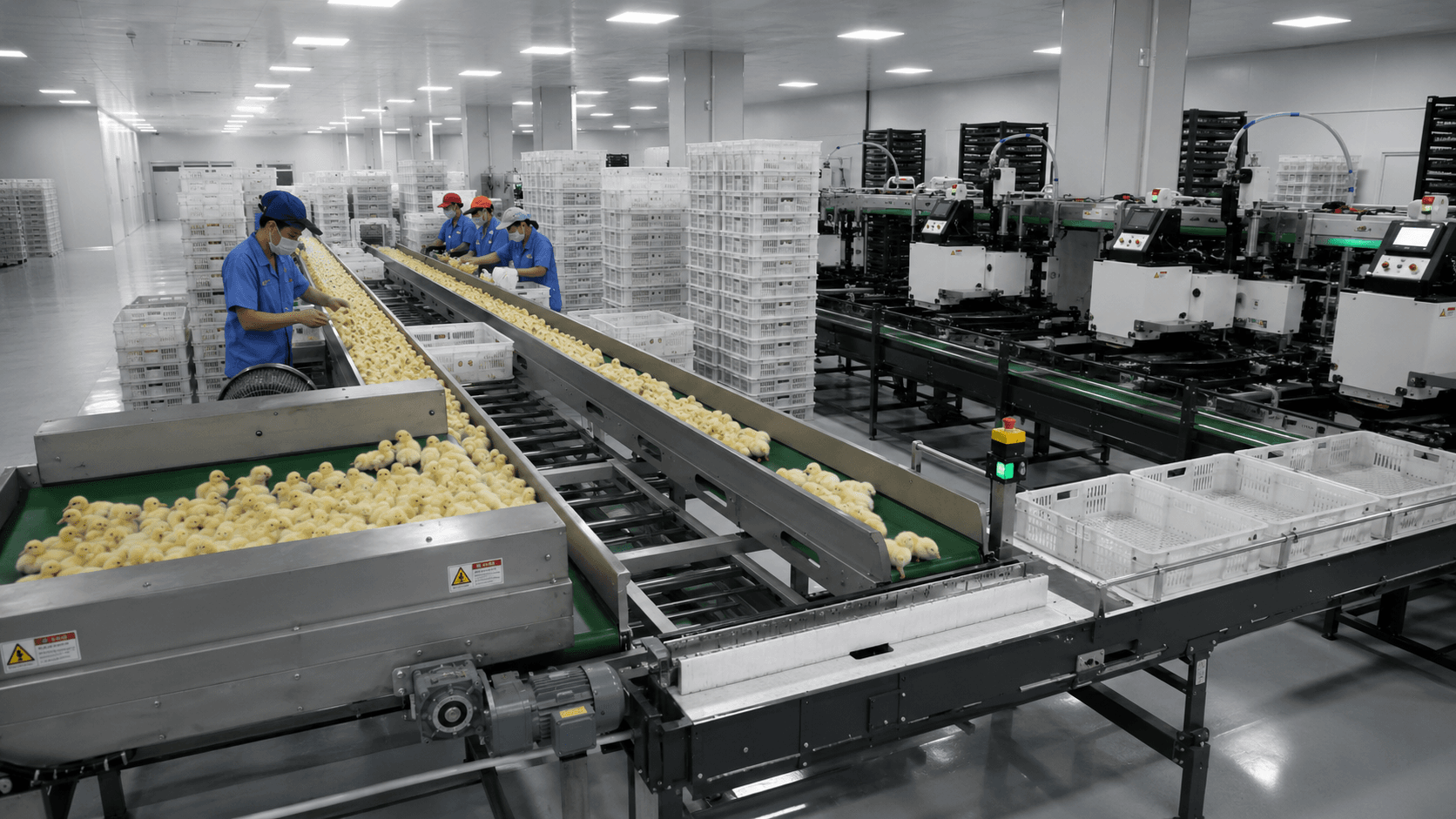
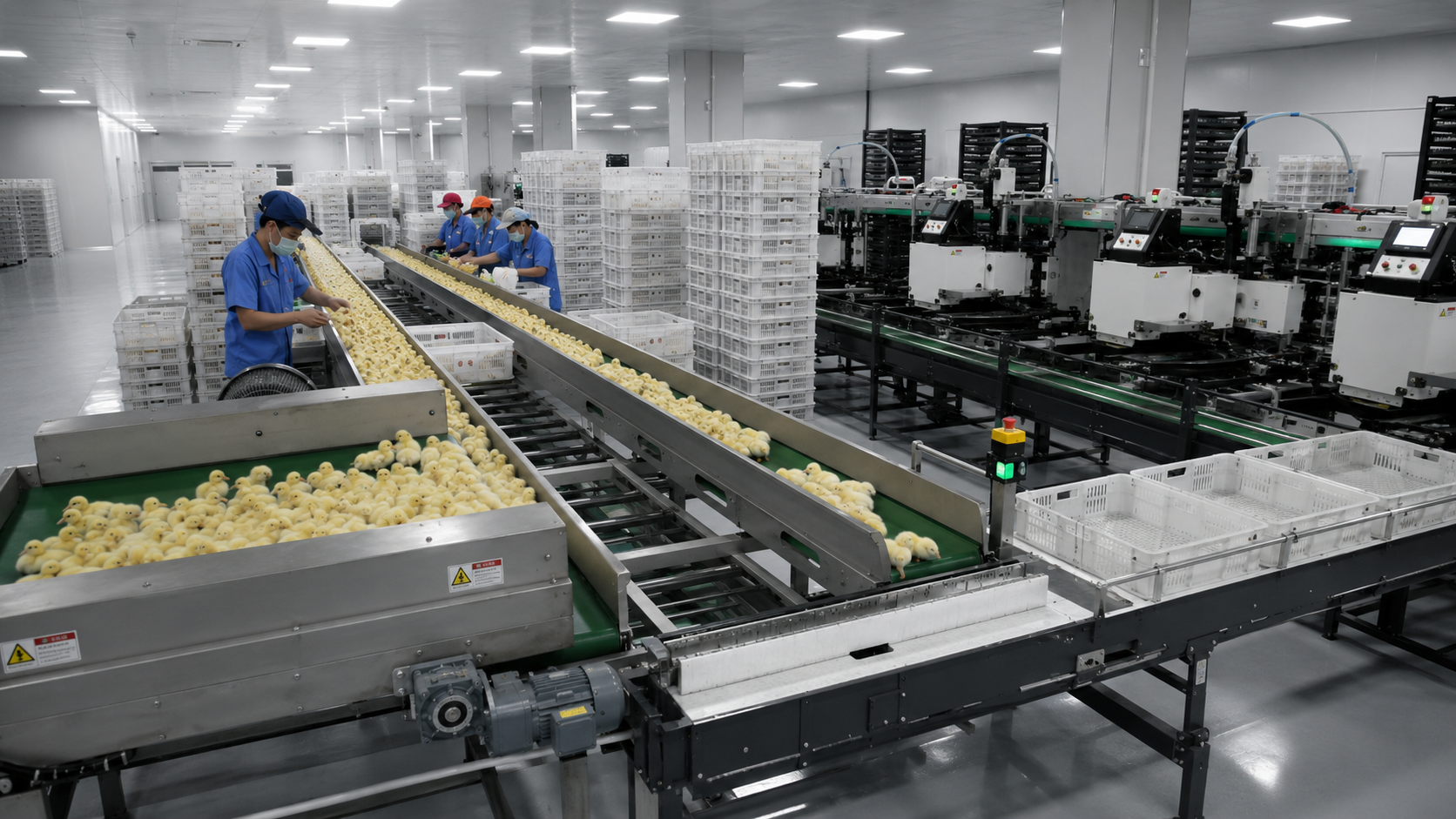
Stand in the chick room at the end of a hatch day and watch where the line slows down. It is almost never the middle of a machine. It is the point where one machine hands over to the next: the tray that arrives at the wrong angle, the transfer that waits for a vaccination head, the stack that grows because nobody owns the exit.
Poultry hatchery automation line integration is the work of designing those handovers deliberately. Machines are usually the easy part. The boundaries are where projects succeed or stall.
Start with the boundaries, not the machine list
A connected line has four places where ownership changes. Each one is a design decision, and each one needs a name attached to it before installation rather than after.
Working through them in this order is what makes poultry hatchery automation line integration predictable rather than experimental.
Boundary one: the hatcher tray
Everything downstream depends on how chicks leave the tray. Angle, depth, shell load and the wetness of the tray all travel with the birds. If the take-off or separation station is expected to cope with whatever arrives, the rest of the line inherits an unpredictable input. Deciding the acceptable tray condition is a hatchery decision, not a supplier decision, and it should be written down.
Boundary two: take-off and counting
This is the busiest handover in the room. Chicks leave the tray, are separated from shells and debris, and enter the processing path in a single direction. Where counting sits at this boundary, the count becomes the signal the rest of the line runs on, so it pays to agree whether it is used for traceability, for packing targets, or for both.
Boundary three: treatment and vaccination
Beak treatment and vaccination are often planned as one integrated station because separating them creates a second handling event. Integration here means more than bolting two heads together: the transfer between treatment and injection has to hold the bird in a controlled position, and the timing has to match the rated cycle of the slower head.
Boundary four: dispatch and crate flow
The exit is the boundary that most site surveys shorten. Chicks move into crates, crates move to stacking, and the dock has a departure window that does not move because a line started late. Crate washing sits in this picture too, because the crate that leaves today comes back tomorrow.
An ownership matrix keeps integration honest
Most disputes during commissioning are not technical failures. They are cases where two parties each assumed the other had covered a boundary. The matrix below is short on purpose, and it is worth completing before the purchase order.
| Boundary | Functional question | Typical owner | Evidence to agree on |
|---|---|---|---|
| Hatcher tray | What tray condition is acceptable at the infeed? | Hatchery operations | Written tray standard and a sample check |
| Take-off and counting | What does the count control downstream? | Hatchery plus supplier | Signal list and counter resolution |
| Treatment and vaccination | Which head sets the line cycle time? | Supplier and vet team | Cycle test on agreed settings |
| Dispatch and crate flow | Who owns the exit buffer when the dock is blocked? | Hatchery logistics | Layout drawing and buffer size |
What changes when the line becomes one system
Once the four boundaries are agreed, three things change in the room.
The line gains a single rhythm. Instead of each station running at whatever pace its operator prefers, throughput is set by the slowest head and everything upstream learns to wait. That sounds like a constraint. In practice it is the reason counts match at the end of the day.
It is also the most visible benefit of poultry hatchery automation line integration: fewer decisions made by whoever happens to be closest to the problem.
Faults become visible earlier. When stations share signals, a blocked chute at the far end shows up as a stopped infeed instead of a pile of chicks behind a curtain. Alarms that used to be discovered by walking the room become something the supervisor can see.
Cleaning windows get longer. A connected line is stopped as a unit, which means sanitation is planned rather than squeezed between stations. Hatcheries often underestimate how much this changes the night shift.
Layout questions that decide the result
Three measurements decide more than any feature comparison.
Walking distance between stations: poultry hatchery automation line integration is easier when operators can see both sides of a handover. Long, blind transfers need more monitoring and more maintenance.
Service access on both sides: a machine pushed against a wall is a machine that gets cleaned less often. Plan a service aisle even if it costs floor space, because maintenance will happen in that space whether or not it was drawn.
Direction of crate traffic: crates that enter the chick room clean and leave stacked should not cross the path of crates waiting to be washed. Where they must cross, the crossing belongs in the risk register.
These points sit naturally alongside the room-level planning described on the complete hatchery automation solutions page, and with the layout documentation we prepare during the service and integration phase.
An integration readiness checklist
Before a supplier quotes a connected line, six items should be answerable without guessing. In our experience, projects that arrive with all six move through design noticeably faster.
| Item | Why it matters | Who usually prepares it |
|---|---|---|
| Room drawing with dimensions | Sets transfer lengths and service aisles | Hatchery engineer |
| Hatch-day sequence and volumes | Defines cycle time and buffer sizes | Plant manager |
| Existing equipment list | Identifies interfaces that must be reused | Maintenance lead |
| Utility supply points | Power, water, air and drainage at point of use | Facilities team |
| Hygiene zoning map | Keeps clean and dirty routes separate | Quality team |
| Site rules for contractors | Installation window, PPE, permits | Site management |
Hygiene zoning is the item most often left to the end. Published guidance is useful here: the WOAH Terrestrial Code sets out biosecurity expectations for poultry production, and quality systems built around ISO 9001 give a familiar structure for records and traceability when a buyer audits the project.
Questions buyers ask about line integration
Can we integrate with equipment we already own?
Often yes, but the decision depends on interface details rather than brand. Heights, transfer directions, signal types and control philosophy all need checking, and a site survey is the fastest way to confirm what can stay. New modules are frequently planned so that existing stations remain usable in the first phase.
Does the whole room have to be replaced at once?
No. Phased integration is common, provided the reserved space and interfaces for later stages are agreed in the first drawing. Buying a line without that forward planning is what makes the second phase expensive.
Who tests the handovers?
The handovers are tested as part of commissioning, with the hatchery present, using the settings agreed for the site. A written acceptance record for each boundary prevents a long argument in month three.
How do we judge whether integration worked?
Count the interruptions, not the features. A well-integrated line has fewer unplanned stops, fewer manual rescues between stations and a count that reconciles at the end of the shift. That reconciliation is the clearest everyday sign that poultry hatchery automation line integration has done its job.
Bring us the room, not just the machine
JuliSense designs and builds day-old chick processing equipment and connects it into working lines, from infrared beak treatment and vaccination stations through conveying and stacking to crate washing. If you are planning poultry hatchery automation line integration, send the room drawing, the hatch-day sequence and the volumes, and we will tell you which boundaries need deciding first. Product families are listed on the products page, background is on about us, common questions sit in the FAQ, and project enquiries can go straight to contact us.