

Poultry Hatchery Automation Supplier in China: The Evidence Pack Global Buyers Should Request
Choosing a poultry hatchery automation supplier china is not mainly a search for the lowest equipment price. The real question is whether the supplier can turn your hatchery’s approved process, room limits, operator work, interfaces, and support needs into a project that can be checked before shipment and supported after installation.
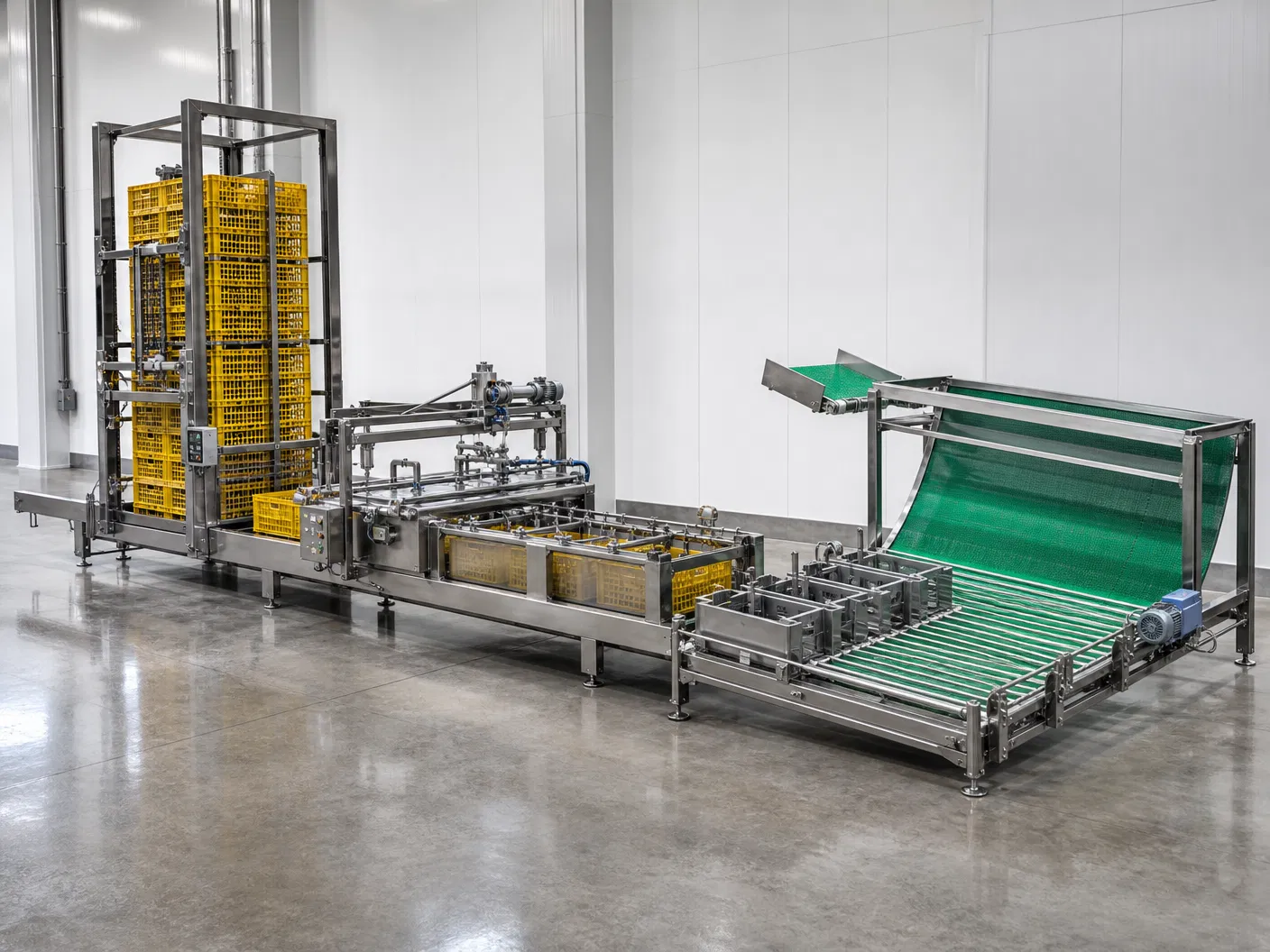
JuliSense works with hatchery equipment, day-old chick processing, vaccination-related stations, conveying, stacking, and integrated automation. For an overseas buyer, the most useful first step is to compare the evidence behind a proposal—not just the product photograph or a headline capacity.
Start With the Buyer’s Project, Not the Supplier’s Brochure
A supplier may describe a machine as “automatic,” but that word does not explain how chicks arrive, where operators stand, what happens when a downstream machine pauses, or who owns the cleaning and release decision. Before requesting quotations, prepare a short project brief with:
- approved application and chick age;
- normal and peak batch pattern;
- current handling method and the problem to improve;
- room layout, utilities, access, and downstream equipment;
- operator positions, shift pattern, and cleaning boundary;
- required records, acceptance tests, destination, and target timing.
This information gives a poultry hatchery automation supplier china a fair opportunity to propose the right scope. It also prevents three suppliers from quoting three different interpretations of the same sentence.
The Supplier Evidence Pack: Six Folders That Make a Proposal Reviewable
Instead of asking for “all technical documents,” ask for six practical folders. Each folder should show what is included, what is assumed, and what the customer must provide.
1. Application-fit evidence
Ask the supplier to connect the proposed equipment to your approved production task. The response should identify the application, chick presentation, consumables, change parts, operator controls, guarding, and adjustable parameters that are actually included.
If the project includes beak trimming, vaccination, sorting, transfer, conveying, or stacking, request a simple process view. You should be able to see where the proposed equipment starts, where it ends, and what happens before and after it.
JuliSense product information can help you review the available equipment families, but the final configuration still needs to be matched to your room, process, and local requirements. Browse the JuliSense products before the supplier meeting and mark the modules relevant to your project.
2. Layout and interface evidence
Request a dimensioned layout, working heights, access zones, maintenance removal path, utility connection points, and interface list. A polished 3D picture is useful for discussion; it is not a substitute for dimensions and responsibility boundaries.
For every connection, ask four plain questions:
- What physical, electrical, control, data, or utility connection is required?
- Who supplies and installs it?
- How will it be tested?
- What happens if the other side is not ready?
This is especially important when a Chinese supplier is integrating equipment from several manufacturers or connecting to machinery already installed in another country. The interface list should name the signal, direction, expected state, and test owner rather than simply saying “communication available.”
3. Factory and site-test evidence
A reliable poultry hatchery automation supplier china should be willing to describe how the equipment will be demonstrated before shipment and after installation. Ask for a draft factory acceptance test and site acceptance test, even if the final documents will be agreed later.
Include representative inputs, normal operation, planned stops, alarms, restart, changeover, records, cleaning access, and connected interfaces that are within the agreed scope. If the supplier cannot test a customer-specific input in China, ask what substitute will be used and how the open point will be closed on site.
For machinery risk work, ISO 12100 provides a useful general framework for identifying hazards and reducing risk. The destination country and customer approvals still govern the final project.
4. Documentation and language evidence
Cross-border projects often become difficult after the equipment is mechanically complete. Ask for a document index that covers drawings, operation, maintenance, cleaning access, spare parts, software or parameter backups, alarm lists, inspection points, and revision history.
Confirm the delivery language and format before the purchase order. A translated summary may help management, while operators and maintenance staff may need clear working documents with consistent names for components and controls.
You can also ask how revisions are controlled. ISO 9001 offers useful quality-management principles for controlled information, but the supplier should explain its project-specific document process in plain language.
5. Service and spare-parts evidence
The strongest supplier conversation includes the first year after commissioning, not only the day the machine ships. Ask who handles technical questions, what information is needed for remote diagnosis, when on-site support is available, which spare parts are recommended, and how urgent issues are escalated across time zones.
Separate common wear parts from project-specific components. Confirm part numbers, lead-time assumptions, storage recommendations, and whether a local technician can perform routine work after training. Review the JuliSense service page alongside the support scope written into your quotation.
6. Commercial and responsibility evidence
Ask the supplier to split the quotation into four columns: included, assumed, customer-supplied, and open. This makes it easier to see whether installation, utilities, civil work, travel, translation, training, validation support, spare parts, and production transition are included.
Do not treat a low equipment price as a complete project price. A clearer proposal may look higher because it has made more work visible. The useful comparison is the cost and risk of the complete route to an accepted, supportable production system.
How to Run a Remote Supplier Review Without Losing Time
An overseas supplier review is more productive when every participant sees the same evidence in the same order. Use a short agenda:
First: confirm the process boundary
Ask the supplier to explain the proposed route in your words. Where do trays, chicks, crates, materials, records, and operators enter and leave? Which parts are supplied by JuliSense, and which remain with the hatchery or a local contractor?
Second: challenge one normal day
Walk through a normal batch from start to finish. Include replenishment, a short pause, a downstream-not-ready condition, an alarm, cleaning access, and shift handover. This reveals practical work that is easy to miss in a presentation focused on the machine cycle.
Third: challenge one difficult day
Ask what changes when output varies, a batch arrives late, a utility is isolated, or a replacement part is needed. The answer should distinguish operator action, maintenance action, technical approval, and supplier support.
Fourth: close the evidence gaps
Record each open question with an owner and due date. A supplier that responds clearly to open items is easier to manage than one that promises to “confirm everything later.”
Compare Suppliers With a Decision Sheet, Not a Feeling
Use a simple scorecard with five decision lines:
| Decision line | What to compare |
|---|---|
| Process fit | Approved application, presentation, staffing, and downstream handoff |
| Project clarity | Layout, interfaces, utilities, customer work, and assumptions |
| Proof before shipment | FAT scope, representative inputs, alarms, restart, and records |
| Lifecycle support | Documents, training, spares, response route, and escalation |
| Commercial confidence | Included scope, exclusions, schedule logic, and open items |
The scorecard is not meant to turn a complex project into a fake mathematical answer. Its purpose is to expose unknowns. Mark each item as confirmed, provisional, or open, then resolve the critical open points before approval.
When a China-Based Supplier Is a Good Fit
A China-based supplier can be a practical choice when the team is prepared to define the application, control the evidence, and coordinate the destination work. It may be a strong fit for a staged project, a new processing room, a connected line, or a customer that needs one supplier to coordinate several equipment modules.
It may be a poor fit when the buyer wants a generic machine immediately, has no reliable room or process information, or expects the supplier to replace the customer’s veterinary, sanitation, compliance, or production decisions.
The location of the supplier does not remove the need for local responsibility. Qualified local parties still need to verify building services, destination regulations, installation work, and production release.
Where JuliSense Fits in the Conversation
JuliSense can discuss equipment and automation routes around day-old chick processing, infrared beak trimming, vaccination-related equipment, conveying, stacking, and broader hatchery integration. The right proposal depends on your application, room, operating rhythm, interfaces, records, cleaning program, destination, and future plan.
Use the JuliSense company profile and FAQ page for background, then send the project evidence through the contact page. Include the layout, batch pattern, operator plan, connected equipment, utilities, acceptance needs, and schedule so the discussion starts with a real project rather than a generic product request.
Frequently Asked Questions
What should I ask a poultry hatchery automation supplier in China first?
Ask the supplier to restate your approved application, process boundary, room assumptions, operator work, interfaces, testing plan, and support route. This reveals whether the proposal is based on your project or on a standard brochure configuration.
Is buying from China mainly a price decision?
No. Price is only one part of the decision. Documentation quality, interface clarity, factory testing, destination work, spare parts, training, and response arrangements can determine the real project cost and risk.
How can I verify a supplier before issuing an RFQ?
Request an evidence pack: application-fit explanation, dimensioned layout, interface list, draft FAT/SAT, document index, service route, spare-parts basis, and an included/assumed/customer-supplied/open quotation split.
Should the supplier provide the complete hatchery automation system?
That depends on your project. A standalone module may be sensible for a staged investment, while a connected line may be better when interfaces, staffing, and future expansion are already clear. Ask the supplier to show both the current boundary and the practical next step.
How do I request a project-specific proposal from JuliSense?
Send the approved application, representative batch pattern, room layout, operator positions, utilities, connected equipment, records, cleaning requirements, destination, and timeline through the JuliSense contact page. The more specific the input, the more useful the response can be.
Choose the Supplier That Makes the Work Visible
The best poultry hatchery automation supplier china is not simply the one that sends the fastest quotation. It is the one that makes application fit, interfaces, testing, documentation, service, and customer responsibilities visible early enough for your team to make a confident decision.
That is the standard JuliSense aims to support: a practical conversation about the hatchery you are actually building, the work your people must perform, and the evidence required to move from proposal to accepted production.