


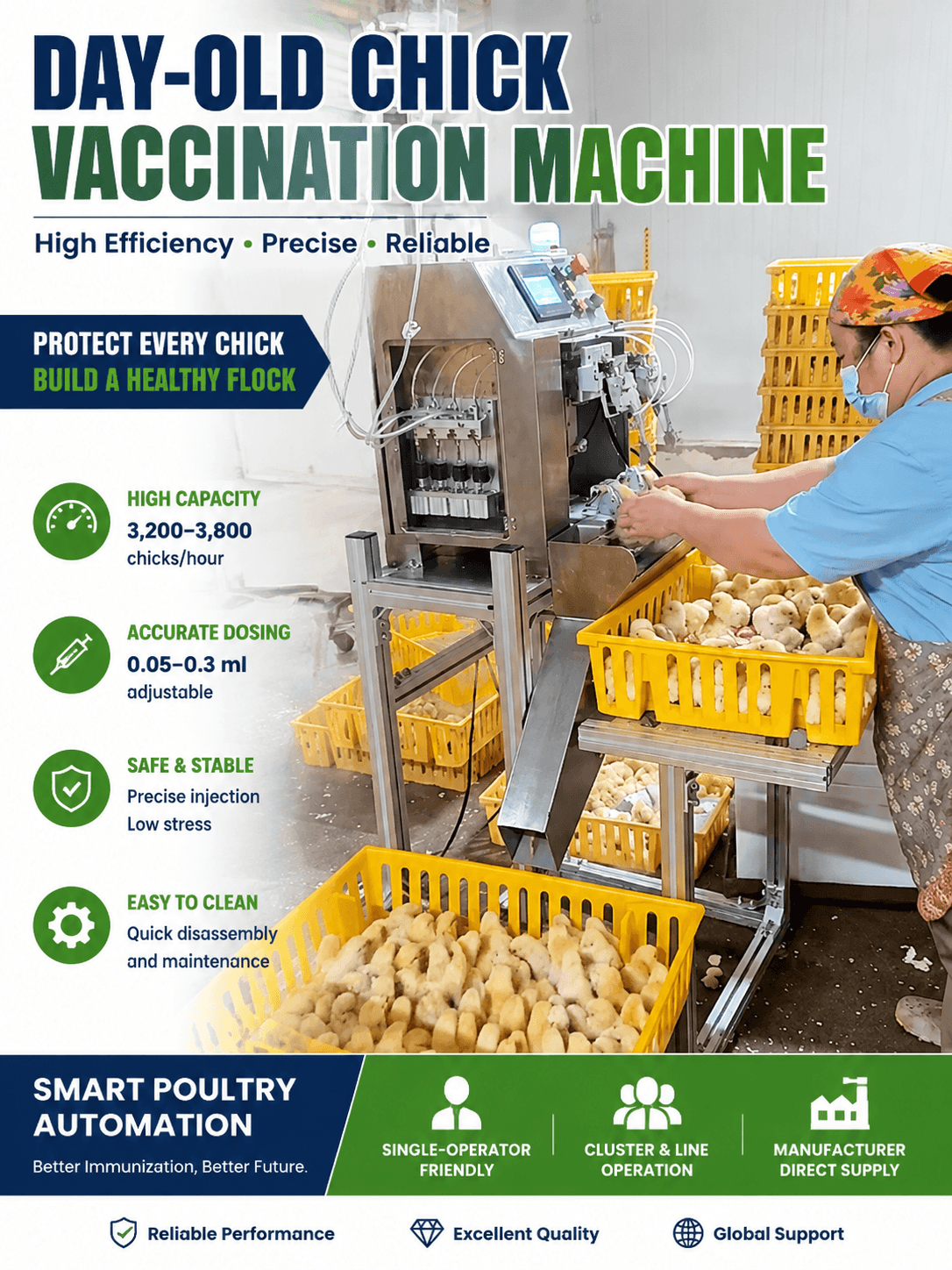
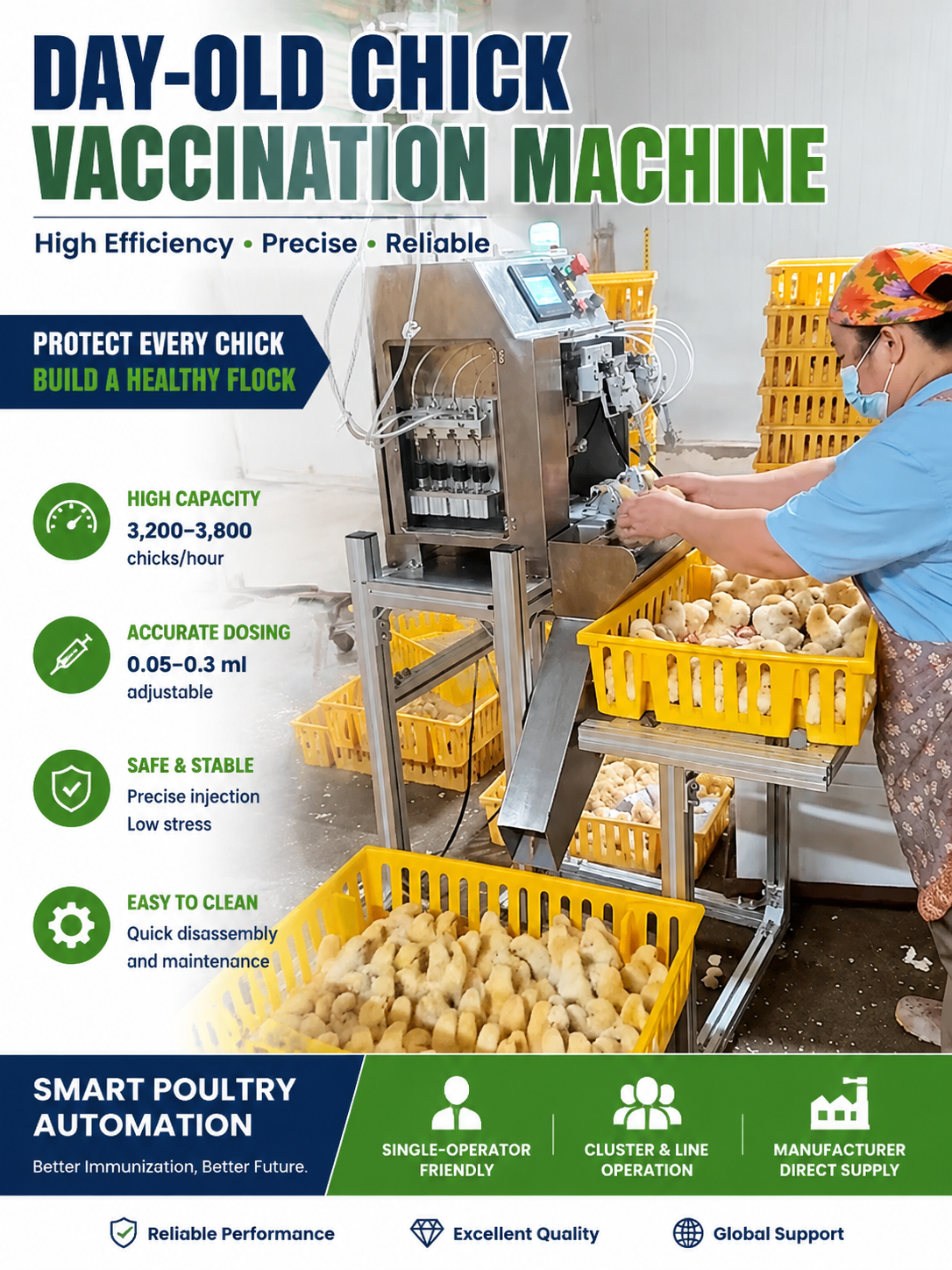
A poultry vaccination machine helps hatcheries scale output when manual vaccination starts to create inconsistent dose delivery, operator fatigue, or slow production rhythm. Buyers usually need more than speed; they need a stable injection process that can be trained, checked, and repeated across shifts.
The Jili Day-Old Chick Injection Vaccinator is used for one-day-old chick neck subcutaneous injection. Product material lists 0.05-0.3 ml adjustable dose, about 3,200-3,800 chicks per hour for four-station equipment, machine size of 659 mm x 600 mm x 995 mm, about 0.2 kW power, and air pressure checks around 0.45-0.5 MPa.
Scaling output requires stable vaccination quality
Higher throughput has limited value if injection quality becomes unstable. Missed injection, leakage, bleeding, or poor dose control can create rework and reduce trust in the process. A better vaccination station supports both output and quality control.
A practical poultry vaccination machine should make dose calibration, needle setup, tubing checks, air pressure, and first-batch inspection easier for operators to follow.
What buyers should compare
- Dose range and calibration method.
- Needle position and guide setup.
- Air pressure requirement before production.
- Tubing flow, bubble removal, and liquid stability.
- Cleaning routine and consumable replacement.
- Operator training and troubleshooting support.
Selection table
| Selection factor | Jili reference information |
| Application | One-day-old chick neck subcutaneous injection |
| Dose range | 0.05-0.3 ml adjustable |
| Reference capacity | About 3,200-3,800 chicks per hour |
| Air pressure | Around 0.45-0.5 MPa before operation |
| Power | About 0.2 kW |
| Machine size | 659 mm x 600 mm x 995 mm |
How to prepare for higher volume
Before scaling, buyers should confirm current vaccination problems and the desired improvement. If the hatchery wants fewer missed injections, more stable output, and easier dose tracking, the RFQ should include those goals. Jili can then discuss equipment fit based on real production needs.
For a focused injection process, the Jili injection vaccinator is the direct match. If vaccination must happen together with infrared beak treatment, buyers can compare the Jili Day-Old Chick Infrared Beak Trimming and Vaccination Machine as an integrated station.
What to send before quotation
Send chick age, vaccine dose, daily volume, peak hourly target, room layout, air supply condition, and current vaccination issues. This helps Jili judge whether a poultry vaccination machine can meet the hatchery’s output and quality goals.
Protect vaccination consistency during shift changes
Scaling a poultry vaccination machine requires the same operating standard across different people and shifts. Buyers can prepare a short startup checklist covering dose setting, needle condition, tubing flow, air pressure, vaccine preparation, cleaning status, and the first inspection sample. The checklist gives operators a common reference and makes abnormal results easier to trace.
Training should include both normal operation and the response to common problems. Operators need to know when to stop, how to identify bubbles or unstable liquid flow, how to replace consumables, and which observations should be reported to maintenance. Supervisors can review missed injections, leakage, bleeding, downtime, and output together rather than judging the machine by speed alone.
When requesting a proposal from Jili, describe the current quality-control method and the records the hatchery wants to maintain. This helps determine the most practical equipment setup, training scope, spare-part list, and startup checks. A consistent routine protects vaccination quality as production volume grows.
Keep a simple commissioning record for each shift, including the selected dose, consumables used, first-sample result, interruptions, corrective actions, and final output. This record gives supervisors and Jili service staff a clearer basis for follow-up when production conditions change.
FAQ
What is a poultry vaccination machine used for?
It supports controlled vaccination work, commonly through neck subcutaneous injection for day-old chicks.
What dose range is listed in Jili material?
Jili material lists 0.05-0.3 ml adjustable dose.
What affects vaccination output?
Dose calibration, needle setup, tubing flow, air pressure, operator training, and first-batch inspection all matter.
When is an integrated machine better?
It is better when beak treatment and vaccination need to happen in the same station.
What information helps Jili quote accurately?
Chick age, dose, target output, room layout, air supply, and current injection problems are useful.