


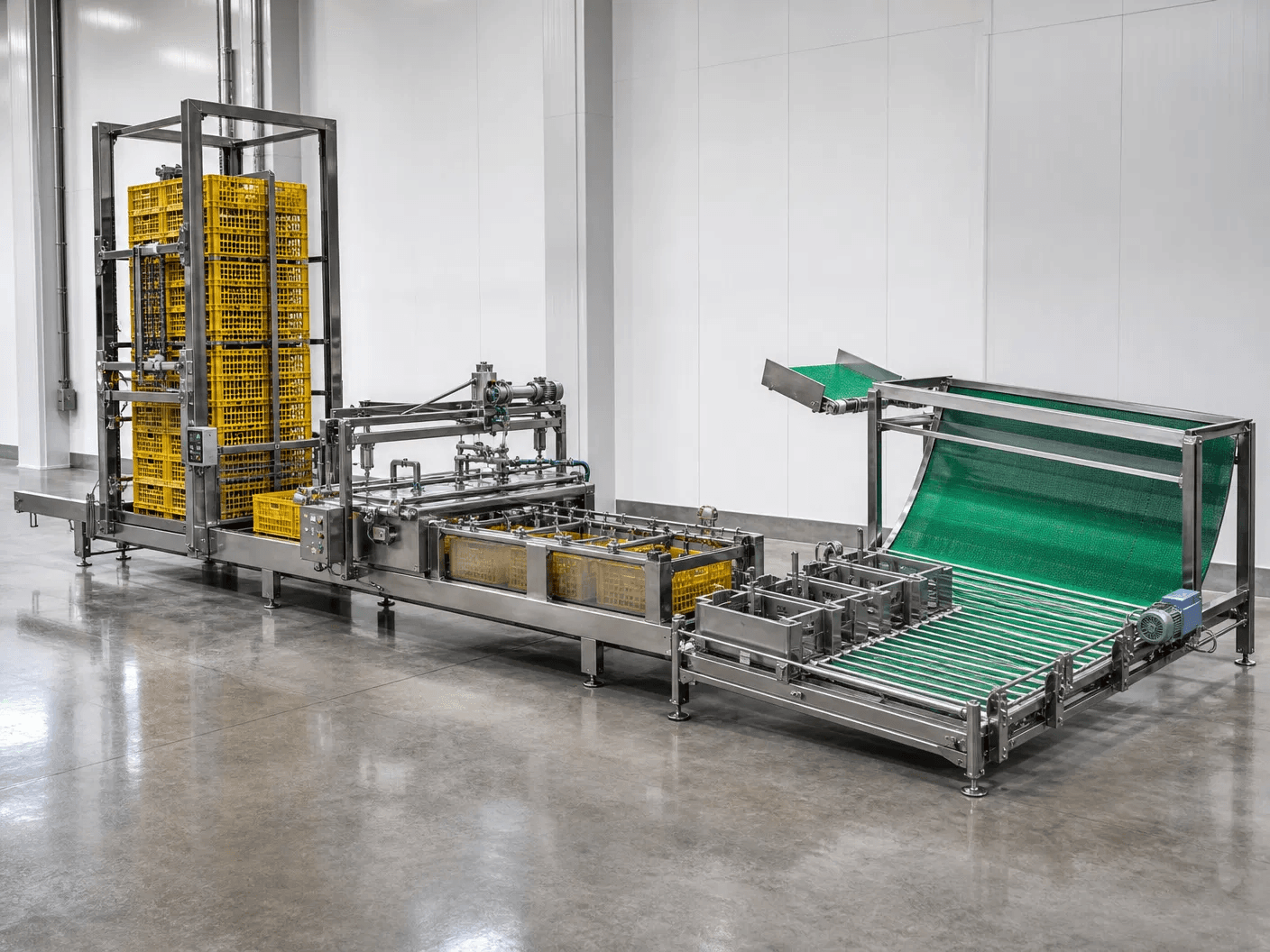
A stacking and destacking machine can help a hatchery scale tray or crate movement when manual handling creates waiting, lifting, inconsistent supply, or congestion around the processing line. The equipment should be planned with the conveyor, tray dimensions, stack height, operator access, and the receiving station.
Jili offers a Conveying and Stacking Line for the Day-Old Chick Infrared Beak Trimming and Vaccination System. Buyers can also review Complete Hatchery Automation Solutions when stacking and destacking must connect with a broader chick-processing workflow.
Scaling starts with the tray movement map
Before selecting equipment, record where empty and loaded trays arrive, how they are oriented, where stacks wait, and how they leave the room. Note any manual turning, lifting, counting, or alignment. These details show whether the main problem is stacking, destacking, conveying, storage, or the handoff to another station.
A practical stacking and destacking machine should reduce unnecessary handling without creating a new queue. The supplier needs tray samples or accurate drawings, stack information, and the required hourly movement.
Confirm tray compatibility before layout approval
Tray dimensions, material, weight, base design, nesting behavior, damage condition, and allowable stack height affect the handling method. Small dimensional differences can influence alignment and release. Buyers should provide several representative trays, including used trays, when possible.
The proposal should also explain how the system responds to a damaged or misaligned tray. Operator access and a clear recovery procedure are important for daily production.
Stacking and destacking planning table
| Planning factor | Information to provide |
| Tray format | Dimensions, material, weight, photos, and drawings |
| Stack | Minimum and maximum stack height and orientation |
| Throughput | Normal and peak trays per hour |
| Conveyor | Direction, height, speed, and connection points |
| Operators | Inspection, loading, recovery, and cleaning positions |
| Expansion | Future stations, extra conveyors, or increased capacity |
Balance the equipment with upstream and downstream stations
Scaling is successful when tray movement supports the whole line. If destacking is faster than the receiving station, trays may accumulate. If stacking is slower than production output, operators may intervene manually. Ask the supplier to explain buffer capacity and the response when another station pauses.
The stacking and destacking machine should be evaluated under normal shifts and peak production. Breaks, cleaning, inspection, damaged trays, and changeovers need to be included in practical capacity planning.
Plan safety, cleaning, and maintenance access
The layout should keep operators away from moving stacks while preserving access for inspection and recovery. Emergency stops, guards, sensors, and working clearances should be included in the acceptance checklist. Cleaning and maintenance points need enough room for the tasks described in the manual.
Buyers can request a preventive-maintenance schedule and a recommended spare-part list. Components that affect alignment, sensing, conveying, and stack control should be included in operator and technician training.
Commission the system with real trays
Commissioning should use representative trays and a realistic production sequence. Test normal flow, partial stacks, maximum stacks, misalignment response, stop and restart, station pauses, and operator recovery. Record issues and agreed adjustments before final acceptance.
What to include in the inquiry
Send tray photos and drawings, dimensions, weight, stack height, trays per hour, conveyor direction and height, room layout, current manual process, operator number, and the stations before and after stacking. Explain future capacity or layout changes.
With these details, Jili can recommend whether a focused stacking and destacking machine or a connected conveying and automation line is the more practical solution.
FAQ
What does a stacking and destacking machine do?
It automates the formation or separation of tray or crate stacks within a conveying and handling workflow.
Why are tray samples important?
Samples help confirm dimensions, nesting behavior, alignment, weight, damage condition, and stack stability.
How should capacity be calculated?
Use normal and peak tray movement while including inspection, cleaning, breaks, damaged trays, and downstream constraints.
Can the equipment connect with an existing line?
Often yes, but the supplier needs accurate conveyor height, direction, speed, layout, and control information.
What should be tested during commissioning?
Test normal stacks, partial stacks, maximum stacks, misalignment, stop and restart, station pauses, and operator recovery.