


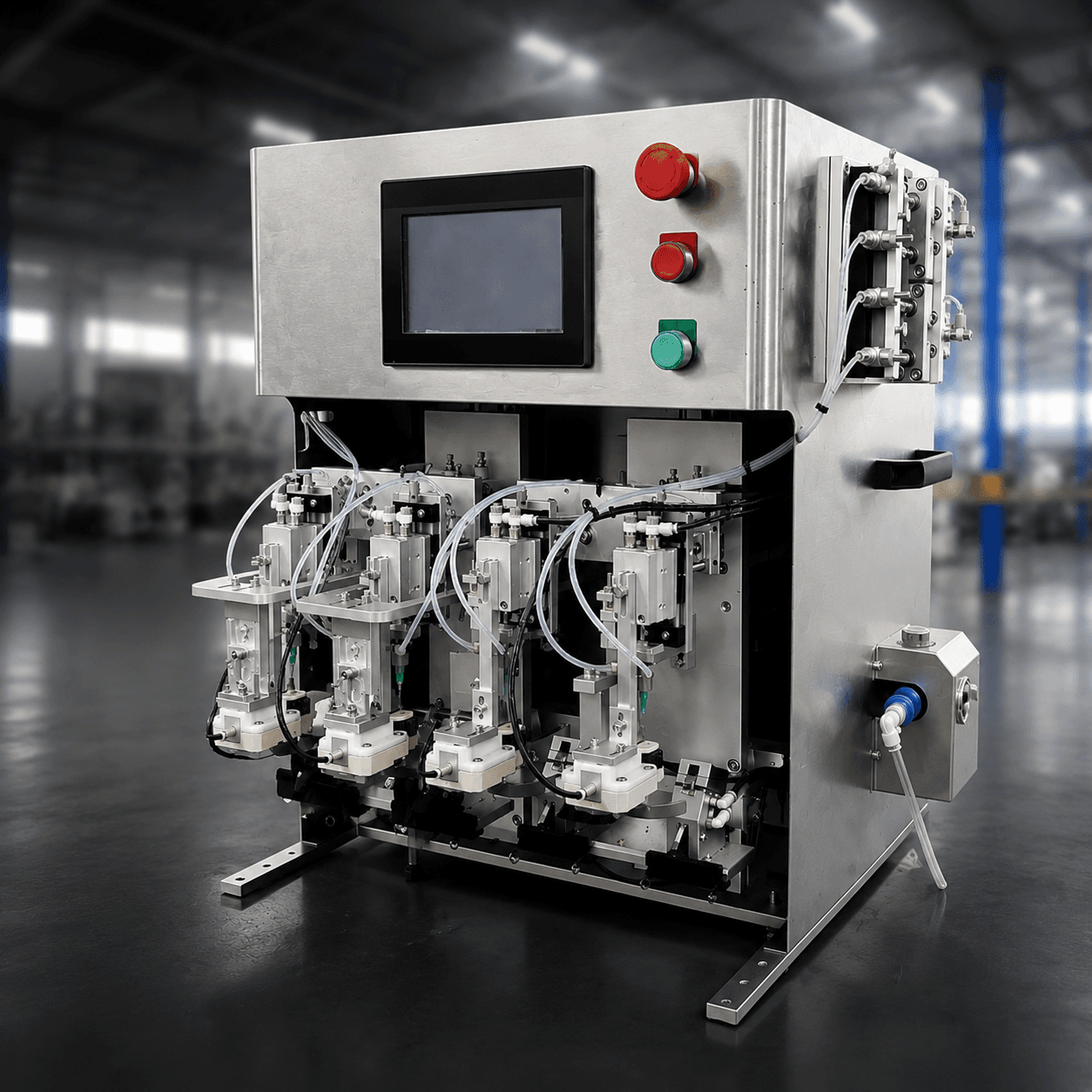
Station count is the first question buyers ask and usually the last one that should be answered. A 4 station day old chick vaccination machine is not automatically faster than a two-station unit, and it is certainly not automatically cheaper per chick. What four stations buy you is parallelism inside one cycle: several chicks are injected in the same movement instead of one after another.
Whether that helps depends on three things you can measure before a quotation is written. Miss them and the machine will still work; it will simply wait, or make your operators wait, for most of the shift.
Start with the arithmetic, not the brochure
Take the number of chicks your hatchery expects to process in the busiest two hours of a hatch day. Not the daily average, and not the annual figure divided by 365. Hatch days are lumpy, and a vaccination station only has to keep up during the lump.
Then divide by the minutes available. If the station has to clear 12,000 chicks inside a two-hour window, that is 100 chicks a minute. A machine that presents four chicks per cycle, on a cycle of roughly two and a half seconds, sits comfortably above that number. The same machine on a cycle of four seconds does not, no matter how good the mechanics are. This is why cycle time, not station count, is the number worth asking a supplier for.
Ask for it in writing, and ask what it was measured on. A cycle time quoted on a bench in a showroom and a cycle time measured with a full tray of live chicks in a warm room are two different things, and only one of them is your reality. Buyers who insist on the second number rarely end up disappointed by a 4 station day old chick vaccination machine, because they have already checked that the machine can carry the peak they actually have.
What four stations actually change on the floor
Going from one or two stations to four changes the shape of the work more than the speed of the work.
The operator's rhythm changes
With four chicks presented at once, the operator's hands follow the machine rather than the other way around. That reduces the number of small decisions per minute, which matters at the end of a long shift, but it also means a single missed placement holds up a whole group instead of one chick. Training emphasises different habits: check the group, not the individual bird.
Downtime costs more per minute
If a four-station machine stops, it stops four lanes of work. That is not a reason to avoid it, but it is a reason to think about who can clear a jam and how quickly a needle change can be done with gloves on. Spare parts that sit three weeks away by courier become a genuinely expensive decision.
The queue moves upstream
Faster injection pushes the waiting to whatever feeds the station: the take-off point, the transfer conveyor, or the person loading trays. Sizing the vaccinator without walking the upstream steps is the most common planning mistake we see, and it is entirely avoidable.
Three numbers to bring to the meeting
Any serious conversation about a 4 station day old chick vaccination machine should be grounded in measurements rather than impressions. These three take an afternoon to collect and will sharpen every option you are shown.
| Number | How to measure it | Why it decides the station count |
|---|---|---|
| Peak rate needed | Chicks processed in the busiest two-hour window, divided by minutes | Sets the minimum cycles per minute the machine must sustain |
| Feeding rhythm | Watch the upstream step for ten minutes and count how birds arrive | Shows whether a faster station would starve or queue |
| Hands available | Compare the roster against the hatch-day plan | Determines whether one operator per station set is realistic |
When four stations is more than you need
There is no prize for buying parallelism you cannot feed. Buyers who would be better served by a smaller configuration usually share two habits: they run modest, steady daily volumes rather than sharp peaks, and they value simple changeovers over maximum output. A 4 station day old chick vaccination machine in that situation becomes expensive furniture long before it becomes a bottleneck.
Your peaks are gentle
If the difference between your busiest hour and your quietest hour is small, extra stations sit idle for most of the week. Idle capacity still needs cleaning, calibration and spares, and it still occupies floor space in a room where space is usually already tight.
Your team is still building confidence
A hatchery moving from manual vaccination to its first automatic station is often better off learning on a simpler configuration and adding capacity later. Since these machines are built around modular assemblies, the second step tends to be cheaper than the first one.
When four stations is not enough
The opposite case is just as common, and it usually announces itself in the same way: a queue that forms at the vaccination station while everyone else waits.
The bottleneck has already moved here
If the steps before and after vaccination can run faster than the station, the station is the constraint. Adding stations is then a genuine fix rather than an expensive way to move the problem.
Your hatch days are compressed
Some hatcheries do not spread work evenly. Everything arrives in a narrow window, the truck leaves at a fixed time, and the vaccination station has to absorb the whole peak. Compressed schedules tolerate idle capacity far better than they tolerate a queue.
The first month is a measurement exercise
Whatever you install, treat the first month as a data-collection period rather than a victory lap. The numbers below are the ones worth recording daily beside the flock record.
| What to record | What it tells you | Typical action |
|---|---|---|
| Cycles per minute actually achieved | Whether the machine meets the rate the quotation assumed | Revisit presentation and feeding, not the control parameters first |
| Minutes lost per shift | Where the real capacity goes | Fix the top one or two causes before adding equipment |
| Stops caused by upstream starvation | Whether the line is balanced around the station | Adjust the upstream step or the loading rhythm |
| Count against flock record | Confidence in the automatic counting function | Investigate feeding or presentation anomalies |
Where JuliSense fits
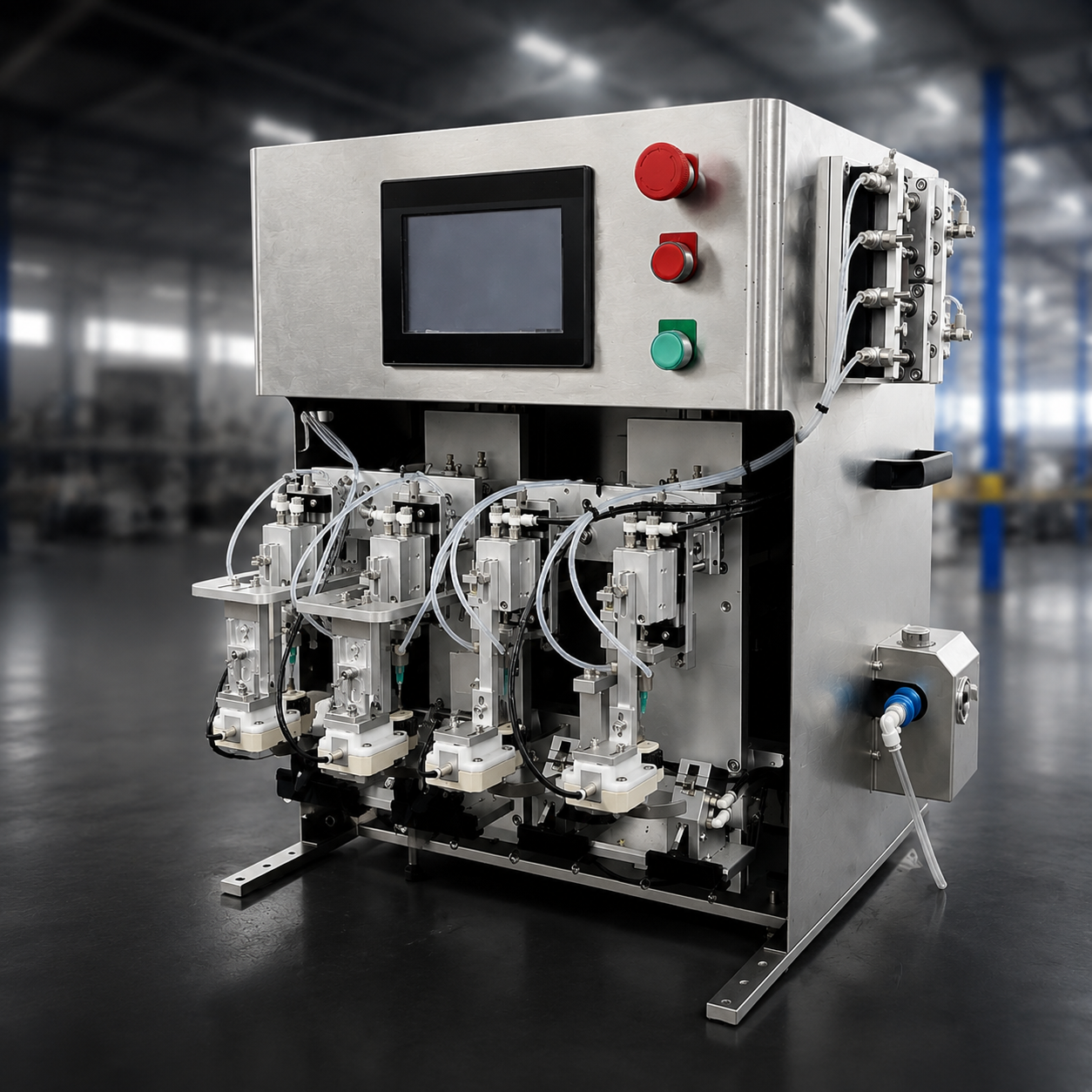
JuliSense, the hatchery equipment brand of Jili Intelligent, builds the 4-station automatic day-old chick vaccination injection machine with four independent stations working inside one cycle. It was designed for broiler, layer and breeder chicks, with adjustable injection parameters, automatic counting, vaccine monitoring and alarm protection built into the control system.
It does not have to be the first machine you buy. The full product range includes single and dual needle options, spray vaccination and integrated beak trimming stations, so the sizing conversation can cover several routes rather than one. The service page covers design, integration and support, the about page explains how the equipment is manufactured, and the FAQs answer the practical questions that come up before a purchase order.
Send your three numbers, the room drawing and the hatch-day schedule through the JuliSense contact page and the sizing discussion can start from your figures instead of ours.
Frequently asked questions
Does a 4 station day old chick vaccination machine need one operator or more?
Station count drives hands, not the other way around. Ask the supplier to state the operating model explicitly, and check it against your roster rather than your best-case scenario.
Can four stations share one vaccine supply?
Yes, and the design usually does. What matters practically is how the supply is monitored, how a partial cycle is handled if a station faults, and how vaccine waste is accounted for at the end of a run.
Is a four-station machine harder to validate?
It has more lines to observe, so the acceptance test takes longer. In exchange you get better statistics from the same number of chicks, because you can compare one station against another under identical conditions.
How do we know when to upgrade from two stations to four?
When the station is the clear constraint in a written line balance, when the queue is measured rather than assumed, and when the upstream feeding rhythm can actually keep up.
Sizing a 4 station day old chick vaccination machine is arithmetic followed by a room walk. Do them in that order and the decision stops being a guess, which is exactly the position you want to be in before the quotation arrives.