


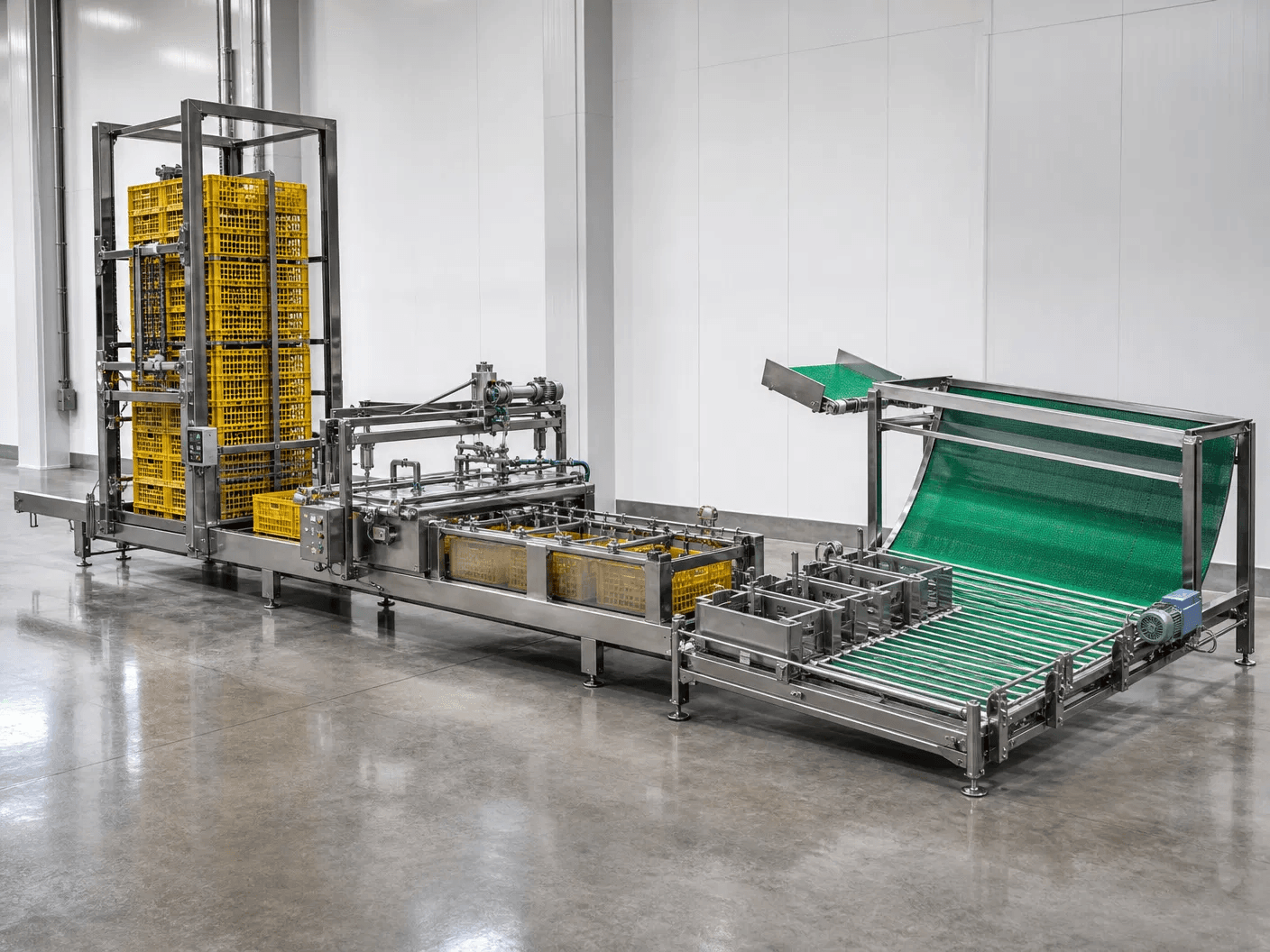
Everyone watches the wash. Nobody watches what happens after it. That gap is where most crate-handling problems live, and it is the reason a crate inverting and liner placement machine deserves more planning attention than it usually gets.
Follow one crate through a full day and the story writes itself. It arrives at the hatchery stacked with chicks. It leaves empty, gets stacked again, sits in a corridor, is loaded onto a truck, comes back dirty, and re-enters the plant. The washing line handles one part of that loop. The rest is handling, orientation and presentation, and it decides whether tomorrow's crates are ready when the truck arrives.
The journey nobody watches
A crate spends far more time being moved, stacked and turned than it spends being washed. Yet when hatcheries plan a new washing line, the conveyor speed and the wash zones get all the attention, and the two steps either side of the washer get treated as detail. In practice, those two steps decide whether the line runs or stands still.
Stage one: the crate arrives dirty, and upside down
Returned crates are never uniform. Some arrive with liners still in them, some are wet, some have been stacked on a truck for hours in the sun, and a few arrive the wrong way up. A washing system that assumes consistent orientation will spend its life stopping for corrections.
Destacking before anything else
The first automated step is usually destacking, because a washer wants single crates rather than a block of them. Doing this by hand looks cheap until you cost the person doing it across a full shift, and until you count the crates dropped in the attempt.
Why orientation matters more than people expect
Nozzle coverage, drainage and drying all depend on which way the crate faces. Getting the orientation right before the washer means the wash cycle does the work it was designed to do, and it means the operator at the exit is checking quality rather than flipping crates.
Stage two: inverting is a quality step, not a gadget
Inverting gets filed under handling, which undersells it. A crate that is turned at the right moment drains properly, dries faster, and presents the right face to whatever comes next. On most site visits, the moment a crate inverting and liner placement machine starts earning its cost is the moment water stops travelling out of the wash line and into the dispatch area.
Drainage and drying
Water that stays in a crate becomes a problem later, in the form of damp liners or a wet truck floor. Turning the crate at the exit of a wash line is the cheapest drying decision available, because it uses gravity instead of heat.
Presentation for the next stage
If a liner is going to be placed, it goes into a crate that is sitting the right way up, clean, and dry enough that paper does not cling. The inverting step is what makes that possible without a person standing there flipping every crate.
Stage three: liner placement is a discipline
Liner placement looks like the simplest part of the whole loop. It is also the part most likely to be done inconsistently by hand, which is exactly why automating it changes the feel of the dispatch area. Teams that have run both ways usually describe a crate inverting and liner placement machine in terms of calm rather than speed.
Consistency that survives a busy morning
A liner placed by hand at 6 a.m. and a liner placed by hand at 11 a.m. are rarely the same. Automatic placement removes that variation, and variation is what turns into damaged chicks or complaints later in the day.
Clean handling inside a clean crate
Once crates are washed and liners are placed automatically, the number of hands that touch a clean crate drops. Fewer touches is a biosecurity gain that does not show up in a yield report but does show up in how confident your team feels about the line.
Stage four: the stack decides tomorrow's truck
The loop closes with stacking and conveying back to wherever crates are held. If that final step is manual, the whole line inherits the pace and the availability of one person. If it is automated, the washing line becomes something you can run while the rest of the plant does something else.
This is also where the numbers get interesting. A washing line that runs continuously at a modest speed usually beats a faster line that needs constant attention, because the second one is never actually running when you need it.
The loop on one page
If you are writing a specification, this is the sequence to check against. Every step should have an owner, a speed, and an answer for what happens when it stops.
| Step | What it does | The question to settle |
|---|---|---|
| Destacking | Separates returned crates into a single lane | Who clears a jam, and how quickly? |
| Orientation | Presents each crate correctly to the washer | What happens with a crate that arrives the wrong way? |
| Washing | Removes contaminants and prepares the surface | Which cleaning agents and temperatures are approved? |
| Inverting | Drains and re-presents the crate | Is the crate dry enough for the next step? |
| Liner placement | Puts a clean liner into a clean crate | How is a missed or doubled liner spotted? |
| Stacking and conveying | Returns crates to storage or dispatch | How many crates must be ready before the truck loads? |
Four ways the loop breaks
None of these are exotic. They are simply the failures that repeat across plants, and each one has a design answer rather than a discipline answer. Every one of them is cheaper to think through while a crate inverting and liner placement machine is still a drawing.
| What goes wrong | What it looks like on the floor | Where the fix usually sits |
|---|---|---|
| Crates arrive mixed | Destacker stops, operators hand-feed singles | Upstream collection routine and lane design |
| Water carried out of the washer | Damp liners, wet floors, slipping risk | Inverting point and drain timing |
| Liner misplacement | Liners on the floor, double liners in crates | Placement mechanism and a visual check at the exit |
| Stack heights drift | Unstable stacks at the end of the loop | Stacking control and the crate specification itself |
Where JuliSense fits
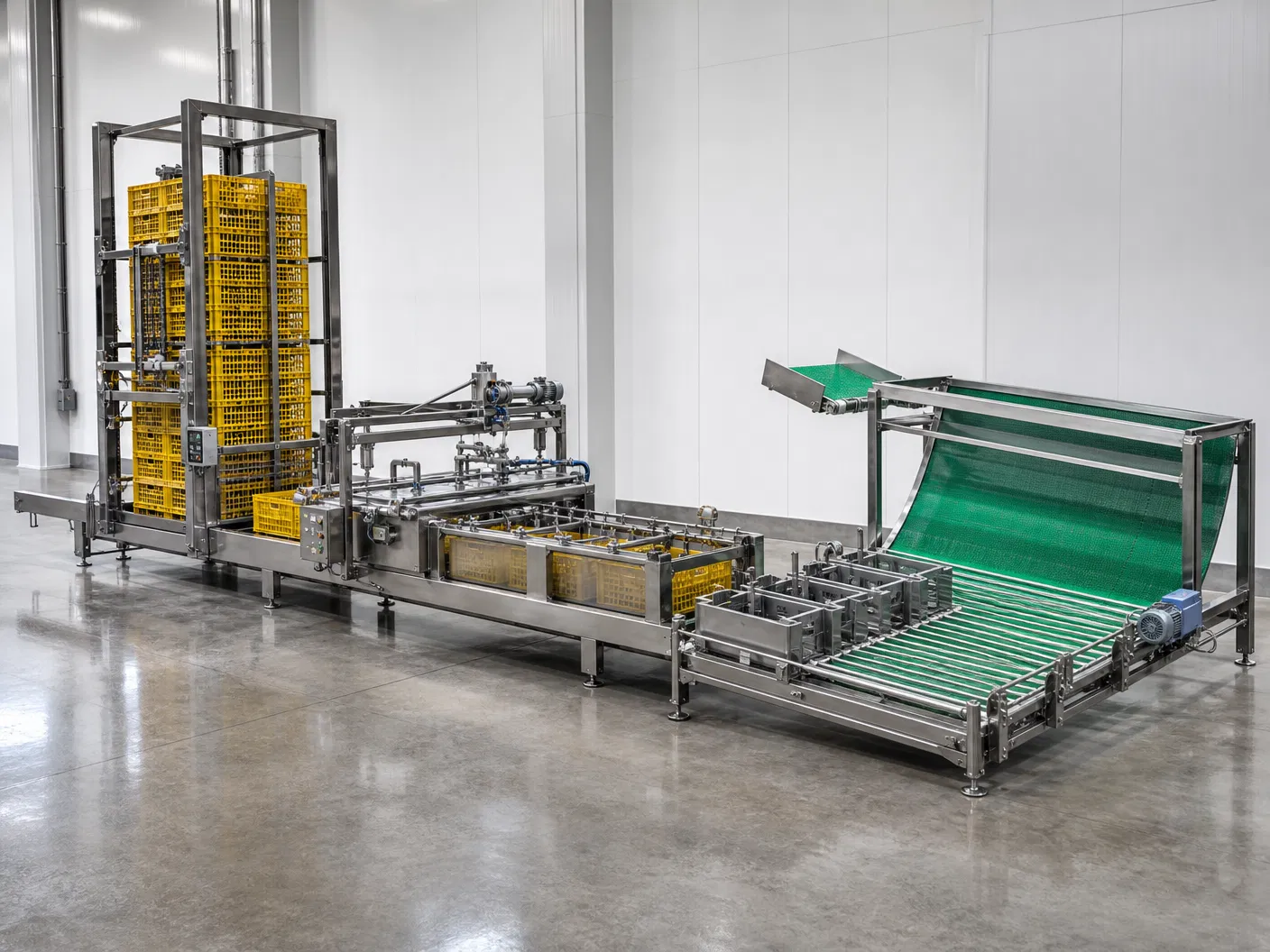
JuliSense is the hatchery equipment brand of Jili Intelligent, and crate handling is part of the same line as chick processing rather than a separate world. The poultry crate washing system with inverting and liner placement combines washing, inversion, liner placement, stacking and conveying under one PLC control, with a touchscreen interface and a stainless steel structure built for a wet room.
Some plants need that full loop. Others already own a continuous crate washer and want the handling steps around it, which is why the system is modular and can be matched to an existing layout. The product range shows how these pieces sit alongside transfer, conveying and vaccination equipment.
Cleaning and disinfection practice belongs to your own biosecurity plan, but it helps to know where the reference points come from. WOAH publishes internationally recognised standards and manuals, including the Terrestrial Code, which many hatcheries use when they write down what "clean" is supposed to mean.
If you would rather start from the drawing than from the catalogue, send the loop as it exists today through the contact page. The service page explains how integration work is scoped, the about page covers the production side, and the FAQs answer the questions that come up most before a crate handling project starts.
Frequently asked questions
Do we need the full loop, or can we keep some steps manual?
Partial automation is normal. Many plants start with washing and add inverting, liner placement or stacking later. The decision usually comes down to which manual step is setting the pace of the whole area.
Can a crate inverting and liner placement machine handle different crate sizes?
That depends on the machine configuration and needs to be stated as a requirement rather than assumed. Give the supplier the full range of crates you actually use, including the awkward ones, not the nominal size.
How does liner placement cope with a bent or damaged crate?
A damaged crate is a handling problem before it becomes a liner problem. Most plants solve it upstream with a simple reject check, so the placement station only ever sees crates worth preparing.
What should we measure in the first month?
Crates per shift, stops per shift and where they happened, liner rejects, and the number of crates that reached dispatch without a liner. Four numbers, recorded honestly, will tell you more than any commissioning report.
Planning a crate inverting and liner placement machine is really planning a loop. Get the loop right, and the washing line stops being the part of the plant everyone avoids talking about.