


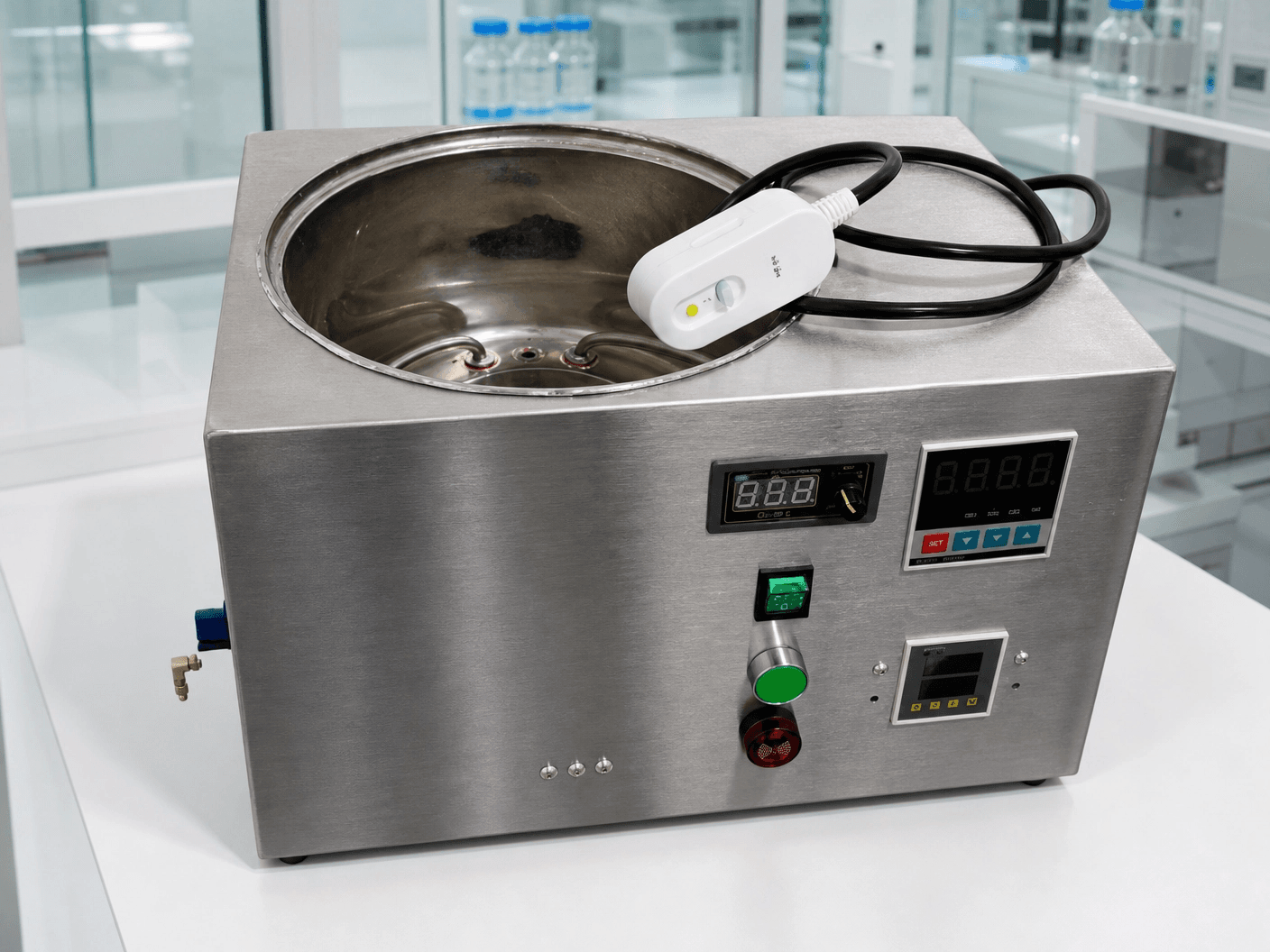
The busiest piece of vaccination equipment in many hatcheries is not the injector. It is the bench where vaccine is taken out of storage and brought to the condition the program requires. A vaccine water bath mixer and warmer exists for that bench, and its real value shows up long before the first chick reaches a needle station.
This is a routine article rather than a specification article. It looks at how the warmer sits inside a shift: what happens before the first tray, what the operator watches while the line is running, and what should be finished after the last chick has gone. The hatchery's approved vaccine handling protocol defines the temperature window, holding rules, and documentation. The equipment's job is to hold those conditions steadily and make them easy to confirm.
A warm-up bench is a schedule, not an appliance
Hatchery teams rarely lose time because a warmer is slow. They lose time because the bench is organised around whatever is closest to hand. A container sits where the last person left it, the timer is remembered by one operator, and the record is filled in at the end of the shift from memory. The equipment works; the routine around it does not.
Treating preparation as a scheduled step instead of an ad-hoc task changes the shape of the morning. The vaccination lead knows when the first container should be ready. The operator knows where the next one waits. The person signing the record knows what they are signing. None of that requires a bigger machine, only a bench that matches the sequence of work.
Map the bench in four zones
Before adding equipment, draw the bench as it will actually be used. A vaccine water bath mixer and warmer needs a defined place inside that drawing, not the last free corner. Four zones cover most hatchery preparations well. The size of each zone depends on container volume and the number of stations being supplied, but the separation matters more than the dimensions.
| Zone | What belongs there | What should not sit there |
|---|---|---|
| Incoming | Containers waiting for preparation, still under the storage conditions the program requires | Anything already warmed, and anything without a clear label |
| Preparation | The warmer itself, its controls, and the approved mixing or handling tools | Personal items, unlabelled bottles, and paperwork that could get splashed |
| Ready | Containers confirmed against the program and waiting to move to the station | Containers that have sat beyond the holding time in the protocol |
| Record | The log, the approved procedure, and the pen that actually stays with it | Loose notes written on the nearest carton |
The record zone is the one teams skip, and it is the one that pays back the fastest. When the log lives beside the warmer instead of in an office, the entry gets written when the event happens rather than reconstructed later.
A shift at the bench: before, during, after
The following sequence is generic on purpose. Use it as a frame and let the hatchery's approved procedure fill in the specifics.
Before the first tray
The warmer is filled and brought to the condition the program specifies. Controls are checked, and the bath is stable rather than merely switched on. The first containers are staged in the incoming zone in the order they will be prepared. The operator confirms the station downstream is ready, because warming vaccine for a line that is not yet running just consumes holding time.
While the line is running
This is where a vaccine water bath mixer and warmer earns attention. The task is not simply to keep the bath warm; it is to keep conditions steady while containers move in and out. Mixing behaviour, water level, and container placement all affect how evenly a container is brought to condition. The operator watches the display, but also watches the bath and the containers themselves.
After the last tray
The batch ends with three actions: unused prepared material is handled exactly as the program requires, the bath is drained or maintained according to the routine, and the record is closed while the details are still fresh. The surfaces and tools are cleaned on the schedule the hatchery already uses for the rest of the station. A bench that is left in an ambiguous state is the most common reason a morning starts badly.
What the display cannot tell you
Digital controls are useful, and they are not omniscient. Three things sit outside what a temperature readout can report, and experienced teams keep them visible.
Condition of the water itself
A bath that reads correctly can still be untidy. Water condition, debris, and level affect how heat moves through the bath, and the cleaning routine around the warmer is what keeps that stable. Build the water change or maintenance interval into the shift checklist rather than leaving it to memory.
Behaviour of the containers
Containers of different sizes and materials reach condition at different rates. When a shift mixes container types, someone has to know which ones need more time and where they sit in the bath. Practical bench layout usually solves this better than any alarm setting.
Ownership at handover
Who is responsible for the bath during a break, and who confirms the record at shift change? A warmer that is technically running but operationally unowned is a familiar source of friction. Naming the owner in the shift plan takes thirty seconds and prevents a long conversation the next day.
Small habits that slowly break a bench routine
None of these are dramatic, and that is exactly why they persist.
- Warming the next container before the downstream station is ready, then leaving it in the ready zone longer than the protocol allows.
- Letting the bath level drop because the refill habit depends on one experienced operator being on shift.
- Keeping the log in a different room, so entries get written from memory at the end of the day.
- Treating the warmer's cleaning routine as optional on short shifts, when short shifts are exactly where drift begins.
Each habit is a routine problem, not an equipment problem, and each one is fixable with a bench layout, a written checklist, and a named owner.
Keep the warmer connected to the rest of the vaccination station
Preparation does not exist in isolation. The warmer feeds the equipment that actually treats the chicks, and mismatched paces create the awkward pauses described above. Many hatcheries run preparation for a spray station, an injection station, or a combination of both in the same window.
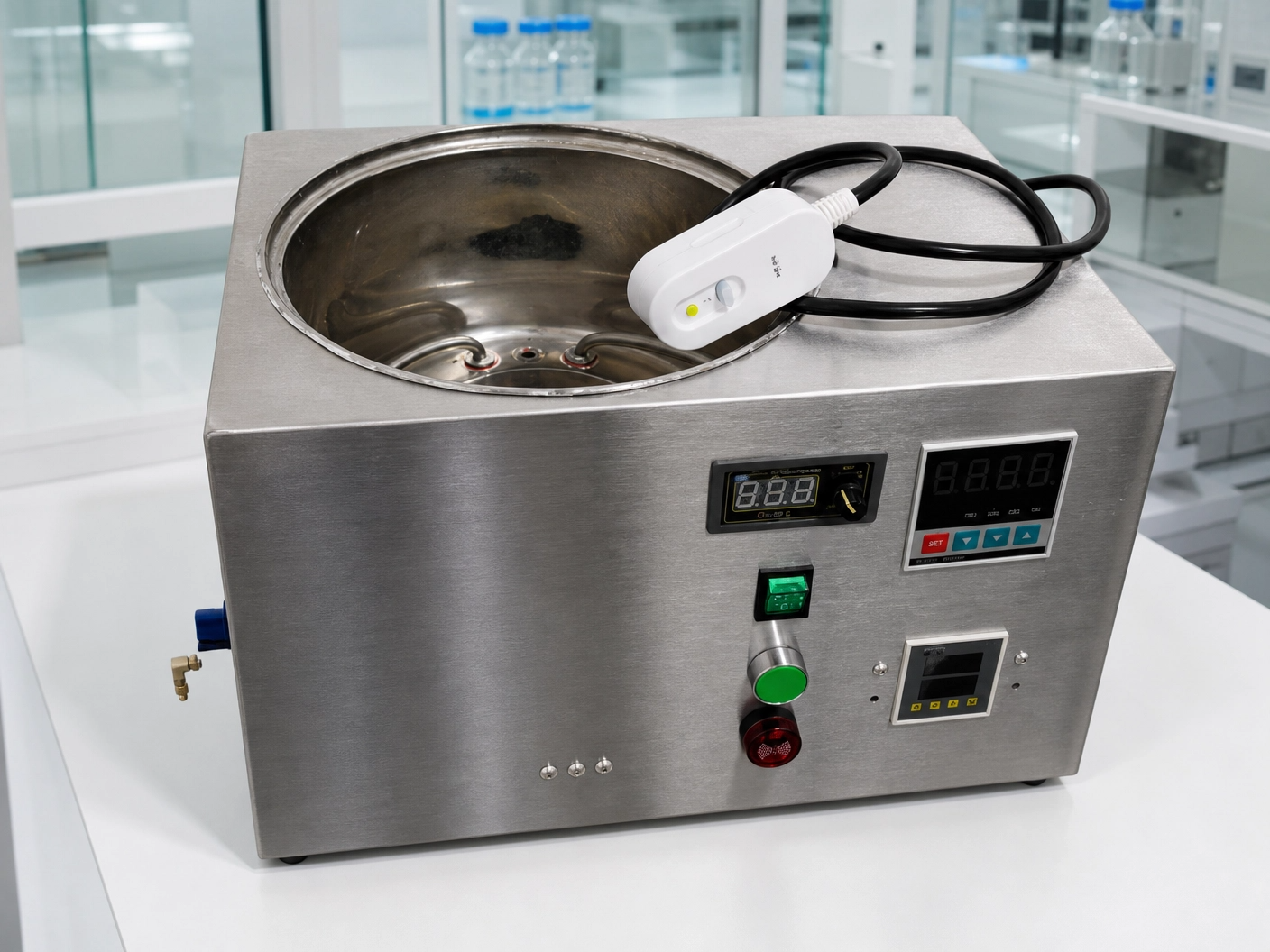
JuliSense builds the automatic vaccine water bath mixer and warmer as a stainless steel unit with intelligent temperature control, uniform heating, and a digital control interface for hatchery and laboratory environments. It sits naturally next to the day-old chick injection vaccinator or the day-old chick spray vaccinator, depending on the route the flock program requires. The JuliSense products page shows the wider station context.
What to look at when you compare warmers
Price is the last question, not the first. Three equipment characteristics decide whether the bench routine stays stable over a year of use.
| Comparison point | Question to ask | Why it shows up at the bench |
|---|---|---|
| Control stability | How does the bath behave while containers are loaded and removed? | Conditions should hold during real work, not only when the unit is idle |
| Cleaning access | How is the bath drained, rinsed, and inspected? | A bath that is hard to clean slowly becomes a bath nobody wants to handle |
| Service access | How does a technician reach the working parts? | Routine maintenance should not require dismantling the bench |
| Container fit | Do the hatchery's own container sizes load and sit comfortably? | Bench layout is easier to fix before delivery than after |
Control stability is the first. A warmer should hold conditions during normal loading and unloading, not only when it is standing idle. Cleaning access is the second, because a bath that is difficult to drain and inspect will slowly become a bath nobody wants to touch. Service access is the third, and it is the one most often forgotten during selection. Ask how a technician reaches the working parts, and ask what the routine maintenance interval actually involves.
Bring a representative container to the discussion. A demonstration with the hatchery's own container sizes tells you more about loading behaviour than any comparison of display features.
Where JuliSense fits
JuliSense is the hatchery equipment brand of Jili Intelligent, focused on infrared beak trimming, chick vaccination, and automated hatchery handling. The preparation bench is a small part of that picture, but it touches everything downstream, and it is one of the easiest places to make a station calmer.
Share the container types, the number of stations being supplied, the shift pattern, the cleaning routine, and the record format your team already uses through the JuliSense contact page. The service page explains how design and support conversations usually run, and the FAQs plus the about page cover the questions that come up before a project starts.
Frequently asked questions
What does a vaccine water bath mixer and warmer actually do?
It holds a water bath at a controlled condition and mixes during warming so that vaccine containers are brought to the state the hatchery's approved protocol requires. It supports preparation; it does not define the protocol.
Can the same warmer serve two vaccination stations?
Often yes, if the preparation window and container volume allow it. The deciding factors are how many containers must be ready at once and how far the bench sits from each station.
How often should the bath be cleaned or changed?
That belongs to the hatchery's own hygiene and maintenance routine. Build the interval into the shift checklist so it does not depend on one person's memory.
Is a digital display enough evidence for the batch record?
The display is one input. The batch record usually also captures who prepared the containers, when they were prepared, and how they were handled afterwards. Confirm the required format with the people who own the vaccination program.
A vaccine water bath mixer and warmer does not make a hatchery faster by itself. It makes the quietest part of the shift predictable, and predictable preparation is what lets the vaccination stations run at the pace the room was designed for.