


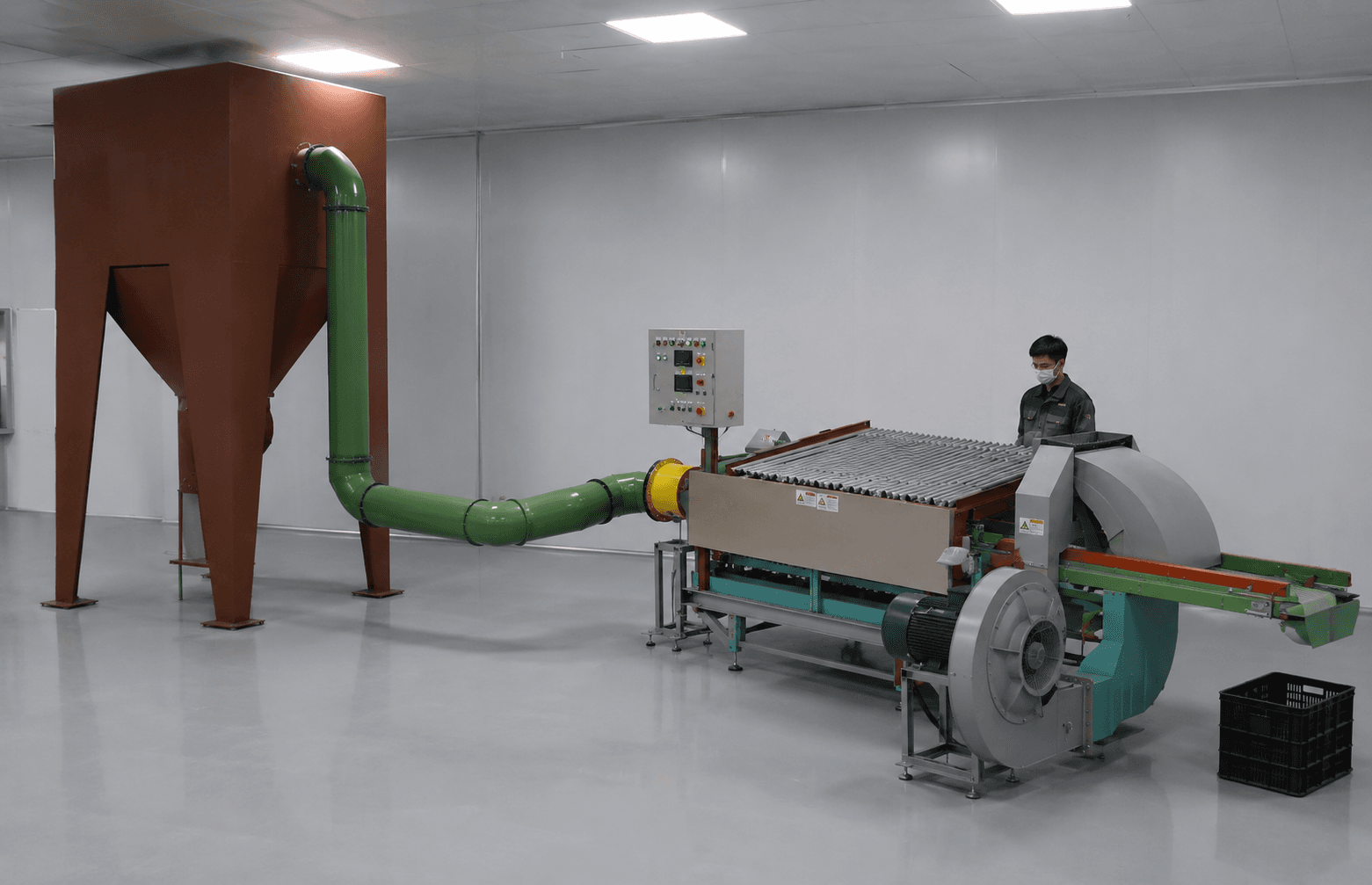
The hatcher opens, the trays come out, and for about ten minutes everything in the plant depends on what happens next. A chick take-off machine sits right at that point, and it is asked to do something deceptively complicated: separate chicks from what they hatched in, move them gently onto a conveyor, and hand them over in a condition the rest of the line can work with.
Most planning conversations about take-off start with throughput. That is the second question. The first is what the machine is expected to separate, because shells, unhatched eggs and debris do not arrive at a convenient and consistent rate.
Why the take-off area keeps producing surprises
The take-off room is the first place in the whole process where biology meets a schedule. Hatch windows vary, tray conditions vary, and the people working there are usually under time pressure because the trucks do not wait. A machine in that environment either absorbs the variation or broadcasts it down the line.
That is why the useful question is not "how fast does it run", but "what does it do when the tray in front of it is not typical". The answer is visible in ten minutes of observation.
Fix the tray before you fix the machine
Every take-off problem we are asked about starts one step upstream. A tray that was stacked unevenly, a tray that sat too long, trays mixed between hatchers with different hatch windows: the machine sees all of it as an irregular feed and responds exactly as designed.
Tray identity and traceability
If trays can be identified as they enter the take-off area, the machine's own counting becomes far more useful. You can compare what a hatcher was loaded with against what came out, and you can find the tray that always behaves differently.
Tray condition
Warped or cracked trays present chicks at the wrong angle, and no amount of tuning downstream fixes that. Checking tray condition as it leaves the washer is a cheap habit with a surprisingly large effect on take-off quality.
Four observations worth ten minutes
When you visit a site or watch a trial, watch these four moments. They matter more than the nameplate figures on the brochure.
Watch the first tray of the day
Cold start tells you how much the machine depends on the operator's warm-up habits. If the first tray always produces a conversation, that conversation will happen every morning forever.
Watch a tray with shells left in it
Ask for the worst tray available rather than the best one. How the machine separates chicks from shells and debris, and where the debris goes, says more about design quality than a clean demonstration.
Watch a pause
Stop the line for thirty seconds and see what happens to the chicks already in the machine. A well-considered transfer design has an obvious answer for the bird in transit; an improvised one has a tray waiting nearby.
Watch the handover
Follow one chick from the tray to the next station. Count the places where a person touches it. Each touch is an opportunity for error, and the count is a useful measure of how integrated the take-off area really is.
Separation, transfer, presentation
The three jobs inside a chick take-off machine are easy to describe separately and difficult to balance together.
Separation sets the pace
Chicks leave the shell at their own rhythm. The machine has to create a single, orderly lane out of an untidy source, and any hesitation here is felt everywhere downstream.
Transfer determines quality
Gentle handling is not a marketing phrase, it is a mechanical property: how the chick is supported, how far it falls, and how much of the journey depends on airflow rather than a belt. The transfer section is where a good design is quiet and boring, exactly as it should be.
Presentation determines the next station
Whatever follows take-off, whether it is beak treatment, vaccination or counting, works best with chicks arriving in a predictable orientation and rhythm. Take-off is therefore the station that quietly sets the standard for the whole post-hatch line.
Dust is part of the specification
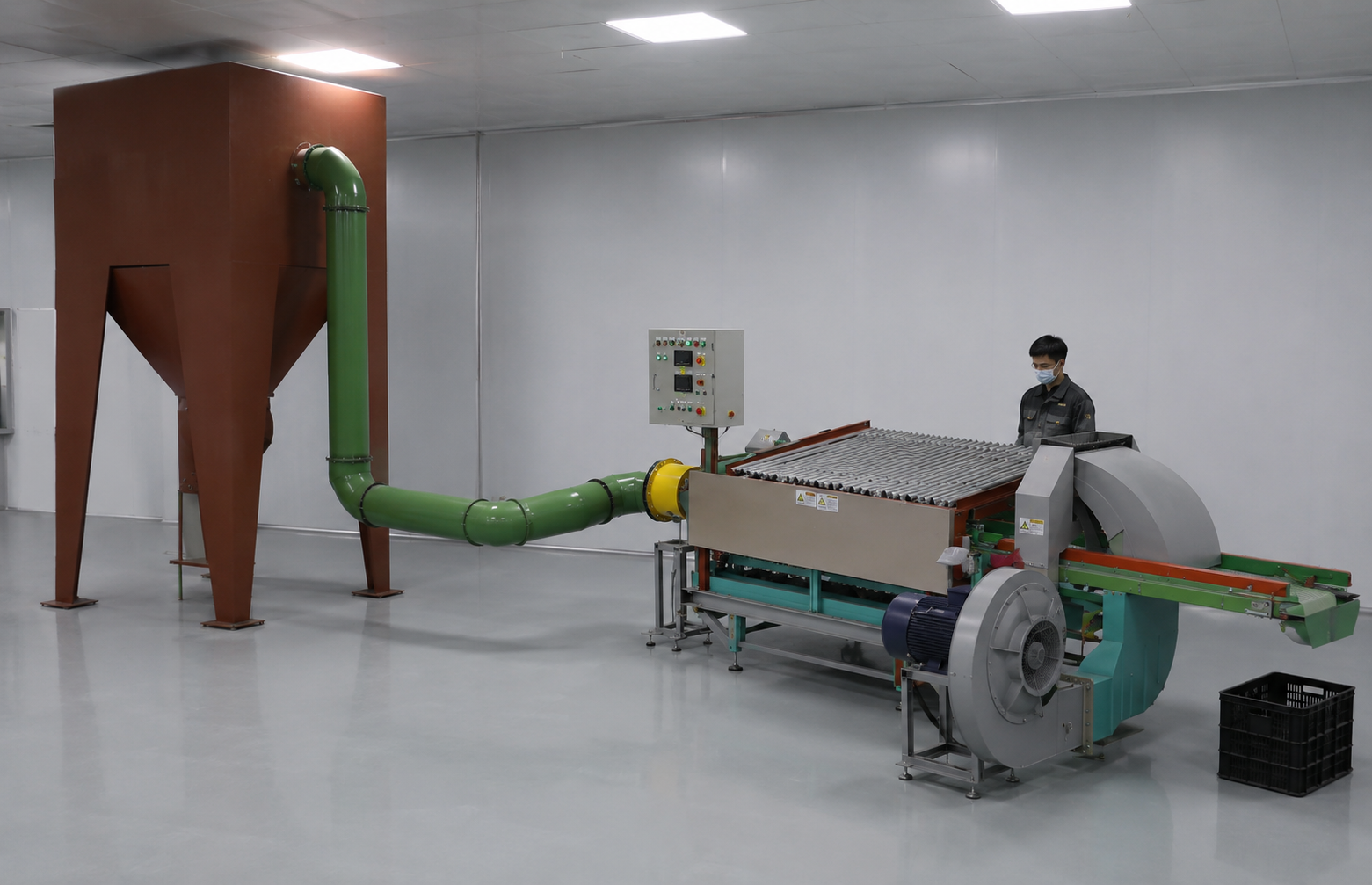
Shell dust and down are unavoidable, and if they are not captured at the source they end up on filters, in the room air, and on the machinery that comes next. Extraction is usually visible in the take-off area as ducting and a collection unit, and it is one of the first things to check on a site visit, because it is also the first thing to be neglected after commissioning.
The take-off room is also a place where hygiene discipline is measured daily. Standards such as the WOAH Terrestrial Code and manual give hatcheries an internationally recognised reference for how cleaning, disinfection and movement between zones should be described, which helps when a supplier's scope and your biosecurity plan need to meet in the middle.
Who owns what
Take-off sits between several teams, which is why responsibilities need writing down rather than assuming. A chick take-off machine that nobody clearly owns is a machine that gets blamed for everybody else's decisions, and this table is a useful starting point for a project meeting.
| Area | Typical owner | What they must be able to answer |
|---|---|---|
| Hatcher to take-off | Hatchery operations | How trays are pulled, stacked and sequenced |
| Take-off machine | Supplier and maintenance | Cleaning access, response time on a jam, spare list |
| Air and extraction | Plant engineering | Duct routing, filter changes, room pressure |
| Handover to the line | Line supervisor | Rate, orientation, and what happens when one side stops |
| Records | Quality | What is counted, kept and compared against the flock |
The two numbers nobody writes down
Ask any experienced take-off supervisor how many chicks they process in a shift and you will get a confident answer. Ask how many minutes the area lost, and how many of those minutes were caused by the step before, and the answer becomes vaguer. Those two numbers decide whether a chick take-off machine needs a redesign, a retraining session, or simply better trays, and they cost nothing to record.
| Record | What it reveals | Usual first response |
|---|---|---|
| Stops per shift | Whether the constraint is inside or outside the machine | Trace the stop to its upstream cause before touching settings |
| Count against hatcher record | Whether feeding and counting agree | Check tray sequencing and hatch window |
| Debris left in trays | Separation performance over a full run | Review tray condition and presentation |
| Operator touches per hundred chicks | How integrated the area really is | Plan the next automation step |
Where JuliSense fits
JuliSense is the hatchery equipment brand of Jili Intelligent, and the day-old chick picking and transfer machine is built for exactly this stage: automatic separation, gentle transfer and stable conveying, with a PLC control system, a touchscreen interface and an airflow structure designed to keep the trip from tray to line as calm as possible.
It is also designed to work as part of a line rather than as a standalone island. The machine integrates with counting, vaccination, beak treatment and tray handling equipment, which is why the product range is worth reading as a whole before a take-off project is scoped. The service page explains design and integration support, the about page covers manufacturing, and the FAQs collect the questions buyers ask most often.
If the take-off area is your current constraint, send the layout, the tray types and the hatch-day timetable through the contact page. Ten minutes of observation is often enough to identify where the first improvement should go.
Frequently asked questions
What is the difference between a take-off machine and a transfer machine?
In many lines they are the same piece of equipment described from two directions. Take-off refers to removing chicks from hatcher trays; transfer refers to moving them on to the next station. What matters is that both ends of that job are written into the scope.
Can a chick take-off machine handle different tray types?
Usually with the right configuration, but the tray list has to be supplied in advance and stated in the specification. Bring samples of every tray you use, including the older ones nobody likes.
How quickly can a jam be cleared?
That is a design question, and it deserves a demonstration rather than an estimate. Ask the supplier to walk your maintenance team through a jam with the machine stopped and guards open.
Should take-off and vaccination be one unit or two?
Both arrangements exist and both work. The deciding factors are the room, the schedule and how many changes you expect in the next five years, which is a conversation better held with drawings on the table than with brochures.
A chick take-off machine is judged in a very short window, on a very ordinary morning, with trays that are not quite perfect. Plan it around that reality and the rest of the line will thank you.