


A hatchery beak trimming vaccination line rarely loses time because one machine is simply “too slow.” More often, the delay appears between the machines: chicks arrive unevenly, an operator waits for a clear signal, supplies are replenished at the wrong moment, or the next station cannot accept the flow. The line may look busy while useful output quietly falls behind.
For a buyer, this changes the first question. Instead of asking only how many chicks a machine can process, ask how one chick moves through the complete route on a normal run, during a brief stop, and at the end of a batch. JuliSense combines infrared beak treatment, vaccination equipment, conveying, stacking, and wider hatchery automation, so that conversation can begin with the handoffs rather than a catalogue of separate machines.
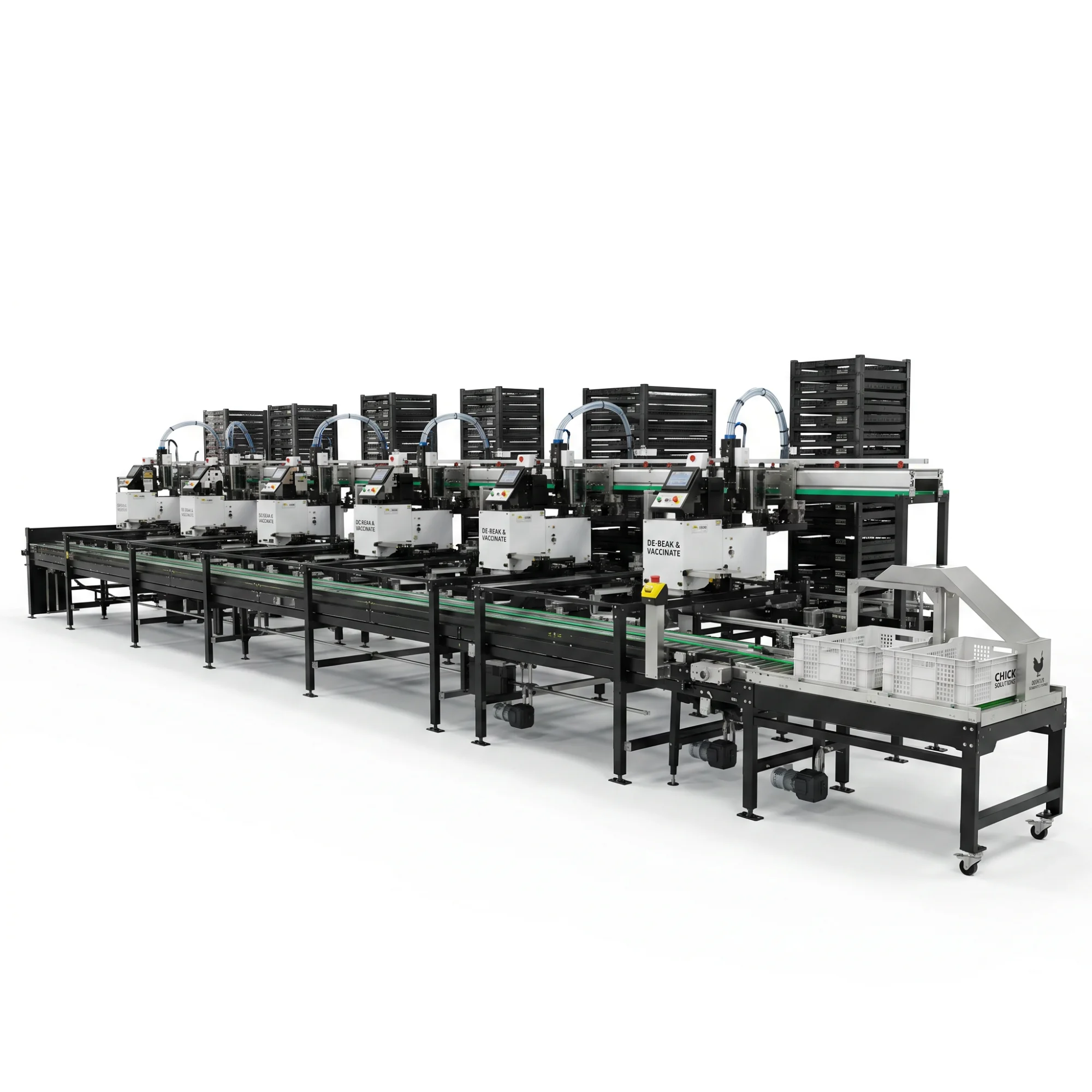
The answer is usually hiding between stations
Imagine the first hour of a hatch day. Chicks do not arrive as a perfect, continuous stream. A tray is released, an operator presents the chicks, the treatment station completes its cycle, vaccination follows according to the hatchery's approved program, and the processed chicks must leave without creating a queue. Empty boxes and full boxes are moving at the same time.
Each machine can perform correctly and the whole route can still hesitate. That is why a line review should focus on four short moments: arrival, presentation, treatment and vaccination, and release. The buyer needs to see what information and physical condition allow the next moment to begin.
Follow one chick through four handoffs
1. Arrival: a wave is not an average
Hourly capacity can hide the real production pattern. Record how chicks arrive in the busiest five or ten minutes, not only the total for the shift. Note the container, batch identity, operator position, and what happens when the previous group has not cleared.
If arrivals come in waves, the design may need controlled presentation or a defined waiting position. The goal is not to push every chick forward immediately. It is to prevent an upstream rush from becoming repeated manual correction at the treatment station.
2. Presentation: the operator sets the rhythm
The presentation point is where equipment design and real human work meet. Ask the supplier to show hand position, working height, visibility, replenishment reach, routine checks, and the action required when a chick is not presented as expected.
A well-planned hatchery beak trimming vaccination line does not hide the operator behind a capacity figure. It makes the operator's normal work, decisions, and limits visible. Those details influence training, staffing, fatigue, and the consistency of the complete shift.
3. Treatment and vaccination: two cycles need one clear boundary
Infrared beak treatment and vaccination may be arranged in an integrated station or as connected modules. The correct choice depends on the approved process, room, staffing, future expansion, cleaning plan, records, and required flexibility. Neither layout is automatically better for every hatchery.
Define where one cycle ends and the next responsibility begins. The customer's qualified veterinary and technical owners remain responsible for the approved vaccination program, process criteria, observation, and release decisions. The equipment proposal should explain how the selected configuration supports those requirements without claiming to replace them.
4. Release: the next box can stop the whole route
Processed chicks still need a destination. Count, box supply, conveying, stacking, staging, and dispatch can become the true constraint. During a review, follow the last chick and the last box rather than stopping at the vaccination station.
Ask what the line does when a full box cannot leave. Does the operator receive an understandable warning? Is there a controlled holding condition? Who decides to stop the upstream station? How is batch identity protected during recovery? A vague answer here usually becomes a busy manual workaround later.
Three scenes reveal more than a long demonstration
Scene one: the downstream conveyor pauses
Create a short, controlled pause during the supplier demonstration or acceptance test. Watch where chicks and boxes wait, which status the operator sees, and whether the upstream process stops in an orderly condition. Then observe the first minute after restart.
The purpose is not to provoke a fault. It is to learn whether the line communicates clearly when normal flow disappears.
Scene two: a supply item needs replenishment
Replenishment is ordinary work, yet it is often missing from sales videos. Ask the normal operator to perform it while the surrounding route is visible. Record walking, reaching, confirmation, waste handling, and the effect on the next few cycles.
If replenishment requires a second person or a complete stop, that is not necessarily unacceptable. It simply needs to be included in the staffing and daily output discussion.
Scene three: the batch ends
The final chicks of a batch expose details that steady running hides. Trace remaining supplies, incomplete containers, records, cleaning preparation, status reset, and authorization for the next batch. The end of the route should be as deliberate as the start.
Integrated station or connected modules?
Buyers often ask whether beak treatment and vaccination should share one station. A practical answer begins with the job the hatchery needs to control.
| Decision point | Integrated station may suit | Connected modules may suit |
|---|---|---|
| Floor and operator positions | A compact route with closely coordinated work | A room that benefits from separate access or spacing |
| Process flexibility | Programs that normally use the functions together | Programs that may run, change, or expand independently |
| Cleaning and maintenance | A shared, clearly defined service boundary | Separate access windows and maintenance ownership |
| Future changes | A stable application with a known combined workflow | A staged project or a planned future module |
| Acceptance testing | One combined operating sequence | Module tests plus explicit interface tests |
Use the table to start a design conversation, not to select equipment by itself. JuliSense can discuss both the individual functions and their connection to a wider chick-processing route. The final scope should state interfaces, customer-supplied work, supplier-supplied work, testing, training, and support.
A fast line can still be the wrong line
Speed matters, but three other questions deserve equal attention. First, can the route handle the actual arrival pattern without repeated correction? Second, can operators understand and recover from a stop? Third, can cleaning, maintenance, and batch change work be completed within the available production window?
A useful performance discussion therefore includes normal flow, a short peak, a planned pause, a downstream-not-ready condition, replenishment, batch end, and restart. The hatchery beak trimming vaccination line should be evaluated as a working shift, not as an isolated continuous run.
What JuliSense needs before drawing the route
Send a scaled room plan, photos where permitted, batch and arrival pattern, chick presentation method, approved process requirements, current equipment, operator plan, utilities, box route, cleaning boundary, destination country, and expansion ideas. Mark every existing item that must remain.
Review the JuliSense product range to identify relevant modules, then use the service page to frame integration, commissioning, training, and support questions. The company profile and FAQ page provide additional context before a project discussion.
Ask the first drawing to show movement direction, operator positions, machine boundaries, utilities, access, box flow, buffers, and exclusions. A drawing that shows only machine outlines cannot explain how the hatchery will work.
Frequently asked questions
What should a buyer test before ordering a hatchery beak trimming vaccination line?
Test representative presentation, normal flow, a short arrival wave, replenishment, a planned pause, a downstream delay, restart, batch end, and the records needed for acceptance. Separate equipment testing from the customer's veterinary validation and production release.
Does an integrated line always require fewer operators?
No fixed staffing result should be assumed. Operator needs depend on presentation, supplies, checks, records, box handling, cleaning, breaks, exceptions, and the selected layout. Ask for a role-by-role work description for normal and peak periods.
Can JuliSense connect the line to existing equipment?
Potential integration should be reviewed project by project. Share drawings, dimensions, container data, utilities, controls information, access, and ownership boundaries so JuliSense can clarify what can be included, what requires local work, and what remains open.
What makes two quotations difficult to compare?
Different assumptions about room work, controls, conveyors, boxes, testing, installation, training, spares, and support can make similar equipment totals misleading. Compare the operating route and responsibility boundary before comparing price.
Start with the moment the flow breaks
The strongest design conversation does not begin with perfect continuous running. It begins with the moment the route hesitates and asks what the people, machines, and boxes do next. That is where the hidden work becomes visible.
If you are planning a hatchery beak trimming vaccination line, share the room, batch pattern, approved process, connected equipment, staffing, box route, and stop scenarios through the JuliSense contact page. Ask for a layout discussion that follows one chick from arrival to release.